4-Betting in Cash Games
Master 4-betting in cash games: value and bluff ranges, correct sizing, blocker hands, and a worked AKs example versus a 3-bettor at 100bb deep.
On this page · 7 sections
4-betting is where preflop poker gets high-stakes fast. A 4-bet re-raises a 3-bet, usually committing enough chips that only strong hands and deliberate bluffs belong in the mix. Done well, it punishes players who 3-bet too loosely and protects you from getting run over. Done badly, it torches stacks. This guide keeps it disciplined.
When a 4-bet makes sense
A 4-bet is the fourth raise: blinds, open, 3-bet, then your re-raise. Because the pot is already inflated, the money at risk is large relative to your stack. That means a 4-bet needs a sharp purpose. For value, you want to get all-in ahead against hands like JJ, AQ, or KK that a loose opponent will stack off with. As a bluff, you want to fold out the middle and bottom of a 3-betting range — hands that were themselves bluffs.
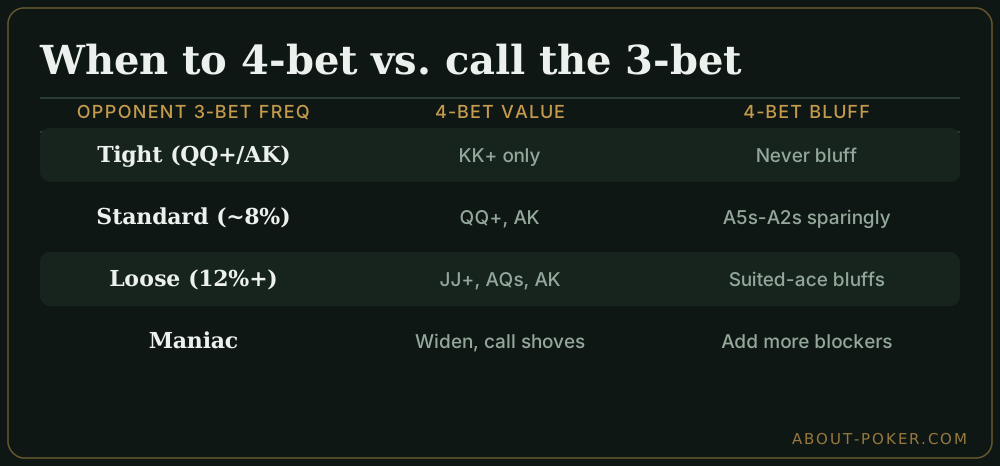
The single most important input is how often your opponent 3-bets. Against a tight player who only 3-bets QQ+/AK, you almost never 4-bet bluff; you fold your marginal hands and only re-raise your absolute best. Against a loose regular 3-betting 12%+, a large share of their range is air, and 4-bet bluffing becomes highly profitable. This is a direct extension of your cash game preflop strategy.
Value 4-bets: the core
The value backbone is QQ+ and AK. These hands are ahead of a typical 3-betting range and are comfortable getting 100bb in preflop. Against players who 3-bet and stack off too wide, you can add JJ and AQs. Note that AKo is a 4-bet-for-value hand even though it is behind QQ+ — it is well ahead of the bluffs and roughly a coinflip against pairs, and folding it to a 3-bet leaves too much value on the table.
Remember the classic all-in matchups: AA is about 82% versus KK, and AK is roughly 43% against a pair (a coinflip). Those numbers tell you a value 4-bet does not need to be crushing every hand it gets called by — it just needs to be ahead of the opponent’s overall calling-and-shoving range.
Bluff 4-bets: blockers do the work
Good 4-bet bluffs are not random trash. They are hands that block your opponent’s premium holdings. Suited aces (A5s through A2s) remove combos of AA and AK and also retain a nut-flush and wheel-draw backup when called. This blocker effect is why A5s makes a far better 4-bet bluff than a hand like KJo, which blocks almost nothing and flops poorly. Using the low suited aces also keeps hands like AQs and AJs free to flat call in position.
Sizing to stay flexible
At 100bb, size 4-bets smaller than beginners expect. In position, roughly 2.2x to 2.5x the 3-bet is plenty; out of position, lean to 2.5x to 3x. If a 3-bet is 11bb, a 4-bet to about 24-26bb is standard. This size pressures the opponent while leaving you the option to fold a bluff to a shove without being pot-committed. Oversizing to 35bb+ just burns extra chips on your bluffs and telegraphs strength. For how sizing threads through the whole hand, see bet sizing in cash games.
Worked example: 4-betting AKs at 100bb
You open the cutoff to 2.5bb with AsKs. The button, a regular you have seen 3-bet aggressively, makes it 8bb. Action folds back to you.
AKs is a clear value 4-bet here. You make it 20bb (2.5x). Against this button’s wide 3-bet range, AKs is ahead of the bluffs, flips against pairs, and has the nut-flush blocker plus a suited runout. If the button 5-bet shoves 100bb, you call: you are getting a good price and are never in terrible shape (worst case a coinflip versus a pair, dominating shape versus AQ/AJ, and only crushed by AA/KK). If the button folds, you win a healthy pot preflop. When the button flat-calls the 4-bet, you take the initiative into the flop — plan your continuation before you act, drawing on playing 3-bet pots in cash games.
Common 4-betting mistakes
The biggest leak is 4-bet bluffing against tight players who only 3-bet monsters — you are folding out nothing and getting called by hands that crush you. The second is choosing bluffs with no blockers or poor playability. The third is oversizing, which makes folding to a shove painful and turns a cheap bluff into a costly one. Finally, do not fold AK to a 3-bet out of fear; against most 3-betting ranges it is a call or a 4-bet, rarely a fold.
Quick 4-bet checklist
- Estimate the opponent’s 3-bet frequency first; it decides everything.
- Value core: QQ+ and AK; add JJ/AQs versus loose 3-bettors.
- Bluff with low suited aces for blockers and a flush backup.
- Size 2.2-2.5x in position, 2.5-3x out, so you can still fold a bluff.
- Never 4-bet bluff a tight, value-only 3-bettor.
Frequently asked
What hands should I 4-bet in cash games?
For value: QQ+ and AK are the core, sometimes JJ or AQs versus loose 3-bettors. For bluffs: hands with an ace or king blocker that flop okay when called, such as A5s-A2s and Axs, because they reduce the combos of AA, KK, and AK your opponent can hold.
How big should a 4-bet be?
At 100bb, size to roughly 2.2x to 2.5x the 3-bet in position and about 2.5x to 3x out of position. A 3-bet to 11bb typically gets 4-bet to around 24-26bb, leaving room to fold to a shove without being pot-committed on a bluff.
Should I 4-bet or just call the 3-bet?
Calling keeps their bluffs in and lets you realize equity in position with hands like AQs or a pocket pair. 4-betting is best when you hold the top of your range, when your opponent 3-bets too often, or when you have a good blocker to turn into a bluff.