AQ vs KK: Preflop Odds & Equity
Ace-queen is a big underdog to pocket kings — about 28% offsuit and 31% suited. Here are the exact preflop equities and why AQ is dominated.
On this page · 7 sections
You open A♦ Q♣, get three-bet, jam, and villain rolls over K♠ K♥. It’s not a coinflip and it’s not close: you’re roughly a 28% underdog, and pocket kings are about to win seven times out of ten. Ace-queen looks strong on its own, but the moment it collides with a bigger made pair, it becomes exactly what it is — two overcards chasing a hand that’s already ahead.
The headline equities
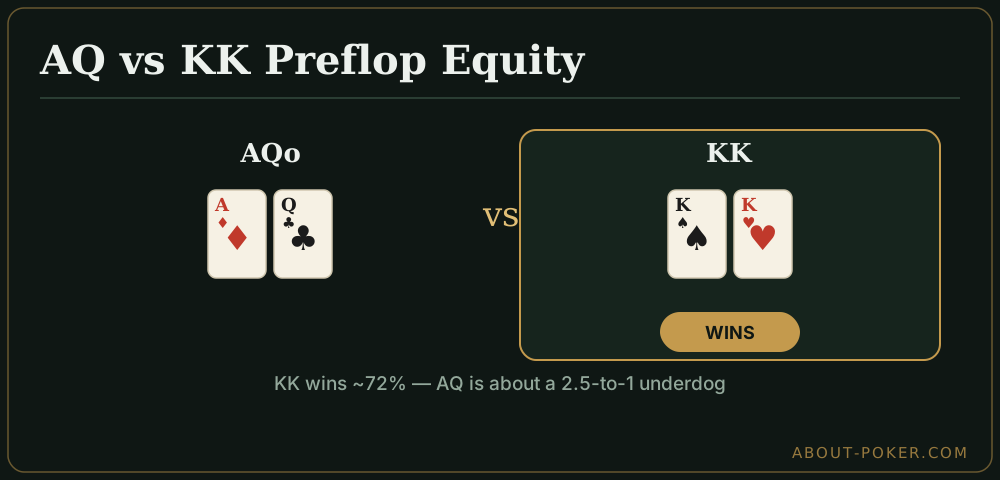
Every figure below comes from running the matchup across all possible boards and confirming with a Monte Carlo sim:
| Matchup | AQ equity | KK equity |
|---|---|---|
| AQo vs KK (offsuit) | 28.0% | 72.0% |
| AQs vs KK (suited) | 31.0% | 69.0% |
| AQ vs KK (mixed avg) | ~29% | ~71% |
Kings win about 70% of the time. That’s a hair better than their edge over ace-king (~70% vs AKo) — because unlike AK, ace-queen can’t even make a hand as good as top pair top kicker with an ace over kings’ setup; it’s just two overcards with slightly worse straight coverage.
Why AQ is stuck at 28%
Pocket kings are a made pair that outranks the queen. For ace-queen to win, it almost always has to pair up or run out a straight or flush. Count the live cards:
- Pair the ace: three aces remain.
- Pair the queen: three queens remain.
- Six overcard outs, plus thin backdoor straight and flush chances.
Six outs across five board cards is a real draw, but it isn’t enough to catch a made pair more than roughly three times in ten. The kings win every time the board bricks — and low-and-middle boards are common. This is the same made-pair-over-overcards dynamic that governs KK vs AK; ace-queen just brings one fewer point of raw card strength than ace-king.
The suited bump is flushes
Suited ace-queen does about three points better than offsuit, from 28% up to roughly 31%. Every bit of that gain is flush outs: A♥ Q♥ can back into a heart flush that A♥ Q♠ cannot. The aces, queens, and straights are identical between the two versions — the flush is the whole difference, just as it is in every pair-versus-overcards matchup.
A worked example: pot odds to call
Say the pot is 30bb and villain shoves for 70bb more, so you’re calling 70 to win 100 (the 30 pot plus villain’s 70). Your pot odds require:
- Break-even equity = 70 ÷ (70 + 100) = 70 ÷ 170 ≈ 41%.
If you knew villain had exactly KK, your 28% falls well short of the 41% you need — a clear fold. The math is unforgiving when you’re behind a made pair with no fold equity of your own. That is precisely why blind AQ hero-calls against tight players bleed money: you’re paying a 41% price for a 28% hand.
The range problem changes everything
Nobody shoves only kings. Against a realistic all-in range, ace-queen’s picture improves because the range is full of hands it beats or flips with. Using combinatorics to count:
- KK, AA, QQ+ that crush you: each pair is only 6 combos (fewer for QQ and AA if you hold an ace/queen blocker).
- AK that has you dominated: 16 combos, but you’re not drawing dead — you still flip-ish around 25-30%.
- Worse aces, smaller pairs, and bluffs you dominate or flip with: often the bulk of a loose range.
Weight it out and AQ can be a fine call against a wide, aggressive jammer — even though it’s a 28% dog to kings specifically. Against a nit whose range is genuinely KK+/AK, fold and move on. The full call-or-fold framework lives on preflop all-in odds, and the counting behind it on combinatorics.
How stack depth changes the AQ decision
The same 28% equity leads to different actions at different stack depths, because depth changes both the price you pay and the mistakes that go unpunished. This is where a lot of players go wrong — they treat “AQ vs a shove” as one fixed decision when it is really several.
- Short stacks (10-20bb): ranges get wide because a jam is cheap and steals blinds effectively. Against a 15bb shove from the button or small blind, AQ is a comfortable call — the range is stuffed with worse aces, suited connectors, and small pairs, and AQ is at worst flipping. The pot odds are also better because the blinds you already posted are dead money working in your favor.
- Medium stacks (30-50bb): the shove range tightens. A 40bb all-in usually means a genuine premium or a rare bluff, so AQ leans toward a fold against unknown or tight players and a call only against aggressive regulars.
- Deep stacks (100bb+): nobody jams 100bb with a wide range, so a deep all-in is almost always AA, KK, or QQ. Here AQ is a clear fold against everyone but the wildest opponent, because the deep shove range is exactly the set of hands that crushes you.
The rule to remember: the shorter the stack, the wider the range, and the more often AQ becomes a call. Depth is a proxy for range strength.
Playing AQ postflop when the money isn’t in yet
Not every AQ hand ends preflop, and knowing you’re a 28% dog to kings shapes how you play the flop when you do just call a raise. AQ’s whole problem is that it makes top pair with a good-but-not-great kicker, so it runs into the classic reverse-implied-odds trap: the hands that call your value bets are often the exact kings and sets that beat you, while the hands you beat fold.
A concrete example. You call a middle-position raise with A-Q and the flop comes Q-8-3. You have top pair, top kicker — a genuinely strong hand here — but temper it. If the preflop raiser was tight, a big raise on this board rarely comes from a worse queen; it comes from a set, two pair, or the occasional over-pair. Against most opponents you value-bet a street or two and control the pot rather than stacking off, precisely because A-Q’s weakness is exactly the KK-style made hand this page is about. The overpair-versus-overcards lesson from KK vs AK carries straight into postflop: the made hand keeps the initiative, and the overcard hand has to improve to feel safe.
Lock in the anchor — AQ is about 28% against kings, a 2.5-to-1 dog — and then let the width of villain’s range, not the fear of the single worst holding, decide the hand. Keep sharpening through the poker odds & math hub.
Frequently asked
What are the odds of AQ vs KK preflop?
Ace-queen is a clear underdog: about 28% against pocket kings offsuit and about 31% suited. Pocket kings win roughly seven times out of ten, close to a 2.5-to-1 favorite.
Why is AQ such an underdog to KK?
Kings are a made pair that outranks the queen, so AQ has to improve to win almost every time. It's chasing three aces and three queens across the board, which lands it near 28-31% depending on suit.
Is AQ dominated by KK?
Partially. KK doesn't share a card with AQ, so it isn't classic domination like AQ vs AK. But the pair is simply higher-ranked and already made, which produces a similar lopsided result of about 70/30.
Should you fold AQ to a preflop all-in?
Against a range that is only KK+ and AK, AQ is a fold. But most all-in ranges are wider, containing worse aces, smaller pairs, and bluffs AQ dominates or flips with, so the decision depends heavily on the opponent.