Minimum Defense Frequency Explained for Beginners
Minimum defense frequency is how often you must continue against a bet so bluffs can't auto-profit. Learn the simple formula and a worked example.
On this page · 6 sections
Minimum defense frequency, or MDF, answers one defensive question: how often do I have to keep playing against a bet so my opponent can’t profitably bluff me with anything? If you fold too often, a thinking opponent can bet any two cards and win the pot outright often enough to print money. MDF is the frequency of continuing that shuts that door.
It sounds abstract, but the formula is short and the intuition is clean. Get MDF right and no one can run you over just by betting.
The formula
MDF = pot ÷ (pot + bet)
That is it. You defend the pot divided by the pot plus the bet. A few common results worth memorizing:
- Pot-sized bet: MDF = 1 ÷ (1 + 1) = 50%. You must continue with half your range.
- Half-pot bet: MDF = 1 ÷ (1 + 0.5) ≈ 67%. You must continue with two-thirds.
- Two-thirds-pot bet: MDF = 1 ÷ (1 + 0.67) ≈ 60%.
- Quarter-pot bet: MDF = 1 ÷ (1 + 0.25) = 80%.
Notice the pattern: the bigger the bet, the less you have to defend. That makes sense — a big bet risks a lot to steal the pot, so the bettor needs it to work less often, and you can afford to fold more.
MDF is the exact defensive mirror of the bettor’s bluffing math. The bettor’s break-even bluff frequency, sometimes called alpha, is bet ÷ (pot + bet) — and MDF plus alpha always sums to 1. You can see the attacking side of the same equation in the bluff-to-value ratio.
MDF versus pot odds
Beginners often confuse MDF with pot odds. They are different tools:
- Pot odds tell one hand the equity it needs to call profitably.
- MDF tells your whole range what fraction must continue to deny the bettor a free bluff.
Pot odds decide “should I call with this exact holding?” MDF decides “am I folding too much overall?” You use pot odds when you have a specific drawing or bluff-catching hand; you use MDF to sanity-check that your folding rate isn’t handing the pot away.
A worked example
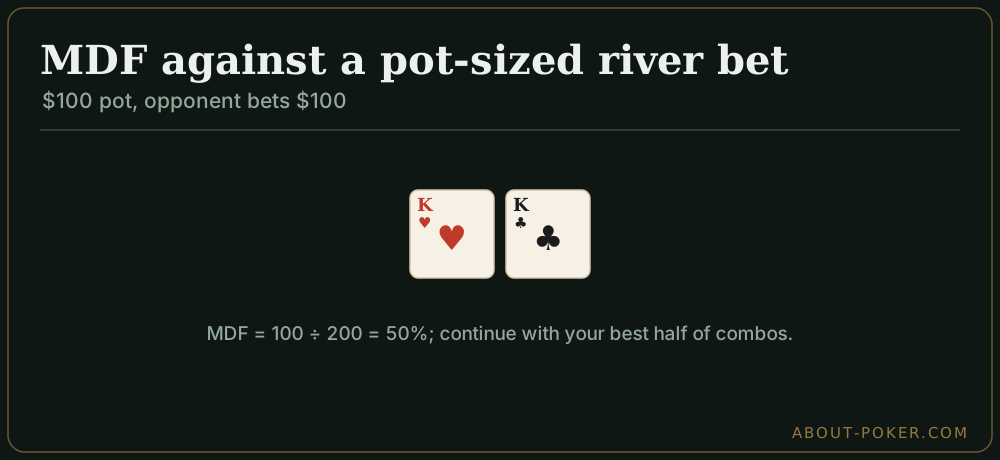
The pot is $100 on the river and your opponent bets $100, a pot-sized bet. MDF says you must continue with pot ÷ (pot + bet) = 100 ÷ 200 = 50% of your range.
Suppose your range at this point contains 20 combinations of hands. MDF tells you to continue with at least 10 of them — the top half by strength as bluff-catchers. If you fold 12 or 15 of those combos, your opponent can profitably bet a total blank as a bluff, because they win the $100 pot more than half the time by simply betting. By calling with your best 10 combinations, you keep them honest: their bluffs no longer auto-profit, because they get called often enough to lose money on them.
Now change the bet to $50 into the $100 pot. MDF rises to 100 ÷ 150 ≈ 67%, so you must continue with about 13–14 of your 20 combos. The smaller bet is cheaper to call, so you are obligated to defend more of your range. This is exactly how the fuller treatment on the minimum defense frequency page works through multiple sizes.
When to ignore MDF
MDF is a defense against a balanced, aggressive opponent. Real players are rarely balanced, so treat MDF as a floor, not a law:
- Against players who never bluff, defend less than MDF. If their bets are almost all value, calling to hit a frequency just donates chips — fold your bluff-catchers.
- Against maniacs who over-bluff, defend more than MDF and call down lighter, since their extra bluffs make your bluff-catchers more profitable.
Use MDF to notice when you’re folding too much, then adjust to the specific human across the table. It is a compass, not a cage.
Common MDF mistakes
Beginners misuse MDF in a few predictable ways, and each one costs money:
- Defending to MDF against players who never bluff. MDF assumes a balanced opponent. If someone only bets big hands, matching a 50% or 67% defense frequency just pays off value bets. Fold your weak bluff-catchers and let them win small pots.
- Applying MDF facing an all-in or overbet mechanically. MDF is derived from bet size, so an overbet of 1.5x pot lowers your required defense to about 40% (MDF = 1 divided by 2.5). Players who keep defending “half their range” out of habit are over-defending against big bets and burning chips.
- Confusing defending with calling. Continuing at MDF includes raises, not just calls. A well-timed raise counts toward your defense frequency and can be better than a pure call with a hand that plays poorly as a passive bluff-catcher.
- Ignoring your own range. MDF tells you how much to continue, not which hands. You still defend your strongest bluff-catchers and best draws, folding the true bottom of your range.
MDF across streets and multiway
MDF is street-by-street. If an opponent barrels the flop, turn, and river, they only need to get through once at each street, so your defense frequency compounds down. Continuing 60% on the flop, then 60% of that on the turn, then 60% again on the river means only about 22% of your original range reaches showdown — which is why triple-barrel bluffing is so powerful and why over-folding on early streets is punished hardest by aggressive players.
Multiway pots change the picture too. MDF is built for one bettor versus one defender. When three or four players face a bet, the table’s combined defense easily covers MDF even if each individual defends less, so you can and should tighten up out of position. The formula is a heads-up baseline; treat multiway spots as looser folding territory, not a reason to call more.
Frequently asked
What is minimum defense frequency (MDF)?
MDF is the smallest share of your range you must continue with against a bet so that your opponent's bluffs cannot show an automatic profit. If you fold more often than MDF says, any hand can bluff you profitably.
How do you calculate MDF?
MDF equals pot divided by (pot plus bet). For a pot-sized bet, MDF is 1 ÷ 2 = 50%. For a half-pot bet, MDF is 1 ÷ 1.5 ≈ 67%. The bigger the bet relative to the pot, the less you must defend.
Is MDF the same as pot odds?
No, but they are related. Pot odds tell you the equity a specific hand needs to call. MDF tells you what fraction of your whole range must continue to stop bluffs from auto-profiting. MDF is about frequency, pot odds are about a single hand.
Should beginners always defend at MDF?
No. MDF is a baseline against a balanced, aggressive opponent. Against players who rarely bluff, you should fold more than MDF and let their value bets go. MDF is a defensive floor, not a rule to obey blindly.