Odds of a Split Pot
Split pots are rarer than they feel — under 3% of Hold'em hands reach a chop at showdown. The real numbers, the common chop scenarios, and how to spot them.
On this page · 8 sections
Split pots feel more common than they are, mostly because the ones you remember are the frustrating chops where you flop top pair and get quartered of your winnings. In reality, ties at showdown are uncommon in Texas Hold’em — the seven cards available to each player create enough combinations that clean separation is the norm. Let’s put real numbers on it and cover exactly when chops happen.
How often pots actually split
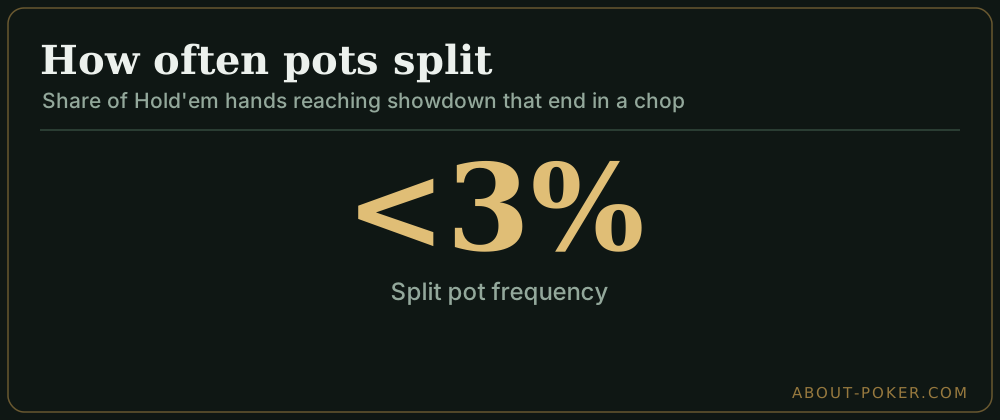
Across all Hold’em hands that reach a showdown, split pots occur only a small share of the time — well under 3% in typical heads-up-at-showdown situations, and even less when more players see the river. The reason is simple: a five-card poker hand has a lot of ranks and a kicker structure, so two hands landing on the exact same five-best-cards is a narrow target.
The rate is highly situation-dependent, though. Some spots chop constantly; others essentially never do. The headline “how often does a hand split” question is really several different questions bundled together.
The three ways a pot chops
Every split falls into one of three buckets:
- Identical made hands with identical kickers. Both players make, say, top pair with the same kicker because their unmatched card plays no role.
- Playing the board. The five community cards form the best five-card hand and no player’s hole cards improve it. Everyone still in the hand chops equally.
- Matched draws completing to the same rank. Two players make the same straight or the same flush that ends on the same high card.
Worked example: two AKs collide
The most famous chop is two players both holding ace-king. Suppose you hold Ac Kd and your opponent holds As Kh. The board comes Ah 9c 4d 7s 2c. You both play A-A-K-9-7 — top pair, king kicker, identical. This pot chops every time unless a suit or a straight/flush changes things.
That last clause matters. If instead you held Ac Kc and the board were Ah 9c 4c 7s 2c, your matching clubs give you a possible flush that your opponent (with off-suit A-K) cannot make. Now you win outright rather than chop. This is exactly why suited hands quietly reduce chop frequency: they hold tie-breakers. When two premium pairs clash the dynamics differ again — see AA vs KK preflop odds and equity for how dominated matchups play out.
When chops are common
- Both players hold the same big offsuit hand (AK, AQ). Very high chop rate when the top card pairs and the board doesn’t run out a straight or three-flush.
- A board that pairs the top and threatens a straight for everyone. Boards like J-T-9-8-7 give many hands the same nut straight.
- Full houses using the board pair. Two players each with a pocket pair that can’t beat the board-made boat.
When chops almost never happen
- One player holds a flush draw the other cannot match. Suits break ties decisively.
- Deep, dry boards with a live kicker. A single high side card almost always separates two top-pair hands.
- Any spot where one player has a straight or flush and the other has a pair. Different hand classes essentially never tie.
Why this matters at the table
Understanding chop frequency changes two decisions. First, value betting thin: if you fear a chop with a hand like AK on an ace-high board, remember that chops are the exception, not the rule — worse aces and second pairs still exist and pay you off. Second, reading the board for splits: on a board that makes the nuts for everyone (like a board-made straight or flush), betting is pointless and you should check to avoid getting raised off a guaranteed share. For the full picture on hand frequencies see probability of poker hands.
A related idea: running it twice
In cash games, players sometimes agree to run the board twice when all-in, which is a deliberate way of splitting the pot’s variance rather than the pot itself. It doesn’t change your equity but it halves your outcome swings. If that concept is new, running it twice walks through the math.
Quick checklist
- Treat chops as rare — under 3% overall — and don’t let the fear of them make you passive.
- The single biggest chop source is two players with the same big offsuit broadway hand.
- Suits and live kickers are the tie-breakers that turn potential chops into outright wins.
- On boards that make the nuts for everyone, check rather than bet — you can only lose value or get shown a better runout.
- Watch for “playing the board” spots where a min-bet can steal a pot others assume is a lock chop.
The takeaway: pots split far less than the memorable bad-beat chops suggest. Knowing the exact scenarios lets you value bet confidently and avoid burning chips into a guaranteed tie.
Frequently asked
How often does a hand end in a split pot?
Across all Texas Hold'em hands that reach showdown, a chop happens only a small fraction of the time — under 3% overall, though the rate spikes in specific spots like two players holding AK. Most pots are won outright because the five community cards plus two hole cards create a lot of separation between hands.
What is the most common split pot scenario?
The classic chop is two players both holding the same top hand, such as both having AK when an ace flops and neither makes a better hand, so both play top pair with the same kicker. Another common one is both players 'playing the board' when the five community cards make the best possible five-card hand.
Do suited cards reduce the chance of a split?
Slightly, yes. Two players holding AK will chop far less often if one holds a suit that matches a three-flush on the board, because that player can make a flush and win outright. Suits create tie-breakers that turn would-be chops into decisive wins.