Odds of Being Dealt a Pocket Pair
You are dealt a pocket pair about 5.9% of the time — 16 to 1 against. A specific pair like aces is 220 to 1. Here is the exact combinatorics.
On this page · 7 sections
Across a long session the single most important starting-hand fact is how rare pairs are. Any pocket pair arrives about 5.9% of the time — 16 to 1 against. A specific pair, such as aces, is far rarer at 0.45%, or 220 to 1. Both numbers come from simple counting, and once you internalize them, a lot of preflop decisions get easier.
The 16-to-1 number, derived
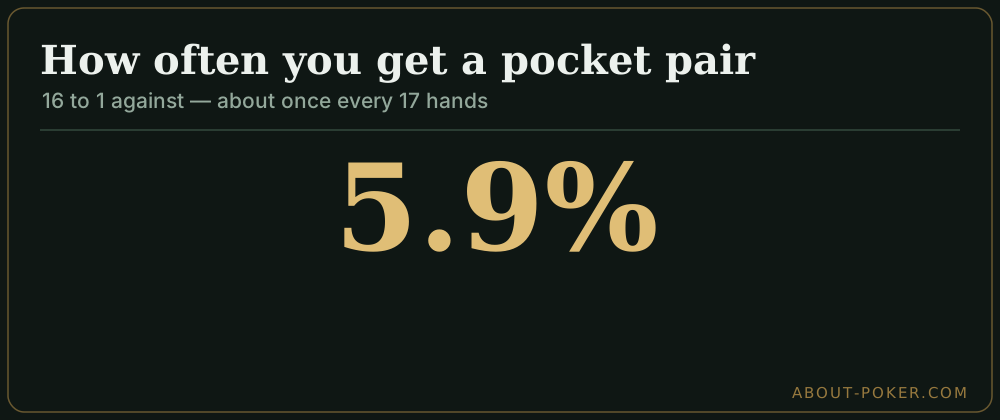
There are C(52,2) = 1,326 distinct two-card starting hands in Texas Hold’em. To count pocket pairs, note that each of the 13 ranks can be paired in C(4,2) = 6 ways (six ways to choose two suits out of four). So:
13 ranks × 6 combos = 78 pocket-pair combinations
Divide by the total: 78 ÷ 1,326 = 5.88%. A faster mental route gives the same answer — your first card can be anything, and the second only has to match its rank. Three matching cards remain among 51 unseen, so 3 ÷ 51 = 5.88%. Either way you land on 16 to 1 against.
Why a named pair is 13 times rarer
Ask for one particular pair, like queens, and you are limited to that rank’s six combos. So the probability is 6 ÷ 1,326 = 0.452%, which rounds to 220 to 1 against. That factor of 13 (78 total pair combos ÷ 6 for one rank) is exactly the number of ranks — a tidy way to remember it. The same 0.45% applies to aces, kings, or any other single pair; the deck does not care which rank you named.
Odds for the pairs that matter
Premium pairs are the ones that change a hand. There are four of them — aces, kings, queens, jacks — for 4 × 6 = 24 combos, or 24 ÷ 1,326 = 1.81%, about 1 in 55. If you widen “big pair” to tens-plus (five ranks, 30 combos), you are at 2.26%, roughly 1 in 44. This is why you should not sit around waiting for a monster: fold too much and the blinds will eat you long before jacks-or-better shows up. For deeper counting practice, see our poker combinatorics primer.
A worked example at the table
Say you have played 60 hands in a session and have not been dealt a single pair. Is the deck rigged? Run the math. The chance of no pair on one deal is 1 − 0.0588 = 0.9412. Over 60 independent hands that is 0.9412^60 = 0.026, about 2.6%. Unusual, but a 1-in-40 dry spell is entirely normal across thousands of hands. Conversely, the chance of at least one pair in 60 hands is 97.4% — so a pairless hour is a genuine outlier, not a signal that something is wrong.
How the odds shape your play
Rarity has consequences. Because a specific big pair is 220 to 1, you will rarely run kings into aces — the classic cooler happens far less often than table lore suggests. When you do pick up a pair, position and stack depth decide how much you can make from it. Small and medium pairs derive most of their value from set-mining, which is why the odds of flopping a set (about 11.8%, or 7.5 to 1) matter more than the raw preflop equity. A pocket pair is only a made hand until the flop rearranges everything.
Common mistakes
- Overrating the pair itself. 22 is a pair, but it is behind most two-overcard hands’ equity on many boards. The pair’s value lives in set potential, not its face rank.
- Waiting for premiums. At 1.8% for JJ+, you would post dozens of blinds between them. Play a proper opening range instead of hoarding chips.
- Confusing “a pair” with “my pair.” The 5.9% figure is any pair; the specific pair you want is 0.45%. Mixing these up wildly distorts your read on how often opponents hold aces.
Quick reference checklist
- Any pocket pair: 5.9% (16 to 1).
- One specific pair (e.g. AA): 0.45% (220 to 1).
- Premium pairs JJ+: 1.8% (about 1 in 55).
- Tens-plus: 2.3% (about 1 in 44).
- Both players dealt any pair same hand:
0.0588 × 0.0588 ≈ 0.35%.
Memorize the first two lines and you can reconstruct the rest. For the fuller derivation and how pairs compare to other starting hands, read our companion piece on pocket pair probability.
The practical takeaway is simple: you will be dealt a pocket pair about once every 17 hands, but a big pair (JJ+) only about once every 55 hands. That rarity is exactly why premium pairs are worth playing fast and why set-mining with the small ones needs the right implied-odds price — you will not see them often, so you must extract when you do. Do not let the 6% number tempt you into overplaying every pair; a pair of twos and a pair of aces sit at opposite ends of the strength scale even though each is dealt with the same frequency.
Frequently asked
What are the odds of being dealt any pocket pair?
About 5.9%, or 16 to 1 against. In practical terms you can expect a pocket pair roughly once every 17 hands you are dealt.
What are the odds of being dealt pocket aces?
A single named pair such as aces is 0.45%, or 220 to 1 against. There are only 6 combinations of aces out of 1,326 possible starting hands.
How often will I get a premium pair (JJ+)?
There are four premium pairs (AA, KK, QQ, JJ) with 6 combos each, so 24 combos out of 1,326. That is about 1.8%, or roughly 1 in 55 hands.