Odds of Making Quads
Four of a kind is dealt about 0.024% at showdown (4,164 to 1). From a pocket pair you make quads by the river about 0.8%. Here is the full quad math.
On this page · 7 sections
Quads — four of a kind — are among poker’s rarest made hands, and the odds reflect it. A random five-card hand is four of a kind just 0.024% of the time, or 4,164 to 1 against. In Hold’em, where you see seven cards, quads still show up only about once every 4,000 hands at showdown. Knowing the true rarity keeps you from overreacting when a fourth card of a rank hits the board.
The classic five-card number
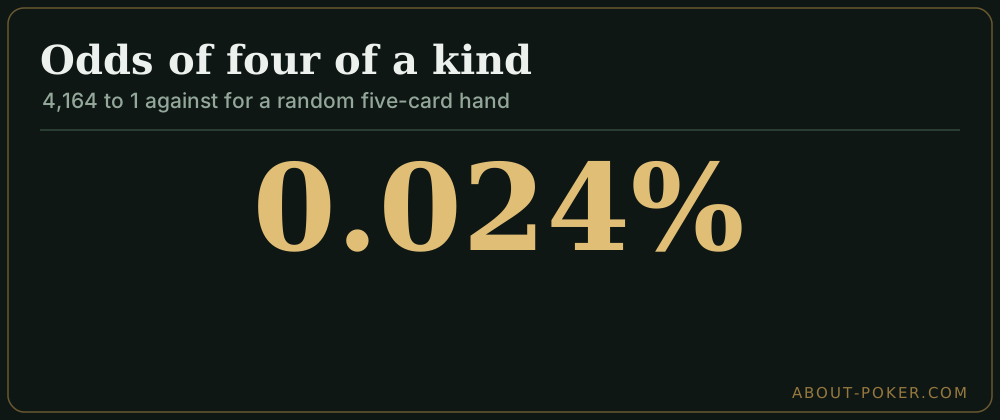
For a straight five-card hand there are C(52,5) = 2,598,960 possible combinations. Four of a kind is easy to count: pick the rank (13 ways), take all four suits (1 way), then pick any of the remaining 48 cards as the fifth — 13 × 48 = 624 combinations. So the probability is 624 ÷ 2,598,960 = 0.024%, exactly 4,164 to 1 against. This is the figure quoted in hand-ranking charts, and it sits just below a straight flush in rarity. For how quads compare to trips, see our quads and trips odds breakdown.
Making quads from a pocket pair
In practice, the most common route to quads is holding a pocket pair. To get there you first need the other two cards of your rank on the board. The path is: flop a set (about 11.8%, per our flop a set numbers), then catch the case card on the turn or river. Roughly, the chance of turning a pocket pair into quads by the river is about 0.8%, or 122 to 1 against. It is a long shot even from the best starting point for it.
A worked example
You hold 7c-7d and the flop comes 7h-K-2 — you have flopped a set with exactly one card left to complete quads: the 7s. There are 47 unseen cards, so on the turn your chance of the case seven is 1 ÷ 47 = 2.1%. Miss, and the river gives 1 ÷ 46 = 2.2%. Across both streets:
P(quads by river) = 1 − (46/47 × 45/46) = 4.3%
So even after flopping a set, you complete quads only about 1 time in 23. That single out is why quads feel like lightning: you are almost always winning with the set anyway, and the fourth seven is a rare bonus.
Flopping quads
Catching both remaining cards of your rank on the flop is rarer still. With a pocket pair, two specific cards must land among the three flop cards. Working it out gives about 0.245%, or 407 to 1 against. In other words, you will flop quads with a pocket pair roughly once every 400 times you hold one — a lifetime highlight for most players. Quads from unpaired hole cards (needing the board to pair a rank you hold and then complete it) are rarer yet and best handled through general combinatorics.
Why the rarity matters at the table
Because quads are so infrequent, board-pairing situations almost never mean your opponent has them. When a fourth suit or a paired board appears, far more likely holdings are a full house, trips, or a flush — not four of a kind. Overfolding to “the board paired, they might have quads” is a leak; the odds say quads are the least likely explanation by a wide margin. Play the realistic range, not the nightmare.
Common mistakes
- Fearing quads on every paired board. At 4,164 to 1 for a random hand, quads are the rarest thing your opponent can hold. Full houses are far more common.
- Slow-playing into a cooler. When you do flop quads, the hand is unbeatable — but so slow that you often win nothing. Bet to build a pot; opponents rarely put you on it anyway.
- Confusing the routes. The 0.024% figure is a random five-card hand; the 0.8% figure is a pocket pair improving by the river. They answer different questions.
Quick reference
- Random five-card hand quads: 0.024% (4,164 to 1).
- Hold’em at showdown: about 1 in 4,000 hands.
- Pocket pair to quads by river: 0.8% (122 to 1).
- Case card after flopping a set (both streets): 4.3%.
- Flopping quads from a pocket pair: 0.245% (407 to 1).
Quads are a bonus, not a plan — you make your money with the underlying set or full house. For the neighboring hand strengths, read our quads and trips guide.
Frequently asked
What are the odds of making four of a kind?
A random five-card poker hand is four of a kind about 0.024% of the time, or 4,164 to 1 against. In Hold'em, using seven cards, quads appear roughly once every 4,000 hands at showdown.
What are the odds of making quads from a pocket pair?
About 0.8% by the river, or roughly 122 to 1 against. You need to flop a set first (or turn the case card), then catch the fourth card of your rank.
What are the odds of flopping quads with a pocket pair?
Very small — about 0.245%, or 407 to 1 against. Both remaining cards of your rank must appear on the same flop.