Odds of Making Trips
The odds of making trips depend on how you start. Flop trips with one card about 1.35%, or roughly 13% by the river. Here is the full count and strategy.
On this page · 6 sections
The odds of making trips depend entirely on how the three of a kind comes together. If you flop trips using one hole card and a board pair, that happens about 1.35% of the time. If you count the turn and river, one of your hole cards pairs the board into trips roughly 13% of the time. Trips are strong, but because the pair sits on the board, they behave differently from a hidden set. Here is the full picture.
Trips versus a set: the key distinction
Both are three of a kind, but the way you build them changes the math and the strategy. A set means you hold a pocket pair and catch the third card of your rank on the board. Trips means you hold one card that matches a pair already on the board. The difference matters because a set is hidden and a set is almost never out-kicked, while trips are visible and can be beaten by a better kicker.
For the set version, the number every player should know lives in odds of flopping a set: about 11.8%, or 1 in 8.5, with a pocket pair. This article focuses on the trips version, where one unpaired card connects with a paired board.
Flopping trips: the exact count
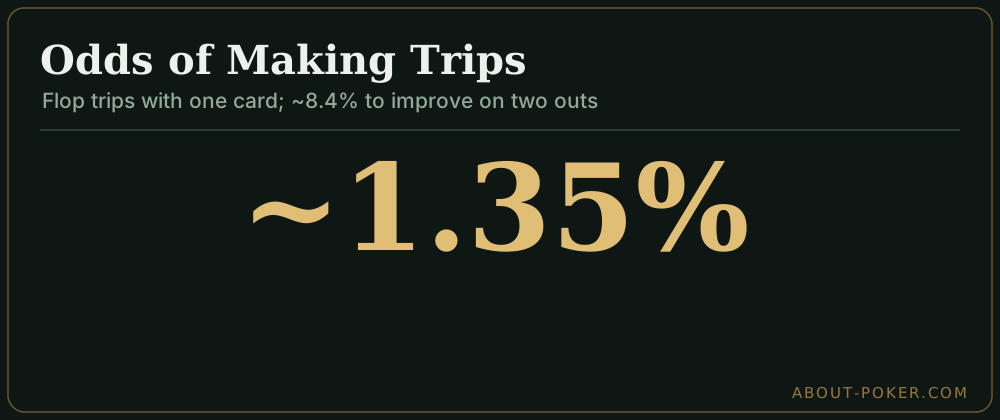
Say you hold A♠7♦ and the flop comes 7♥7♣2♠. You now hold trip sevens with an ace kicker. How likely was that? For a specific unpaired card to flop trips, the board must show a pair of that rank plus one blank. There are only two remaining sevens, and both must land on a three-card flop. Working the combinatorics, this happens about 1.35% of the time for a given card. The detailed count is laid out in odds of flopping trips.
That is rare on the flop, which is why most trips arrive later.
Making trips by the river
Now extend the board to five cards. With one unpaired hole card, the board pairs that rank and gives you trips by the river roughly 13% of the time — but only when a second matching card also appears, which is why the practical “trips” outcome is less common than simple pairing. The clean way to count it during a hand is with outs: if the board already shows a pair of a rank you hold one of, you have exactly two outs to trips, and two outs across the turn and river hit about 8.4% of the time.
Counting these live cards is the same discipline covered in poker outs. Two outs is thin, so trips-by-improvement is rarely a hand you chase directly; it is a bonus that lands on top of an already-decent holding.
A worked example
You hold K♦Q♣ on a Q♥Q♠5♦ flop. You have trip queens with a king kicker. Only one queen remains in the deck, so nobody else can hold a queen — a big comfort. Your main threat is a full house from someone holding a pocket pair, or a better kicker, but with king kicker you beat every other trip-queen holding except A-Q. This is close to the ceiling for trips: top trips, top-two kicker, on a dry board. You should bet all three streets for value.
Common mistakes with trips
The first mistake is ignoring your kicker. On a paired board, trips with a weak kicker can be dominated by trips with a bigger kicker. If you hold 8-4 on a 4-4-K board, your trip fours are behind any four with a better side card. Slow down.
The second mistake is missing the full-house threat. Trips on a board that can pair again, like 9-9-6, are fragile: any turn or river that pairs the six or a card an opponent holds can make a boat. Bet to charge draws, but read the runout.
The third mistake is slow-playing trips on wet boards. Because the pair is public, opponents fear it and often fold; charging draws and worse pairs is usually worth more than trapping.
Quick reference
- Flop trips with one specific unpaired card: about 1.35%.
- Two outs to trips on turn or river combined: about 8.4%.
- Flop a set with a pocket pair: about 11.8% (1 in 8.5).
- Make three of a kind of any kind by the river with a pocket pair: about 19%.
Trips reward aggression when your kicker is strong and the board is dry, and caution when the board can pair or your side card is weak. Know which situation you are in before you commit chips.
Frequently asked
What are the odds of making trips?
It depends on how you build the hand. With one card that matches a board pair you flop trips about 1.35% of the time. Counting the turn and river, one of your hole cards pairs the board into trips roughly 13% of the time. Trips made with a pocket pair are called a set and follow different math.
What is the difference between trips and a set?
Trips means your three of a kind uses one hole card and a pair on the board, so both cards are visible to opponents. A set means you hold a pocket pair and one more of that rank comes on the board, keeping your hand disguised. A set is usually the stronger, safer version because it is hidden and rarely dominated.
Are trips a good hand?
Trips are strong and win a lot of pots, but they are more vulnerable than a set because the pair is on the board for everyone to see. Watch out for higher kickers on paired boards and for full houses when the board pairs again. Value bet, but do not overcommit against big aggression on dangerous runouts.