Odds of Flopping Trips
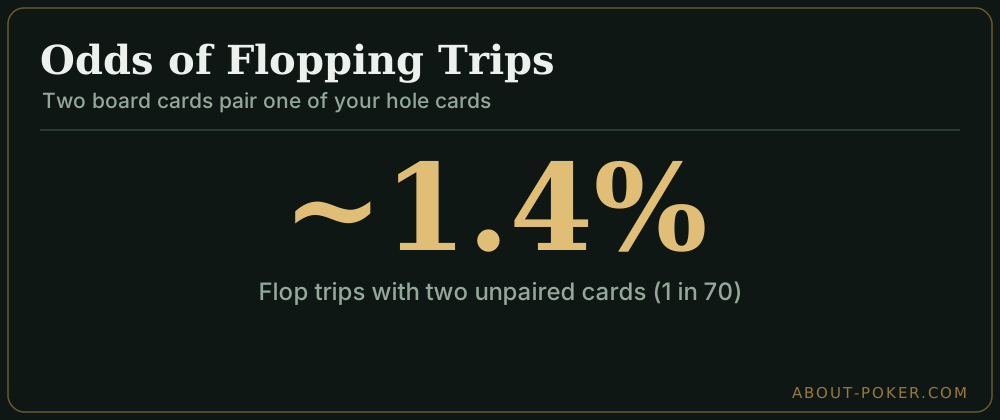
You flop trips about 1.4% of the time (1 in 70) with two unpaired cards. Here is the exact count, how trips differ from a set, and how to play them.
On this page · 6 sections
Hold two unpaired cards and you will flop trips about 1.4% of the time — roughly 1 in 70. Trips means one of your hole cards plus a pair on the board, giving you three of a kind that everyone can partly see. It is a strong hand, but it plays very differently from a hidden set. Here is the exact math and how to handle it.
The exact count
Take A♥ K♠. To flop trips you need two of the same rank as one of your cards on the board. Say two aces come: three aces remain, so you choose two of them, and the third flop card can be any of the 47 cards that is not the last ace (avoiding quads). The same logic applies to flopping two kings, so we multiply by two:
P(trips) = 2 × [C(3,2) × 47] ÷ C(50,3) = 2 × 141 ÷ 19,600 = 1.44%
That is about 1 in 70. If you want the deeper counting framework behind these numbers, see poker combinatorics — every flop probability shares the same 19,600-combination denominator.
Trips versus a set: the crucial difference
Both are three of a kind, but they are not equal. A set comes from a pocket pair plus one matching board card, so two of your three cards are hidden — opponents cannot see it coming. Trips comes from one hole card plus a paired board, so two of the three matching cards are face up for everyone. That visibility matters: when the board is paired, thoughtful opponents slow down, and your trips get paid off less. It also means opponents can hold trips too, and the pot is often decided by kicker. For the fuller comparison of how often each lands, see odds of flopping a set and odds of quads and trips.
A worked example
You raise with A♦ Q♣ and the flop comes Q♥ Q♠ 5♦. You have flopped trip queens with top kicker — a 1-in-70 hit and almost certainly the best hand. But because two queens are on the board, your opponent knows a queen is possible and will fold most hands to big pressure. The right approach is often to bet smaller or check once to let a bluff or a weaker made hand catch up, then extract on later streets. The kicker is your safety net: against another player who also holds a queen, your ace kicker plays and you win. Contrast this with holding Q♦ 5♣ on the same board — you have trips with a weak kicker, and against a bigger queen you can lose a stack. Kicker strength is everything with trips.
How to play trips by street
Because trips is readable, value extraction is the whole game. On a paired, dry board, bet in a way that keeps worse hands in — sometimes smaller than usual, sometimes with a check to induce. Watch the turn and river for boards that complete straights or flushes, which can quietly beat your trips. Also stay alert to full-house potential: if the board pairs a second rank, your trips may now be behind a boat. When you flop trips with a weak kicker on a high board, pot control is your friend — you want a medium pot, not a stack-off, because the times you lose you are usually out-kicked or out-boated.
Common mistakes
The most common error is overbetting trips into a paired board and getting only calls from better kickers or folds from everything else. Size to the situation. A second mistake is ignoring the kicker: trips with a bad kicker is a trap that looks stronger than it is, and it should be played for a controlled pot. Third, players forget that a paired board sets up full houses — when the turn or river brings a card that pairs the other board rank, reassess, because your unbeatable-looking trips can be second best. Finally, do not confuse trips with a set in your reads: the hand strengths overlap, but the disguise, and therefore the profit, does not.
Quick checklist
- Flopping trips with two unpaired cards: about 1.4%, or 1 in 70.
- Trips = one hole card + paired board; a set = pocket pair + board card and is more hidden.
- Kicker decides many trips pots — value top-kicker trips, control the pot with a weak kicker.
- Watch paired boards for full houses and monotone or connected boards for straights and flushes.
- Size bets to keep worse hands paying, since a paired board warns your opponent.
Frequently asked
What are the odds of flopping trips?
About 1.4%, or roughly 1 in 70, when you hold two unpaired cards and the board pairs one of them. Trips means one hole card plus two matching board cards, and it is a strong but somewhat readable holding.
What is the difference between trips and a set?
A set is three of a kind made from a pocket pair plus one board card, so two of the three matching cards are hidden. Trips is one hole card plus a paired board, so two of the three are visible to everyone. Sets are more disguised and more profitable.
Are trips a strong hand?
Yes, trips is usually the best hand on the flop, but it is more readable than a set because the pair sits on the board. Bet it for value, but be alert to kicker problems and to opponents who can also have trips with a better kicker.