C-Betting Paired Boards
Paired boards reduce the combos of strong hands and reward small, frequent c-bets. Learn how to attack flops like K-K-4 and 7-7-2 and when to size up.
On this page · 6 sections
Paired boards look scary — trips are on the table! — but they are among the most profitable flops to c-bet. A board like K-K-4 or 7-7-2 removes a huge chunk of the strong hands either player can hold, and that “combinatorial” quirk usually hands the initiative straight to the preflop raiser. Understanding why is the difference between fearing these flops and printing on them.
Why Paired Boards Favor the Bettor
Start with combinatorics. On an unpaired flop, both players can have sets, two pairs, and a full range of strong hands. Pair the board and much of that disappears. On K-K-4 there is no possible two pair that isn’t a full house, no flush draw, and no straight draw — the only monsters are a case king (trips) or pocket fours and pocket kings (full houses). Those are rare combinations.
What’s left is a board where both players mostly hold one-pair hands and air. But the preflop raiser has more of the high cards that pair or connect: aces, the remaining kings, and big overpairs. The caller, who flatted, missed most of the time. That asymmetry is a range advantage, and it means you can bet cheaply and win a lot — the same principle that drives c-betting dry flops. For how the passive player should defend, see playing paired boards.
Bet Small and Frequently
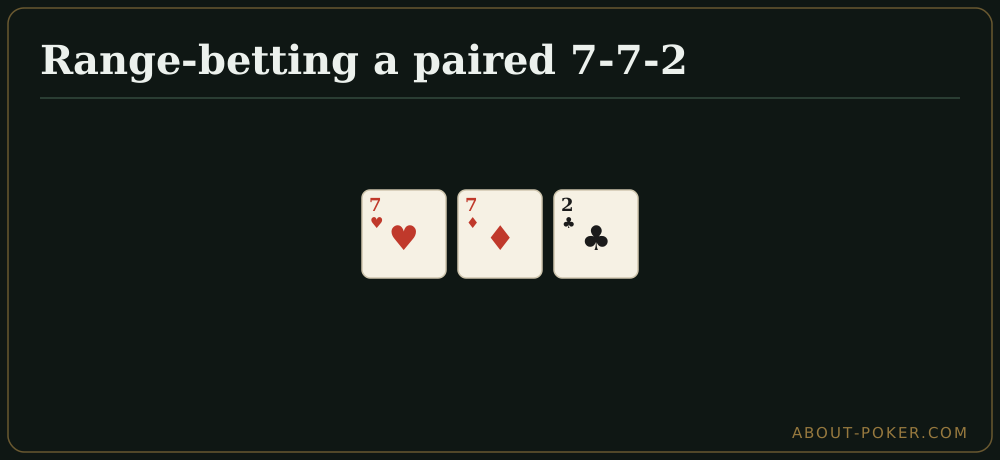
On most paired flops the correct approach mirrors dry-board strategy: c-bet around one-third pot with a very wide range, close to a pure range bet. Neither player has a big draw to worry about, so you don’t need a large bet to deny equity. A small size folds out the caller’s weak air, gets called by their marginal pairs, and costs you little when you’re the one bluffing.
There’s a second reason paired boards suit small bets: your opponent is often drawing dead or nearly so against your value hands, and you’re rarely in huge trouble with your bluffs because the turn cards that hurt you are limited. Firing a cheap bet across a range that missed the board is a low-variance way to accumulate chips.
A Worked Example
You open A♠J♠ from the cutoff, the button calls, and the flop is 7♥7♦2♣ in a 5.5bb pot. You have ace-high with a backdoor flush — no pair, but plenty of showdown and bluff value.
C-bet one-third pot (about 1.8bb). Think about what the button called with: suited connectors, small-to-medium pairs, broadway hands. On 7-7-2 the connectors and broadways whiffed completely, and only a handful of hands (a seven, pocket deuces, or an overpair) are ahead of you. Your small bet folds out all the missed broadways and picks up the pot far more often than it needs to. When called, you still have ace-high and a backdoor flush to improve. This is exactly the cheap, high-frequency aggression a strong continuation bet strategy is built on.
Now flip to a value hand: you hold Q♥Q♣ on the same 7-7-2 board. You have a big overpair that’s ahead of everything except trip sevens and the rare overpair. Still bet small — a large bet folds out the worse pairs and floats that would pay a small one, and you’re not scared of many turn cards. Keep the pot manageable and let them pay you off.
When to Deviate
Two situations call for adjustment. First, paired boards with a high pair and a live draw, like Q-Q-9 with two of a suit, are wetter than they look — the flush draw and the connectivity mean you should mix in a bigger, more polarized bet with your value and best draws, much like c-betting wet flops. Second, if you actually flop the full house or trips, you can slow down and check some of the time to trap, since your opponent is drawing nearly dead and you want to keep their air in the pot.
Common Mistakes
The biggest error is over-respecting the pair — checking back or folding because “he might have trips.” Trips are a small fraction of combos; most of the time neither of you has them, so passivity just surrenders pots you’d win by betting. The second leak is sizing too big on the dry paired boards, which turns a cheap, wide range bet into a value-killing overbet. The third is failing to recognize the wet exceptions — treating Q-Q-9 two-tone the same as K-K-4 rainbow.
Quick Checklist
Ask: Is the board dry-paired (no flush or straight draw) or wet-paired? For dry-paired flops, bet one-third pot with a wide range and enjoy the folds. For wet-paired flops, size up and polarize. Either way, remember the combinatorics — the pair on the board is stealing your opponent’s strong hands far more often than it’s stealing yours.
Frequently asked
What is a paired board in poker?
A paired board is a flop, turn, or river that contains two cards of the same rank — for example K-K-4 or 7-7-2. Because two of a rank are already on the board, far fewer strong made hands like sets and two pair are possible.
How should you c-bet a paired flop?
On most paired flops you can c-bet small and often, similar to a dry board. Neither player hits these boards hard, so a one-third-pot range bet pressures a range that has missed most of the time.
Who does a paired flop favor?
Usually the preflop raiser. Paired boards contain no draws on the paired rank and few strong hands for the caller, so the aggressor's range advantage and stronger high cards let them keep betting profitably.