Defending vs a Turn Probe
When your opponent probes the turn after you skip a c-bet, your range is capped. Learn how to defend, when to raise, and when to fold with a worked example.
On this page · 6 sections
You raise preflop, get called, and then check back the flop — maybe the board didn’t hit your range, maybe you wanted to control the pot. Now your opponent, sensing weakness, leads into you on the turn. That’s a probe bet, and it’s one of the most common spots recreational players misplay. The key insight: by checking back the flop, you told the table your hand is probably not strong, so your opponent is right to attack. Defending well means calling wider than feels comfortable while still folding true air.
Why the probe works against you
When you c-bet a flop, you show strength. When you check back, you cap your range — you’re telling your opponent you likely don’t have a big overpair, a set, or top pair with a great kicker, because those hands almost always bet. A skilled opponent exploits that by probe betting the turn, knowing your capped range struggles to continue.
That’s the bad news. The good news is that a probe range is also very wide. Your opponent is betting made hands, draws, and plenty of pure bluffs, because the whole point is to attack your weakness. So while your range is capped, theirs is uncapped and thin. You don’t need a strong hand to defend — you need to defend often enough that the probe can’t auto-profit.
Start with minimum defense frequency
The math of defending is the same as facing any bet: your opponent’s bluffs need fold equity to be profitable, so you have to continue with enough hands to keep them honest. Against a half-pot probe, you should continue with roughly 67% of your range (MDF = pot ÷ (pot + bet), which for a half-pot bet is 2 ÷ 3). Against a full-pot probe, you defend about 50%.
You don’t have to hit those numbers to the decimal, but they anchor your instincts: a probe bet is not a signal to fold everything. It’s an invitation to defend widely, because a big chunk of your capped range still has showdown value or equity. This is the flip side of exploiting capped ranges — recognizing when yours is being attacked and refusing to over-fold.
A worked example
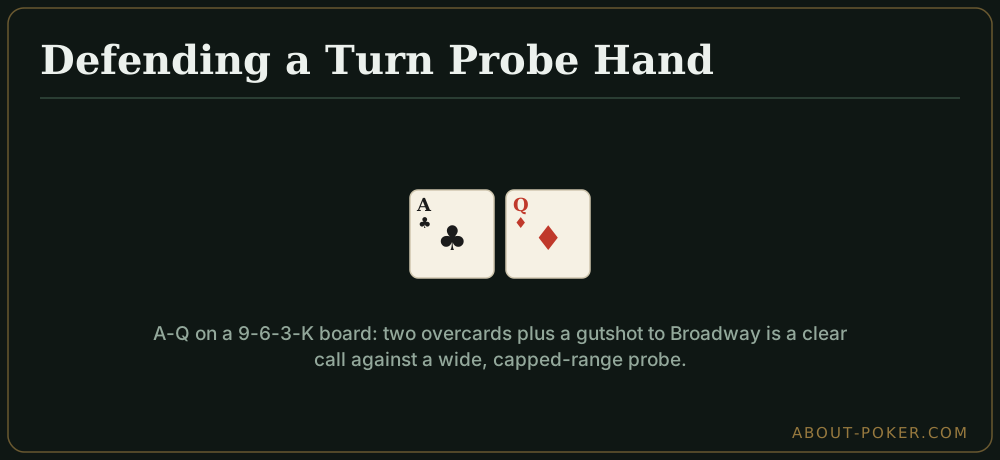
You open A♣ Q♦ from the cutoff and the big blind calls. Flop is 9♠ 6♠ 3♥. You decide to check back — the board favors the caller and you have overcards with a backdoor draw. Turn is the K♦, giving you a gutshot to Broadway and two overcards.
Your opponent leads half pot. Fold? No. You have two overcards to a king plus a gutshot — call. You beat their bluffs at showdown some of the time, and you can improve to the best hand. Folding here would let the probe run you over, and you have a real equity slice. Calling keeps the pot manageable and sets up a river decision. This is standard turn play: continue with equity, don’t panic because your range is capped.
Now change your hand to 9-9 for a set: you’d raise, because you want value and protection against a wide, weak range. And with total air like 5-4 offsuit with no draw, you fold — MDF doesn’t require defending your very worst combos.
When to raise the probe
Raise your strongest hands — sets, two pair, and the occasional strong draw as a semi-bluff. A probe range is wide and frequently weak, so a turn raise applies enormous pressure and gets value from the many second-best hands that led out. Balance those value raises with a few semi-bluffs (like a nut flush draw) so you’re not exclusively raising the nuts.
Avoid raising with medium-strength hands like second pair or a weak top pair. Those prefer to call, keep the pot small, and reach a cheap showdown against a range full of bluffs. Raising them just isolates you against better hands and folds out the bluffs you beat.
Common mistakes
- Over-folding because your range is capped. Capped doesn’t mean dead. Defend to your MDF with pairs, draws, and overcards.
- Only continuing with made hands. Draws and overcards are essential defends — folding them lets the probe print.
- Raising medium hands. Second pair wants to call, not build a pot against a range that has you beat when it continues.
- Ignoring the bettor. Against a passive player who only probes with real hands, tighten up. Against an aggressive one who probes any time you check back, defend wide and raise more.
Quick checklist
- A probe attacks your capped range after you skip the c-bet.
- Defend to your MDF: roughly 67% vs a half-pot probe, 50% vs a full-pot probe.
- Call with pairs, draws, and overcards; raise sets and two pair plus a few semi-bluffs.
- Fold only true air with no equity.
- Adjust: tighten vs passive probers, widen vs aggressive ones.
Defend the probe correctly and opponents learn they can’t simply steal every pot you check back.
Frequently asked
What is a turn probe bet?
A turn probe is a bet made by the out-of-position player on the turn after the preflop raiser declined to continuation-bet the flop. It attacks the raiser's capped range — since strong hands usually c-bet — and it's a standard way to seize the pot when the aggressor shows weakness.
How do you defend against a turn probe?
Call with pairs, draws, and any hand with showdown value or equity, since probe ranges are wide. Raise with your strongest hands and some semi-bluffs to punish the probe. Fold your total air that has no equity, but defend widely enough that the probe can't profit automatically.
Should you raise a turn probe bet?
Sometimes. Raise your two pair, sets, and strong draws for value and protection. A probe range is wide and often weak, so a turn raise applies real pressure. But don't over-raise with medium hands that prefer to call and reach a cheap showdown.