Exploiting Capped Ranges
When your opponent can't have the nuts, you own the pot — how to spot a capped range and attack it with overbets, relentless barrels, and big raises.
On this page · 6 sections
The most exploitable situation in poker is an opponent who cannot have a big hand. When a player’s range is capped — the nutted holdings have been ruled out by how they played — you can bet as large as you like and know they never have a hand strong enough to fight back. Their entire range is bluff-catchers, and bluff-catchers hate big bets. Recognizing capped ranges and attacking them is one of the highest-leverage reads in the game, and it flows directly from putting players on a range: once you see the cap, the strategy is nearly automatic.
What caps a range
A range gets capped whenever a player skips the action their strongest hands would take. The tells:
- Flat-calling preflop instead of three-betting. A pure caller usually three-bets aces and kings, so their flat range is capped below the premium pairs.
- Calling a wet flop instead of raising. With a set or two pair on a draw-heavy board, most players raise to protect and build. Just calling caps them out of those hands.
- Checking a turn that improves value hands. If the turn helps their range and they check anyway, they’ve usually checked away the strong part.
- Checking the river in position. A player who checks back the river almost never holds a value hand they could have bet.
Every one of these is a missed raise or missed bet — the natural strong-hand play that didn’t happen. That absence is the cap.
Why capped ranges are so exploitable
Against a range with no nutted hands, big sizing has no downside. Overbet the pot and their strongest holding is still just a bluff-catcher facing a bet that makes calling awful. This lets you play a maximally polarized strategy: bet huge with your genuine value hands (they can’t have better, so they pay off with second-best) and bet huge with pure air (they can’t call comfortably, so they fold). The capped range turns your bluffs and your value bets into the same profitable action. This is the ideal setting for the polarized range and for overbetting the river — the theory finds its perfect target here.
A worked example
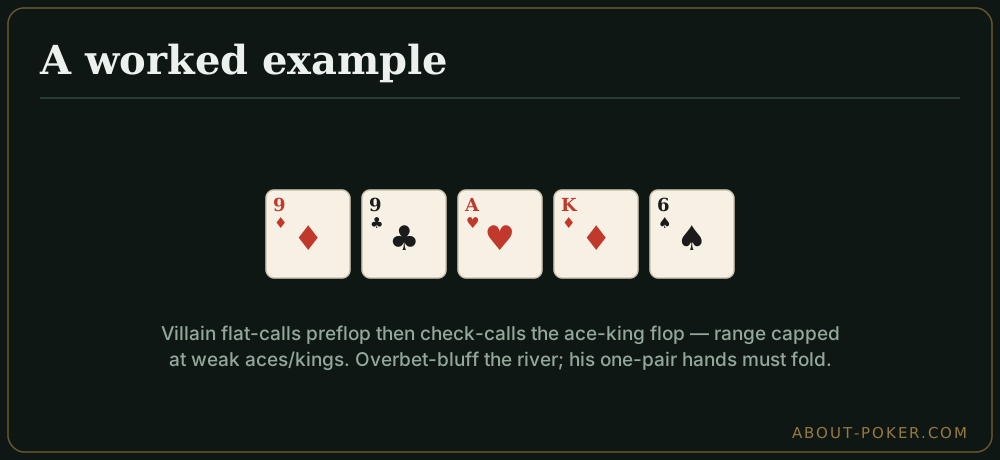
You open the button with 9d 9c, the big blind flat-calls (not three-betting — first cap; his premium hands would usually raise). Flop is Ah Kd 6s. He checks, you c-bet small, he calls. Turn is the 2c. He checks again. River is the 5h.
Think about his range. He called preflop without three-betting, so no aces-full-of-kings monsters. On this ace-king-high flop he check-called — a range of weak aces, some kings, pairs, and floats — and never raised, so no two pair or sets (he’d raise those on a two-broadway board to protect). By the river his range is capped hard at one-pair hands, mostly weak aces and kings. Your nines are behind most of that. But because his range is capped, this is a perfect overbet-bluff spot: shove an overbet and his top-pair-weak-kicker aces are in agony — you never have a worse hand betting this big (you’d check nines for showdown), so your overbet range is polarized to strong aces-plus and bluffs, and his capped one-pair range can’t call. You turn a showdown-value hand you’d otherwise give up into a profitable bluff because he can’t have the nuts.
Sizing: go big
The correct sizing against a capped range is large — pot-sized or an overbet — precisely because the opponent has no hand that wants to face it. Betting small against a capped range wastes the read; a small bet lets the bluff-catchers call cheaply and realize their equity. The whole edge of a capped range is that you can charge maximum, so charge it. Size to the top of what you’d bet with value and let the bluffs come along at the same size.
Protecting your own range
The mirror of this is defensive: don’t let your range get capped. If you always check weak hands and bet strong ones, your checking range is capped and a good opponent will bet into it relentlessly, just as you’d bet into theirs. Slow-play a few strong hands into your passive lines, and occasionally take the strong-hand action with a medium hand, so your range never obviously lacks the nuts.
Common mistakes
Watch for these:
- Not noticing the cap. The read is invisible if you don’t track missed raises. Ask on every street, “would his strong hands have played it this way?”
- Betting too small. Small sizing throws away the license the cap gives you. Go big or the read is wasted.
- Bluffing a range that isn’t actually capped. A passive player who traps will check-call with monsters — against those specific opponents, the “cap” is fake. Confirm the tendency first.
- Ignoring your own cap. The strongest hand-readers will overbet you off marginal hands if your line screams capped.
Master this and a huge share of your profit comes from spots where you never even have the best hand — you simply recognize that your opponent can’t, and you make them pay for it.
Frequently asked
What is a capped range?
A capped range is one that contains no truly strong hands — the very top of the possible hands has been ruled out by the player's actions. For example, a player who just calls preflop and flat-calls the flop rather than raising has usually shown they don't hold the nutted hands, so their range is capped at medium strength.
How do you exploit a capped range?
You apply maximum pressure with large bets and overbets, because your opponent can never have a hand strong enough to continue against big sizing. Their whole range is bluff-catchers, so you polarize hard: fire big for value with your strong hands and bluff big with air, knowing they must fold most of the time.
How do I know an opponent's range is capped?
Look for passive lines that skip the natural raise. Flat-calling instead of three-betting preflop, calling instead of raising a wet flop, or checking a turn where they'd bet their strong hands all cap the range. Missed raise opportunities are the biggest tell that the nuts aren't there.
Can my own range get capped?
Yes, and good opponents will attack it the same way. If you always check your weak hands and always bet your strong ones, your checking range is capped and gets bet into relentlessly. Protect against this by mixing some strong hands into your passive lines so your range is never obviously nut-free.