Fold vs Call on the River
Fold or call the river? Learn how pot odds set your break-even, how blockers and bet sizing shift the call, plus a worked bluff-catch with ace-high pot odds.
On this page · 7 sections
The river is where poker pots are won and lost. There are no more cards to come, no more equity to realize — your hand is exactly as strong as it will ever be, and so is theirs. When a bet slides in front of you, the decision collapses to a single clean question: fold or call? Getting this right consistently separates break-even players from winners, and it’s almost entirely a matter of math plus a few well-chosen reads.
Start with pot odds — always
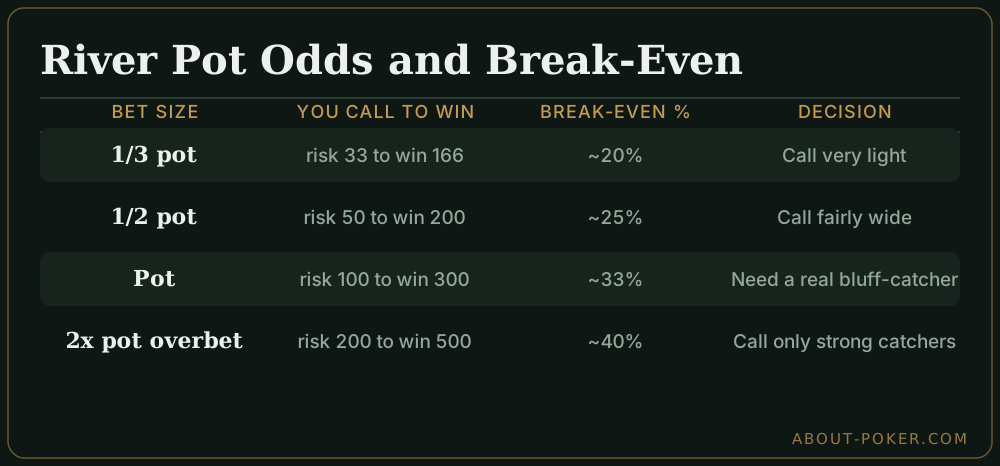
Before any read, compute the price. If the pot is $100 and your opponent bets $50, you must call $50 to win the $150 that’s now out there. You’re risking 50 to win 150, so you need to be good 50 ÷ (150 + 50) = 50 ÷ 200 = 25% of the time. That 25% is your break-even threshold — call if you beat at least a quarter of their betting range, fold if you beat less.
The bet size sets the price directly:
- A half-pot bet needs you good ~25% of the time.
- A full-pot bet needs you good ~33%.
- An overbet of twice the pot needs you good ~40%.
Bigger bets demand a stronger hand to call, which is exactly why polarized players overbet — they charge you a premium to look them up.
From break-even to a decision: read the range
Pot odds tell you how often you need to win. Now you estimate how often you actually win by asking what your opponent bets. Split their river range into value hands (that beat you) and bluffs (that don’t). If the share of bluffs exceeds your break-even threshold, call. This is the heart of bluff catching the river: you’re not hoping to have the best hand, you’re being paid enough to catch the bluffs.
A worked example: catching with ace-high
You hold A♠K♦ on a final board of K♠ 9♥ 4♣ 2♦ 7♠. You have top pair, top kicker — a strong bluff-catcher, but by no means the nuts. The pot is $200 and your opponent overbets $200 (a pot-sized bet). Your price: you risk 200 to win 400, needing to be good 200 ÷ 600 = 33% of the time.
Your top pair beats every bluff (missed flush draws, busted straight draws like JT and A5) but loses to two pair, sets, and the occasional slowplayed monster. If your read is that this opponent turns missed draws into bluffs often enough that at least a third of their pot-sized bets are air, you have a mandatory call. If they only ever bet this size with the nuts, you fold — even top pair top kicker. The hand strength barely matters; the bet’s composition is everything.
Blockers tip close spots
When the decision hovers right at your break-even point, blockers break the tie. Holding a card that removes combos of the value hands makes a bluff relatively more likely. On that K-high board, your own king blocks some of their two-pair and set combos, nudging a marginal spot toward a call. Conversely, if your hand blocks the exact bluffs they’d fire — say you hold the flush draw that missed — that’s a reason to fold, because there are fewer bluffs left in their range.
Common mistakes
- Calling because the hand “looks good.” Top pair is irrelevant if the opponent only value-bets better. Judge the range, not your two cards in isolation.
- Folding to any big bet. Overbets are often the most bluff-heavy sizing. Don’t reflexively fold to size — compute the price and the range.
- Ignoring the story. If the line makes no sense as value (an opponent who checked a scary turn then jams a blank river), that’s frequently a bluff.
- Calling stations and nits both cost you. Against a player who never bluffs, fold your marginal hands. Against one who bluffs too much, call light. Adjust to the human, not the textbook.
Opponent type overrides the math
The pot odds set the baseline, but the person across the table sets the deviation. Against a tight, passive opponent who only bets value, fold everything but the near-nuts. Against a wild, aggressive one, your bluff-catchers print money — call down and let them barrel into you. The best river players hold the math in one hand and the read in the other, and let the two meet.
Quick checklist
- Compute the pot odds and your break-even percentage first.
- Split their betting range into value and bluffs.
- Call if bluffs exceed your break-even share; fold if not.
- Use blockers to settle spots within a few percent of the line.
- Adjust hard for calling stations (fold more) and maniacs (call more).
For the deeper mechanics of hero-calling and hand-reading, dig into the full postflop library.
Frequently asked
How do I know whether to fold or call on the river?
Work out the pot odds — the price you're being laid — and compare it to how often you need to be good. If a pot-sized bet lays you 2:1, you need to win about 33% of the time; call if you beat at least that share of the opponent's betting range, otherwise fold.
What are pot odds on the river?
Pot odds are the ratio of the current pot to the amount you must call. A $50 call to win a $150 pot (100 pot plus 50 bet) means you're risking 50 to win 150, needing to be good 50 ÷ 150 = about 33% of the time to break even.
Do blockers matter when deciding to call the river?
Yes. Holding a card that removes combos of the hands that beat you — like an ace on an ace-high board, which blocks their two-pair and sets — makes it more likely they're bluffing, tilting a marginal spot toward a call.