Playing Trips on a Paired Board
How to play trips on a paired board: why your kicker decides everything, how to value bet safely, and when trips is a bluff catcher against a full house.
On this page · 6 sections
Trips on a paired board looks like a monster and often is, but it comes with a hidden trap: much of your hand is community property. Because two of your three matching cards sit on the board for everyone to see, the strength of your holding is decided almost entirely by your kicker and by how the action develops. Playing trips well means value betting relentlessly when you are ahead and recognizing the specific moments when your big hand quietly becomes a bluff catcher.
Trips versus a set, and why it matters
First, the vocabulary. A set is three of a kind made from a pocket pair plus one board card; both of your hole cards are hidden, so a set is disguised and rarely dominated. Trips is three of a kind made when the board is already paired and you hold one matching card. The difference is huge for how the hand plays, because with trips your opponents can share the paired card just as easily as you can. For a broader look at these boards, see playing paired boards.
The practical consequence is that on a paired board, whoever holds the matching card is often relying on their kicker to win. If the board is K-K-7 and you hold K-Q, an opponent with K-J also has trip kings, and your queen kicker wins the pot. This is why the number-one rule of trips on a paired board is: your kicker is your hand.
A worked example
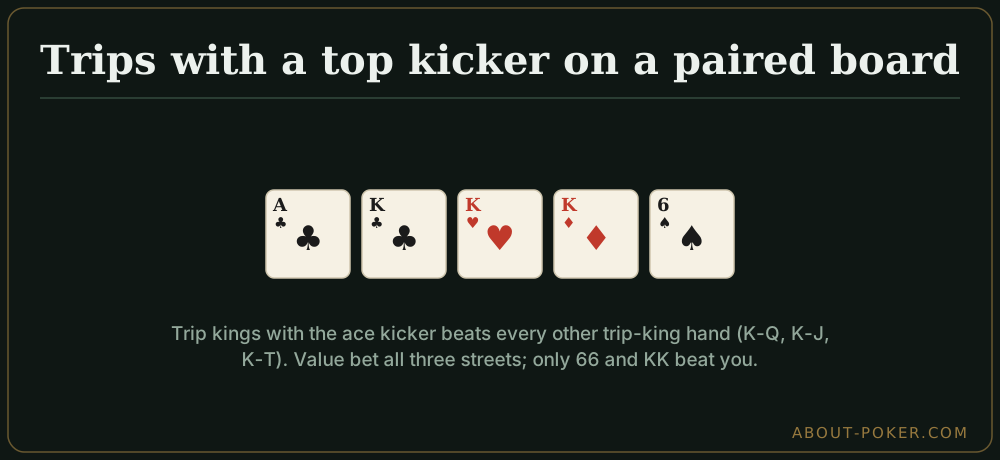
You raise from the cutoff with Ac Kc and the big blind calls. The flop comes Kh Kd 6s. You have trip kings with an ace kicker, which is close to the nuts here; the only hands beating you are pocket sixes for a full house and pocket kings for quads, both very rare given you hold a king. This is a hand to bet for value on all three streets.
You c-bet, the big blind calls. The turn is the 3c; you bet again and get called. The river is the 9h. You should bet a third time for value, because worse trips like K-Q, K-J, and K-T will call, as will stubborn pocket pairs and the occasional bluff-caught missed draw. Your ace kicker means you beat every other trip-king hand, so you are value betting into a range that is mostly worse. Size the river to get called by those weaker kings rather than blasting an overbet that only folds them out. This is textbook value betting: extract from the many hands that beat a bluff but lose to your kicker.
When trips becomes a bluff catcher
The same hand changes character when the story starts screaming full house. If a passive opponent suddenly check-raises the turn or leads big into you on a board like 8-8-4-4, you have to ask what a small kicker beats. On double-paired boards, an opponent holding any pocket pair or any card matching the second pair now has a full house that crushes your trips. When the action gets heavy on a board that easily makes boats, your trips quietly demote from a value hand to a bluff catcher, and a marginal kicker should often just call rather than raise.
The reverse is also true. Against an aggressive opponent who barrels missed draws, do not fold trips to one big bet just because a full house is possible. Most of their range is still one pair or air, and trips beats all of it.
Common mistakes
- Overvaluing a weak kicker. Trip kings with a deuce kicker is not the same hand as trip kings with an ace. Against multi-street aggression, small-kicker trips is often a call-down, not a raise.
- Slowplaying. Because trips is partly visible, opponents underrate your hand and pay off bets. Checking to trap usually just misses value.
- Ignoring the full-house threat on double-paired runouts. When the board pairs a second time, reassess; your relative strength can crater.
- Betting too big for value. Overbetting folds out the exact worse trips and pairs you want to call. Size to keep their range in.
Adjusting by position and opponent
In position, you can bet three streets and control the sizing, which is ideal for a value-heavy hand like trips with a good kicker. Out of position, leading out is fine on paired boards where you hold the trips, because checking lets opponents check back and deny you value; this connects to c-betting paired boards. Against a calling station, bet bigger and thinner because they pay off; against a tricky, aggressive regular, be more willing to call down and less eager to raise into a possible boat.
Quick checklist for trips on a paired board
- Identify your kicker first: it decides ties against other trips.
- With a top kicker, bet for value across streets and size to get called.
- With a weak kicker, lean toward calling down rather than raising.
- Watch for double-paired runouts and sudden aggression that represents a full house.
- Adjust sizing and aggression to the opponent: thin and big vs. stations, cautious vs. trappy regs.
Frequently asked
What is the difference between trips and a set?
A set is when you hold a pocket pair and hit a third matching card on the board, giving you three of a kind with two hole cards contributing. Trips is when the board is paired and you hold one card matching that pair, so two of your three-of-a-kind cards are on the board and visible to everyone.
Is trips a strong hand on a paired board?
Trips is strong but not the nuts, and how strong depends heavily on your kicker. On a paired board everyone with the same trip card shares the pair, so your side card breaks ties. A big kicker is a clear value hand while a small kicker can be dominated by another player's trips.
Should you slowplay trips on a paired board?
Usually no. Because the trips are partly on the board, opponents often have weaker one-pair hands or their own trips with a worse kicker that will pay you off. Betting for value is generally better than checking, though you should slow down against heavy aggression that credibly represents a full house.