Playing Wet Flops
Wet flops flip the script — draws are everywhere and equities run close. Learn how to size bets, protect value, and pick bluffs on coordinated boards.
On this page · 7 sections
Wet flops are where postflop poker gets sharp. When the board is coordinated — connected ranks, two of a suit, or both — draws are everywhere, equities run close, and the hand that leads on the flop can be behind by the river. On these textures the cheap, high-frequency range bet that crushes dry boards falls apart. You have to bet bigger, bet more selectively, and think one street ahead.
What Makes a Flop Wet
A wet board has draws in abundance: a flush draw (two or three of a suit), straight draws from connected or one-gapped ranks, or both at once. Textbook wet flops are 9♥-8♥-7♣, T♠-9♠-6♦, and J♥-T♥-4♣. Compare that with a bone-dry K-7-2 rainbow, where nothing connects — the wet vs dry board texture guide lays the two side by side.
The defining word is dynamic. On a dynamic board the best hand on the flop often is not the best hand on the river. A flush card, a straight card, or a board pair reshuffles the order of hands constantly. Because equities are so fluid, protection and pot-building matter far more than they do on static boards.
Why the Caller Catches Up
On dry boards the raiser owns the range advantage. Wet boards narrow that gap. A connected board like 9-8-7 or T-9-6 smacks the middling suited connectors and one-gappers that live in a caller’s flatting range, while missing many of the raiser’s high-card holdings. When you run both ranges on 9-8-7 two-tone — see range vs range on wet boards — equities sit much closer to even, and the caller holds plenty of strong draws and made hands. That is why you cannot simply bet everything for a small size.
How to Bet a Wet Flop
Size up and polarize. On wet boards the standard c-bet climbs to half pot, two-thirds, or even an overbet, and you bet a more selective range built from two groups: strong made hands (sets, two pair, overpairs) and your best draws (a flush draw with two overs, an open-ender with a gutshot backup). The marginal middle — weak pairs, ace-high with no draw — checks back to control the pot and keep bluff-catchers in your checking range. See c-betting wet flops for how solvers split value and bluffs here.
A big bet does the heavy lifting: it charges every draw the maximum, it denies equity to hands that would happily call a small bet, and it grows the pot so your sets and overpairs get paid.
A Worked Example
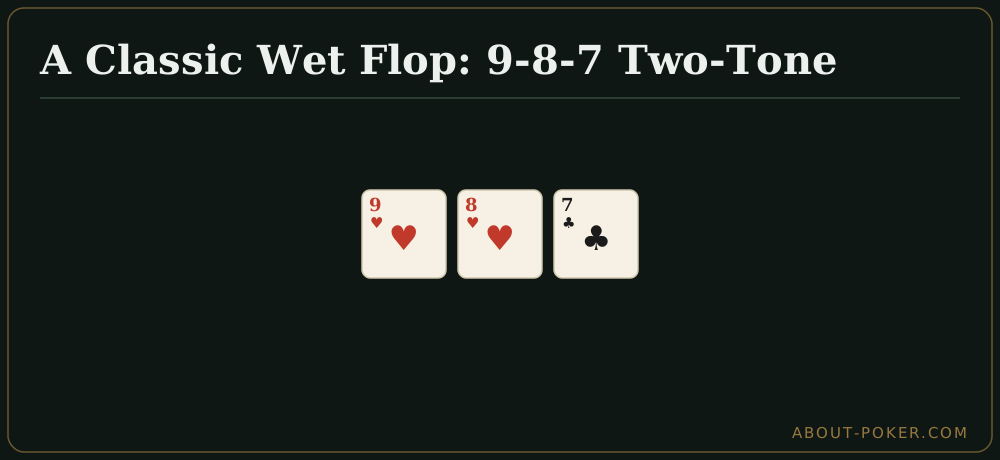
You open A♥K♥ from the button, the big blind calls, and the flop is 9♥-8♥-7♣. The pot is about 5.5bb. This board is soaked — any heart, any six, any ten, and every jack changes the picture.
Here you do not have a made hand, but you hold the nut flush draw plus two overcards — around 15 outs and roughly 50% equity against many made hands. This is a premium semi-bluff, so you bet big, about two-thirds pot (3.6bb). The large size charges the caller’s weaker draws and worse made hands, and when you hit a heart, a ten, or a queen you are drawing to the nuts. Compare that to A♣K♦ with no backdoor help on the same flop: that hand has far less equity and belongs in your checking range, not your betting range. The board texture, not just your two cards, decides whether you fire.
Playing Wet Flops as the Caller
When you are the one facing a big bet on a wet board, lean on your equity. Continue with made hands and with draws that have real outs — a flush draw, an open-ender, a combo draw — and fold the naked overcards that a big bet freezes out. Because the board is dynamic, raising your strong draws (a semi-bluff check-raise) is more attractive here than on dry boards: you have fold equity now and a nut draw for later. Just keep your raising range balanced with value so you are not only ever raising air.
Common Mistakes
- Betting small to save chips. A one-third bet on 9-8-7 two-tone lets every draw call cheaply and outdraw you — exactly the wrong texture to be cheap.
- C-betting your whole range. Wet boards hit the caller too hard for a pure range bet; check your weak, no-equity hands.
- Barreling blanks with pure air. If a brick turns and you have no equity, giving up often beats firing a second big bullet into a range full of made hands.
- Slowplaying sets. On a dynamic board a set needs to charge draws now — bet it rather than trapping and letting a free card sink you.
Wet-Flop Checklist
Before you act, ask: How many draws does this board contain, and does it favor the caller’s range? Is my hand strong enough to bet for value or good enough as a semi-bluff, or should it check back? What size charges the draws without overcommitting? And on the turn, which cards help me and which help my opponent? Answer those and wet boards stop feeling chaotic and start feeling like a well-defined bet-size problem.
Frequently asked
What is a wet flop?
A wet flop is a coordinated board full of draws — connected ranks and two of a suit, like 9-8-7 with two hearts. Many turn and river cards complete straights or flushes, so equities are close and hands change value fast from street to street.
How should you size c-bets on wet boards?
Larger than on dry boards — commonly half pot to three-quarters, and sometimes an overbet. Big bets charge the many draws, deny equity, and build a pot with your strong made hands. Betting small lets draws call cheaply and outdraw you.
Should you c-bet your whole range on a wet flop?
No. Wet boards hit the caller's range harder and equities are close, so you bet a more selective, polarized range — strong value plus your best draws — and check back marginal hands rather than betting every combo.