4-Betting as a Bluff
4-betting as a bluff means re-raising a 3-bet without a premium. Learn the best blocker hands, sizing, when it works, and a worked A-5s example.
On this page · 6 sections
4-betting as a bluff means re-raising an opponent’s 3-bet with a hand that isn’t a premium value holding. Just as light 3-bets balance a value-heavy 3-bet range, 4-bet bluffs stop your 4-bets from being a face-up “A-A / K-K only” range. Without them, opponents can 3-bet you relentlessly and fold every time you 4-bet, since your re-raise always means the nuts.
Why bluff-4-bet instead of just folding or calling
When someone 3-bets your open, you have three options: fold, call, or 4-bet. If your 4-betting range contains only A-A, K-K, and sometimes A-K, an observant opponent can 3-bet a wide range against you and simply surrender to any 4-bet, printing money with their bluffs. Adding 4-bet bluffs fixes this:
- Immediate fold equity. A large chunk of a 3-bettor’s range is itself bluffs and thin value (small pairs, suited connectors, A-Q). A 4-bet folds those out and you win a sizeable pot preflop.
- Balance. Now your 4-bets aren’t only monsters, so opponents can’t exploit you by 3-betting light and folding to the 4-bet.
This is the mirror image of defending against 3-bets — the 4-bet bluff is your most aggressive defensive response.
Choosing 4-bet bluff hands: blockers rule everything
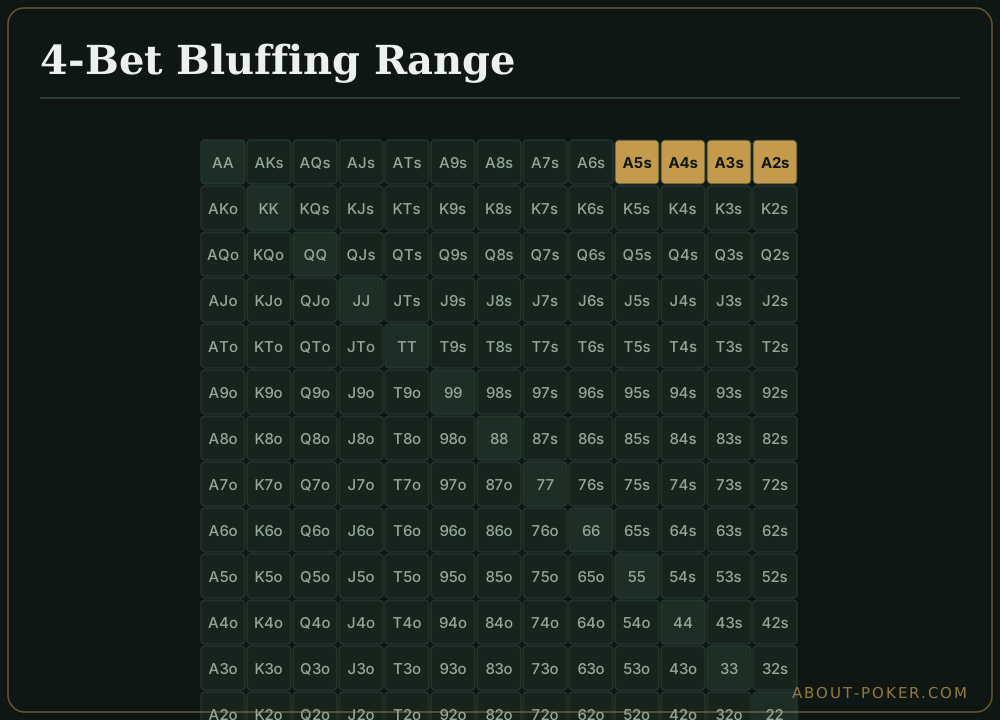
At the 4-bet level, ranges are extremely tight, so card removal is decisive. The premier 4-bet bluffs are suited aces, especially A-5s, A-4s, A-3s, A-2s:
- The ace blocks A-A and A-K — two of the hands most likely to call or 5-bet you.
- The wheel aces retain a straight and nut-flush component when called, so you’re never drawing totally dead.
- Being suited adds a few points of equity versus the value hands that continue.
Some solvers also mix in a fraction of A-Ks and K-Qs as 4-bet bluffs, but suited wheel aces are the workhorse. Offsuit junk makes a poor 4-bet bluff: no blockers, no equity when called.
Sizing your 4-bet bluff
You do not need to jam. A smaller 4-bet keeps your risk down while still forcing folds:
- In position: about 2.2–2.5x the 3-bet size.
- Out of position: slightly larger, roughly 2.5–3x, because you want more fold equity when you’ll be playing the rest of the hand without position.
Because you’re bluffing, use the same sizing you’d use with your value 4-bets — mixing sizes by hand strength gives sharp opponents a read. Consistency is part of what makes the bluff credible. For the full sizing framework across value and bluffs, see 4-betting strategy.
A worked example
You open the cutoff to 2.5bb with A♦5♦ at 100bb. The button, a competent aggressive regular, 3-bets to 8bb. You know their 3-bet range from this seat is fairly wide and contains plenty of bluffs.
A-5 offsuit here is a fold. But A-5 suited is an ideal 4-bet bluff:
- 4-bet to about 19bb (roughly 2.4x their 8bb). The ace blocks their A-A and A-K value combos and their A-x suited bluffs, so a large slice of their range must fold.
- They fold — the most common outcome against a wide, bluff-laden 3-bet range — and you win 8bb + blinds without a flop.
- They call or 5-bet: if called, you have a suited hand that flops flush draws and wheel straights; if they 5-bet, you fold, having risked only ~19bb rather than your stack.
That small-loss / frequent-win profile is exactly why suited wheel aces beat random bluff candidates.
Common mistakes
- 4-bet bluffing without blockers. 7-6 suited has playability but no removal — it lets too many value hands continue. Prefer suited aces.
- Bluffing players who never fold to 4-bets. If a nit 3-bets only premiums, they’ll never fold; against them, drop the bluffs and 4-bet pure value.
- Over-sizing to a jam. Shoving 100bb as a bluff risks far more than necessary; a 2.2–2.5x 4-bet gets the same folds for a fraction of the cost.
- Only 4-betting monsters. With no bluffs, you’re exploitable — opponents 3-bet wide and fold to every 4-bet.
Quick checklist
Before you 4-bet bluff, confirm: the 3-bettor’s range is wide enough to fold a lot; your hand has an ace or king blocker (ideally suited); your sizing matches your value 4-bets; and you’re comfortable folding to a 5-bet. Nail those and the 4-bet bluff becomes a powerful, low-cost way to attack aggressive 3-bettors.
Frequently asked
What is a 4-bet bluff?
A 4-bet bluff is re-raising an opponent's 3-bet with a hand that isn't strong enough to want the money in for value. Its purpose is to make the 3-bettor fold their bluffs and weaker value hands, winning the pot preflop or setting up a favorable spot when called.
What are the best hands to 4-bet bluff with?
The best 4-bet bluffs are suited aces like A-5s through A-2s, plus some A-Ks blends used as bluffs. The ace blocks A-A, K-K (via the ace's card removal on A-x value), and A-K in your opponent's range, so they can continue less often. Suitedness gives modest equity when called.
How big should a 4-bet be?
Against a 3-bet, size your 4-bet to roughly 2.2 to 2.5 times the 3-bet size when in position, and a bit larger out of position (around 2.5 to 3 times). You don't need to risk your whole stack — a smaller 4-bet keeps your bluff cost down while still applying maximum fold pressure.