How to Play Jack-Two Offsuit (J2o)
J2o is one of the weakest hands in poker and a near-universal fold. Learn the rare spots where Jack-two offsuit is playable and how to handle it postflop.
On this page · 6 sections
Jack-two offsuit (J2o) is one of the weakest starting hands in No-Limit Hold’em. The jack can make a pair, but it’s easily dominated, the deuce kicker is dead weight, and — unlike J2 suited — there is no flush draw to bail you out. For almost every player in almost every seat, the correct play with J2o is to fold before the flop.
Where J2o belongs preflop
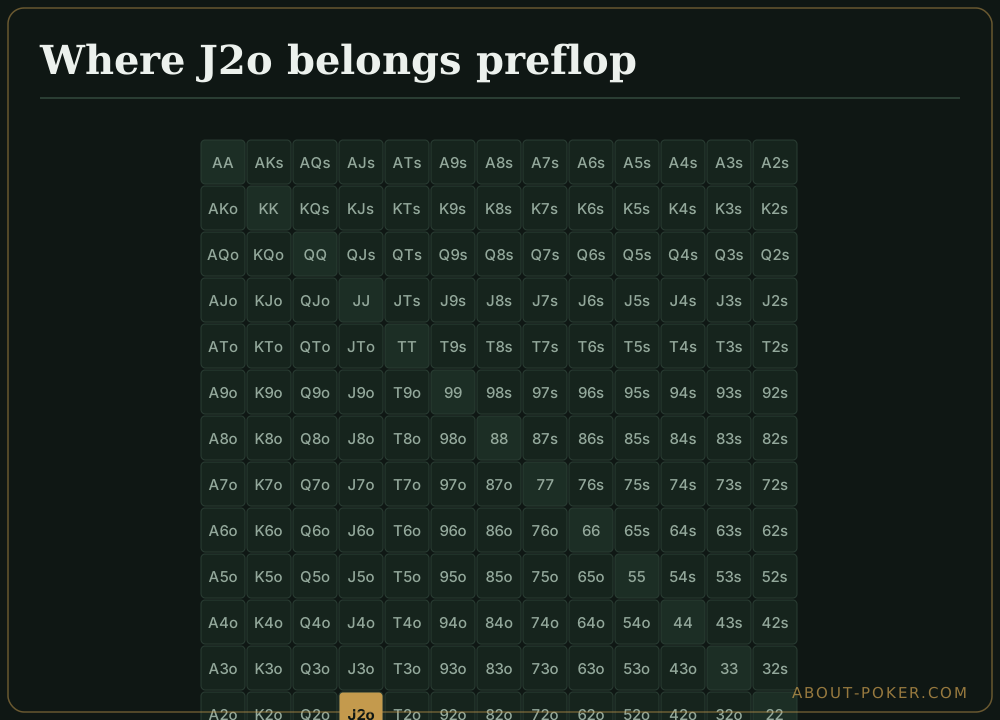
The honest answer is: almost nowhere. In a 6-max game, J2o is not part of any early-, middle-, or even cutoff-opening range. The single spot where it might appear is a very wide button open against two blinds, and even there it’s a marginal, low-frequency inclusion rather than a standard raise. If you’re unsure whether a hand this weak opens from a given seat, the preflop opening ranges chart will confirm it doesn’t from anywhere but the button.
The realistic home for J2o is big-blind defense at a great price. When a button raiser makes it cheap to call and you’re closing the action, you can flat a few J2o combos with the understanding that you’re getting a bargain, not a good hand. You never 3-bet J2o — it has no value and makes a terrible bluff.
Why J2o is so weak
Two problems compound. First, the jack is a middling card that is dominated by every better jack (KJ, QJ, JT, AJ) and by all overpairs, so flopping top pair often means flopping the losing hand. Second, the deuce kicker offers no straight potential worth mentioning and no kicker help. Strip away the flush draw that suited hands enjoy, and J2o is left with almost nothing but “pair the jack and hope.” That’s why it consistently ranks among the bottom hands in every equity chart.
A worked example
Say you defend J♥2♣ in the big blind against a button open at a good price, and the flop comes J♠ 9♦ 5♣. You’ve flopped top pair, deuce kicker.
Check to the raiser. If they c-bet small, you can call once — you have a made hand and a reasonable board — but you’re not building a big pot. The moment the action heats up (a large bet, a turn barrel, a raise) you should be ready to fold, because a button’s continuing range on this board is full of better jacks, overpairs, and sets that dominate you. Your kicker gives you no way to improve your relative hand strength.
If the flop instead comes K♦ 8♠ 4♣, you’ve completely missed. Check and fold to any bet — there’s no draw, no pair, and no reason to invest another chip.
How the spot changes with position and opponents
The little playability J2o has is entirely a function of who’s in the pot and where you sit. Against a tight, aggressive button who opens a narrow range, defending J2o in the big blind is worse than it looks — their raising hands are strong, so your dominated jack collides with better jacks and overpairs far too often. Against a loose, passive player who limps or min-raises a wide range full of weak aces and random broadway cards, your J2o realizes a bit more equity because the field is softer and folds more readily postflop.
Stack depth matters too. Deep-stacked (150bb and up), implied odds favor hands that can flop the nuts and stack someone; J2o can’t, so it gets worse, not better, as stacks grow. Short-stacked play cuts the other way: at 15-20bb there’s no room to be outplayed on later streets, so a rare wide button jam might include a handful of J2o combos purely as a chip-accumulation shove against tight blinds. Even then it’s the bottom of the shoving range, mixed at low frequency.
Common mistakes with J2o
- Calling a raise from outside the blinds. Cold-calling J2o from the cutoff or small blind is a clear loss. You’re out of position with a dominated hand and no price advantage.
- Bluff-3-betting it. J2o has zero backdoor equity and no blocker value worth the name — the deuce blocks nothing relevant. If you want a light 3-bet bluff, pick a suited hand with a straight or flush backdoor instead.
- Getting married to top pair. Flopping a jack feels like something, but with a deuce kicker it’s a bluff-catcher at best. Firing multiple streets with it turns a small pot you might win into a large pot you usually lose.
- Overfolding the actual bargain spot. The opposite leak: some players fold every J2o even when the button opens tiny and the big blind is getting 3.5-to-1. At that price, mucking every hand is also a mistake — you defend a wide range, and a few J2o combos come along for the ride.
The discipline this hand teaches
J2o is a useful reminder that most starting hands are folds, and that the biggest leaks come from playing trash out of position or without a price. Its only real habitat is blind-versus-blind and wide button spots, where ranges stretch to their limits; for how those widest confrontations play, see blind vs blind play.
Bottom line: fold J2o preflop from nearly everywhere, defend it only at a bargain price in the big blind, and never get attached to a dominated pair after the flop. Folding weak hands cleanly is one of the simplest ways to raise your win rate.
Frequently asked
Is J2 offsuit a good hand?
No. J2o is one of the worst hands you can be dealt in Hold'em. It's a fold from every position except a rare, low-frequency button open, and it exists mainly in wide big-blind defenses.
Should I ever open Jack-two offsuit?
Almost never. Only from the button in wide games might a few J2o combos sneak into the very bottom of your range, and even then it's optional. From every earlier seat, fold.
Can I defend J2 offsuit in the big blind?
Only against a late-position open at a very good price, and even then sparingly. You'll flop a dominated jack or nothing most of the time, so play it passively and fold to pressure.