How to Play King-Four Offsuit (K4o)
K4o is a weak offsuit king that lives on the K blocker and blind-vs-blind play. Learn where K4 offsuit opens, when to defend it, and how to survive kicker trouble.
On this page · 8 sections
King-four offsuit (K4o) is a weak offsuit king with a single redeeming feature: the king blocker. Holding a king slightly reduces the chance your opponent has K-K or a dominating K-x, which nudges K4o’s value in a few narrow spots — mostly blind-vs-blind and marginal button steals. Strip away the blocker and you have a bad kicker with no flush and no straight backup. K4o is a hand you play tightly and only when position or heads-up dynamics do the heavy lifting.
Where K4o belongs preflop
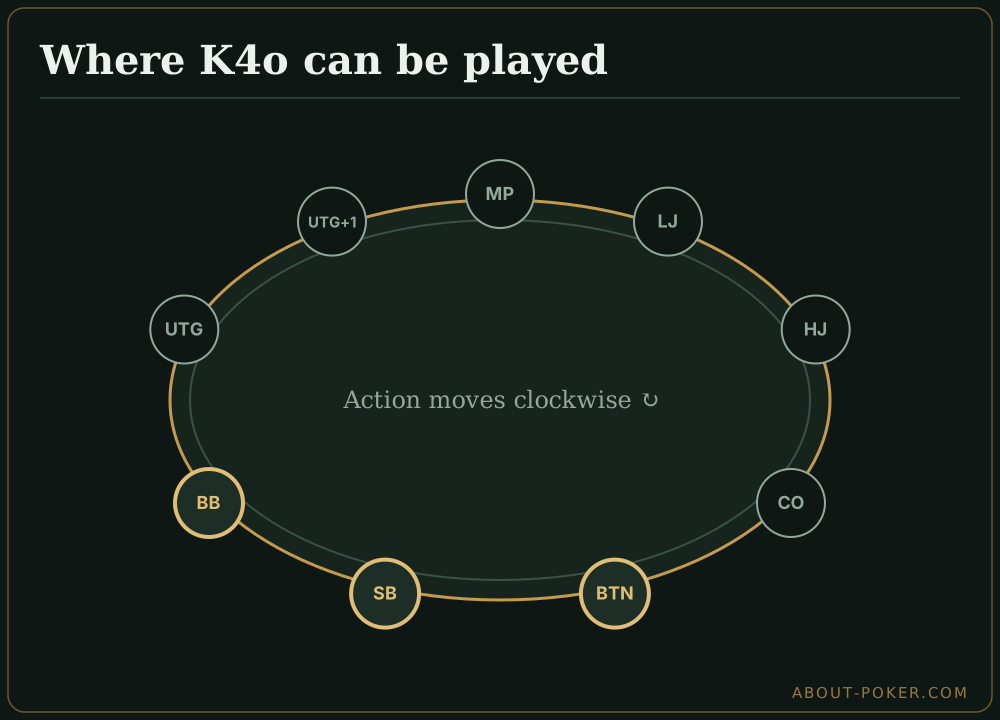
- Early and middle position: fold. K4o is dominated by every better king and can’t defend against strong ranges.
- Cutoff: a fold or a very low-frequency steal in loose games.
- Button: a marginal open when the blinds are tight and likely to fold. Position is doing all the work here.
- Small blind: open by raising in blind-vs-blind spots; the king blocker and heads-up dynamics give it just enough value. See blind vs blind play.
- Big blind: a low-frequency defend against small opens, purely on price. See defending the blinds.
The king blocker, and its limits
K4o’s kicker is poor, so its value is almost entirely about what it removes. Holding a king cuts your opponent’s K-K from 6 combos to 3 and takes some K-Q, A-K, and K-J out of their range. But unlike a weak ace, K4o rarely functions as a 3-bet bluff, because when you’re called you’re often dominated by a better king and you have no flush to fall back on. The blocker matters most in blind-vs-blind pots, where ranges are wide, a top pair of kings is frequently good, and the heads-up dynamic lets you realize equity. Compare that with K4 suited, whose flush lets it play far more aggressively.
A worked example
You’re in the small blind, the big blind is passive, and you open K♦4♠ in a blind-vs-blind spot. The big blind calls. Flop: K♣ 8♥ 3♠. You’ve flopped top pair, weak kicker. Against a wide big-blind calling range, a pair of kings is often the best hand, so a small continuation bet for value and protection is standard. But keep the pot controlled: if you face a raise, your four kicker is dominated by every K-8 through K-5, so you shouldn’t be building a stack-off. If instead the flop comes Q♥ 9♣ 2♦, you have king-high and no pair — an easy check-fold against resistance. K4o’s whole plan is to make a cheap pair of kings heads-up and get to showdown, not to play for stacks with a dominated kicker.
Postflop shorthand
- Top pair (king), weak kicker: bet small for value and protection heads-up; pot-control against aggression.
- Pair of fours: a marginal showdown hand; peel one cheap card at most.
- King-high, no pair: usually a check-fold; the blocker gives it thin bluff-catch value only.
- Gutshots and backdoors: rare — don’t overvalue thin draws with a weak offsuit king.
When not to play it
Fold K4o from early and middle position, and against any raise from a tight range — you’re simply dominated. Don’t call raises out of position hoping to flop a king; you’ll too often make a pair that’s already beaten. And avoid 3-betting K4o as a bluff: unlike weak aces, the king blocker doesn’t remove enough of a raiser’s calling range to justify the risk, and you have no flush equity when called.
The kicker problem, spelled out
The reason K4o plays so tightly comes down to one recurring situation: you flop a pair of kings and can’t be sure whether you’re ahead. When K4o makes top pair, your kicker is a four, which is beaten by every other king in the deck — K-Q, K-J, K-T, K-9, all the way down to K-5. This is textbook “kicker trouble,” and it defines how K4o realizes value.
Think about what happens on a king-high flop against a non-blind opponent. If they have a king, they almost certainly have a better one, so your top pair is behind. If they don’t have a king, they mostly fold to a bet, so you win a small pot. That asymmetry — you win small when ahead and lose big when behind — is called reverse implied odds, and it’s why K4o can’t play for stacks with top pair. The whole approach is to make a cheap pair, bet or check for a modest showdown, and never inflate the pot with a dominated kicker. In blind-vs-blind pots the math flips just enough to be playable, because the opponent’s range is so wide that a bare pair of kings is often genuinely best and a raise with a better king is much less likely.
Reading opponents: when K4o gains and loses value
K4o is one of those hands whose playability is almost entirely about who you’re up against, more than the cards themselves.
- Passive, folding opponents: K4o gains value. A tight big blind who folds to steals lets the button open profitably, and a passive caller who won’t punish your weak kicker postflop lets a pair of kings get to showdown cheaply.
- Aggressive, three-betting opponents: K4o loses its thin value fast. If the blinds re-raise frequently, your button open just gets blown off the pot, and you can’t call a 3-bet with a dominated offsuit king. Against these players, fold it and pick better spots.
- Loose, calling-station opponents: mixed. You’ll get paid when your kings are good, but you’ll also get shown better kings and second pairs that call you down, so pot control matters even more.
The honest summary is that K4o is never a hand you’re happy to have — it’s a hand you play correctly in the narrow band of spots where position and a weak opponent do the work for you. Everywhere else it belongs in the muck. For the spots where it does earn its keep, lean on blind vs blind play, and for the price-based defends, defending the blinds.
Where to go next
K4o is a blocker-and-position hand: fold it early, open it only from the button and small blind, and keep pots small when your weak kicker connects. See the stronger version in K4 suited, master its best home in blind vs blind play, and learn the price-based defends in defending the blinds.
Frequently asked
Is K4 offsuit a good hand?
K4o is a weak hand. Its only meaningful asset is the king blocker, which slightly reduces your opponent's premium holdings. It is too weak to open outside late position and is played mainly as a blind-vs-blind hand and an occasional big-blind defend.
Can you open K4 offsuit?
Only from very late positions. K4o is a marginal button open and a small-blind open in blind-vs-blind spots. From early or middle position it is a clear fold because it is dominated by better kings and offers no flush or straight backup.
How does K4o compare to K4 suited?
K4 suited is meaningfully stronger because the flush adds real equity and lets it defend and even 3-bet-bluff more often. K4o keeps only the king blocker and a weak kicker, so it opens from fewer positions and folds far more frequently preflop.