How to Play King-Eight Suited (K8s)
K8s is a marginal suited king that opens mainly from the button and small blind. Learn where K8s plays, its domination risk, and how to handle it postflop.
On this page · 6 sections
King-eight suited (K8s) is one step weaker than K9s, and that one step matters. The king still gives you a high card and the second-nut flush, but the eight kicker is genuinely poor: it doesn’t connect with the king for straights, and when it pairs it’s rarely the best hand. K8s is a late-position and blind hand only — anywhere else, it’s a fold.
Where K8s belongs preflop
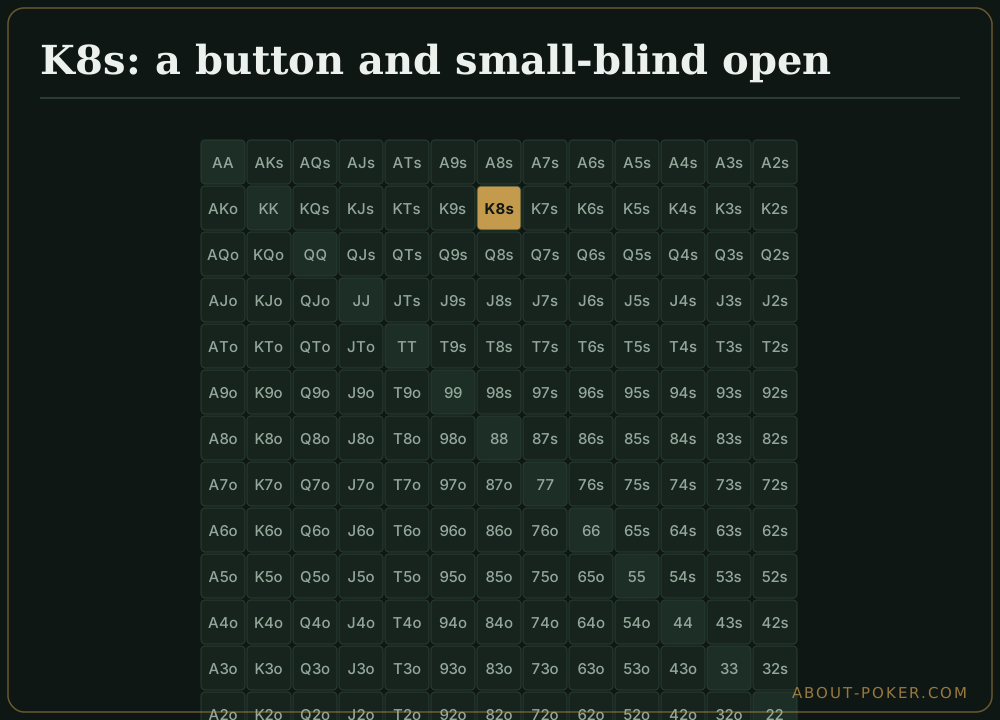
By seat, K8s sits near the bottom of the playable suited kings:
- Early and middle position: fold at a full table. You’re opening into too many players who hold better kings and aces, and the eight kicker cannot survive that exposure.
- Cutoff: a marginal open — inside the range at many tables but close to the bottom of it. Fold it when the players behind are aggressive.
- Button: a standard open. The button opens a very wide range, and K8s is comfortably inside it.
- Small blind: open (raise), not limp — you don’t want to complete and play a weak hand out of position for a cheap price.
- Big blind: defend against late-position opens with the good price the blind gives you.
Ground the exact borders in the preflop opening ranges and see how they widen by seat in poker ranges by position.
The domination problem is worse here
Every medium suited king faces domination, and K8s faces it acutely. When you flop top pair with the king, you’re often behind A-K, K-Q, K-J, K-T, or even K-9, and ahead only of a random bluff. The eight kicker essentially never plays — it’s there to complete the occasional two pair or straight and nothing more. This is precisely why K8s opens only from the last two or three seats: the narrower the field, the fewer better kings can be lurking.
What keeps K8s in a range at all is the second-nut flush and the king’s value as a blocker. When you make a king-high flush, you have a hand strong enough to stack an opponent, and holding the king reduces the combinations of top-pair and better-flush hands your opponent can have.
Facing a raise: mostly fold
When someone else opens, K8s is a hand you should treat with restraint:
- In position vs a button or cutoff open: a light flat call is defensible with a good price, since you flop flushes and can flop two pair.
- Out of position: usually a fold. From the small blind especially, you’d play every street out of position with a dominated king.
- From the big blind: defend against late opens because the price is right; see how wide that defense should run in defending the blinds.
- As a 3-bet: essentially never — it’s dominated when called and a weak bluff.
A worked example
You open K♥8♥ from the button. The big blind calls. The flop comes K♦ 8♣ 3♠ — you’ve flopped top two pair, which is a strong hand here.
You bet, the big blind calls. The turn is the 5♦. You bet again; worse kings, eights, and draws will pay. The river is the 9♠, completing some straight draws, so you size down slightly for value against the worse kings that can’t fold. This is the upside of K8s: it occasionally flops a hand far stronger than its preflop ranking, and in position you can extract from it.
Now picture the same K♥8♥ on a K-8-3 flop but played from the small blind against a button opener. You’d be leading into the aggressor out of position, unsure whether your two pair is best against a set or a slowplay, and you’d have to guess on every street. Same flopped hand, far worse spot — which is exactly why K8s stays folded outside of late position.
Postflop in one paragraph
When K8s flops a flush draw, it’s the second-nut flush draw and a strong semi-bluff. When it flops top pair (king), keep the pot small unless you have position and a read, because the eight kicker means you’re rarely ahead of a better king. When it flops middle pair (eights) or air, treat it as a give-up or one-barrel hand depending on texture — the king high has little standalone value. K8s wants flush and two-pair boards; on everything else, it’s happy to fold cheaply.
Where to go next
K8s is a hand for the last few seats and the blinds, nothing more. Anchor the seat logic in poker ranges by position, tighten your opens with preflop opening ranges, and tie it together through the preflop strategy hub.
Frequently asked
Is K8 suited a good hand?
K8s is a marginal hand. It's a fine open from the button and small blind and a big-blind defend, but it's a fold from early and middle position at a full table. Its value is almost entirely in the second-nut flush and the blocker the king provides, not in showdown strength.
Should I 3-bet with K8 suited?
Almost never. K8s is dominated by every king it would want to get value from and is a weak bluff because of the eight kicker's poor straight potential. Against an opener you should call in position or fold rather than 3-betting.
Can I call a raise with K8 suited?
In position with a good price it can be a light call because it flops flushes and can flop two pair. Out of position it's usually a fold — the king is regularly dominated and you'll play the hand at a disadvantage on every street.