How to Play Jack-Two Suited (J2s)
Jack-two suited is an eight-gap hand and one of the worst suited holdings in poker. Here is the single spot where J2s survives and how to play it.
On this page · 6 sections
Jack-two suited (J2s) is an eight-gap suited hand and one of the worst suited holdings you can be dealt. With eight ranks between the jack and the deuce, there is no straight potential of any kind — the two is a completely dead card, useful only for the rare wheel-adjacent boards that a jack cannot join anyway. J2s leans entirely on its flush chances and a very occasional two pair. It wins roughly 45% heads-up against a random hand, well under a coin flip. In practice J2s is a fold, and the only reason it ever enters a range is the cheapest possible big-blind defense.
The single home for J2s
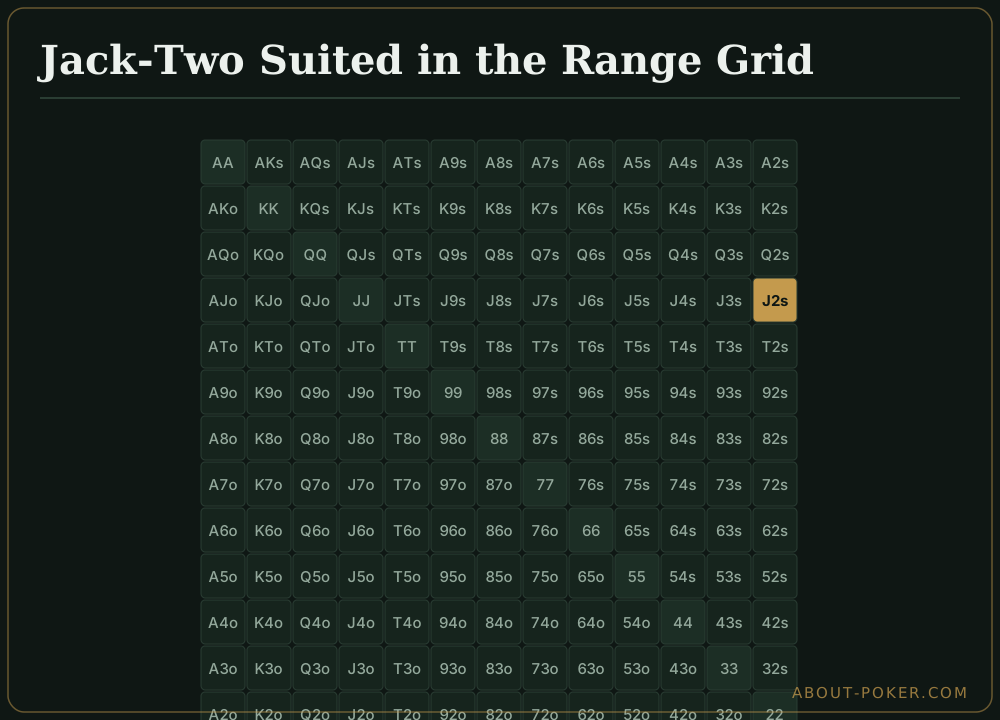
The one defensible use for J2s is defending the big blind at a deep discount. When a late-position player min-raises or makes a small open and you close the action getting an outstanding price, J2s can very occasionally call — you are already partly invested, no raise can come behind you, and suitedness leaves a flush to chase. This is the absolute outer edge of correct blind defense, where you defend far wider than you would open. J2s only qualifies against the widest opens at the best prices, and it is among the very first hands to fold the moment the price gets worse.
As an open, J2s is always a fold. It is weaker than jack-three suited, which already fails to qualify from every seat. Your preflop opening ranges should show J2s as a fold from all positions, and treating it as an automatic muck eliminates a guaranteed losing spot.
Why it is essentially junk
Each gap in a suited hand strips away straights and adds dominated pairs, and J2s has the most gaps of any jack-suited hand. That means zero straights and only the weakest, most outkicked pairs. A flopped jack is routinely outkicked; a flopped deuce is beaten by nearly everything. The flush is the sole holding capable of winning a real pot, and that lone possibility is the only thing separating J2s from a completely unplayable offsuit rag.
A worked example
You defend the big blind with J♦2♦ and the flop comes A♦-9♦-4♣.
This is the exact flop J2s needs: a flush draw, with any diamond completing your flush. That is nine outs — about 35% equity to make a flush by the river. Facing one reasonable continuation bet, you can check-call and try to win a large pot when a diamond falls. Now change the flop to K-8-3 rainbow and you hold jack-high with no draw and no plan — a trivial check-fold to any bet. That gap between a live flush draw and total air is the entire strategy for J2s.
The right mindset
Play J2s as a fold-first hand. Never open it, defend it only from the big blind at a genuine discount, and postflop continue solely with flush draws or the rare strong made hand. Its whole edge comes from the handful of flops where suitedness turns nothing into a real threat — and from the discipline to fold it the overwhelming majority of the time it flops air.
When the defend actually qualifies
The big-blind defend with J2s is far narrower than most players assume, so it helps to spell out exactly when it clears the bar. The best case is a single small raise — a min-raise to 2bb or a 2.2x open — from a late-position player whose range is very wide, when you are the only caller and getting close to 3.5-to-1 or better on the call. In that spot you are risking one big blind to win a pot already worth several, and the flush backup gives you a way to win a large pot when you connect. As the raise size grows, the math turns fast: against a 3x open you are getting a worse price and the raiser’s range is tighter, both of which erode the flush’s value, and J2s should be folded. Against a 3-bettor, an aggressive small blind who has already re-raised, or a multiway pot where a cold-caller has narrowed the field to strong hands, J2s is a fold every time — you no longer close the action cleanly, and being dominated is far more likely.
Position of the raiser is the other filter. A button open is the widest and best to defend against; a raise from the hijack or an early seat carries a much stronger range, so a nine-high or ten-high flush you make can be second-best more often, and the dead deuce contributes almost nothing. When in doubt against anything but a wide, late, cheap open, fold.
Postflop checklist for J2s
When you do defend and see a flop, keep the plan mechanical. Continue only if you flop a flush draw or a genuinely big hand (trips, a strong two pair). Check-call one bet with a flush draw and reassess on the turn — with roughly 35% equity to make the flush by the river, calling one reasonable bet is profitable, but do not build the pot by raising a bare draw, since your fold equity against a range that just opened wide is low and you have no pair to fall back on. Never barrel jack-high or deuce-high as a bluff: the hand has no blockers to speak of and no story that a wide caller will believe. If the flop misses your suit entirely, check and fold to any bet. The single skill J2s demands is folding — before the flop the vast majority of the time, and after the flop the moment you fail to pick up the flush draw that is the only reason the hand was ever in your range. For the closest comparable hand, see how jack-three suited is handled with one fewer gap.
Frequently asked
Is jack-two suited a playable hand?
Almost never. J2s is an eight-gap suited hand and one of the worst suited holdings in the deck. Its only home is deeply discounted big-blind defense against a wide raise. From any other seat it is an automatic fold.
Can you open jack-two suited on the button?
No. J2s is below every standard opening range, including the widest button steals. Folding it preflop from all positions is correct and loses you nothing of consequence.
How do you play J2s postflop?
Continue only with a flush draw. A jack pair is easily outkicked and a two pair is unlikely, so without a flush draw you should check and fold. Never barrel jack-high with no equity.