How to Play Jack-Three Suited (J3s)
Jack-three suited is a seven-gap trash hand that folds almost everywhere. Here is where the rare J3s spot exists and how to handle it correctly.
On this page · 6 sections
Jack-three suited (J3s) is a seven-gap suited hand and one of the weakest holdings in the deck. With seven ranks between the jack and the three, the hand has no straight potential whatsoever — the three contributes nothing to connectedness. J3s survives strictly on its flush chances and the very occasional two pair. It wins about 45% heads-up against a random hand, comfortably below a coin flip against an unknown holding. In every practical sense J3s is a fold, and its only reason to ever appear in a range is dirt-cheap big-blind defense.
The lone playable spot
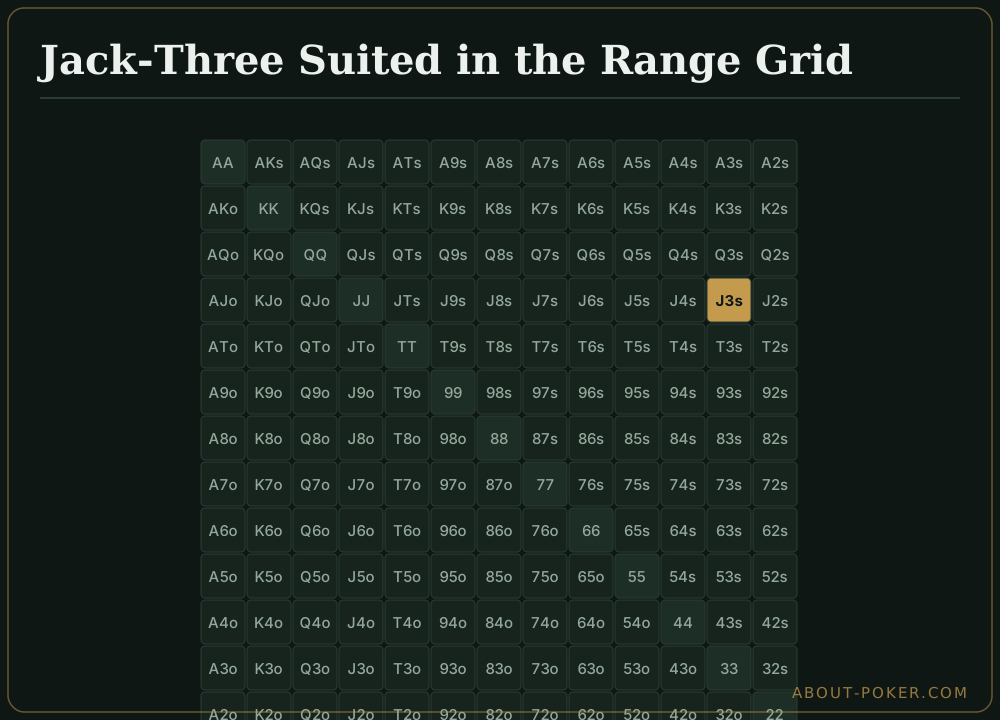
The single defensible use for J3s is defending the big blind at a deep discount. When a late-position raiser makes a small open and you close the action getting an excellent price, J3s can occasionally call — you are already partly invested, nobody can raise behind you, and suitedness leaves a flush to chase. This lives at the far edge of correct blind defense, where your defending range is far wider than any opening range. J3s only sneaks in against the widest opens at the best prices, and it is among the first hands to fold as soon as the price worsens.
As an open, J3s is always a fold. It is weaker than jack-four suited, which already fails to qualify from every standard seat. Your preflop opening ranges should mark J3s as a fold from all positions, and mucking it on sight removes a recurring losing spot from your game.
Why it is close to worthless
The pattern is by now familiar: each gap deletes straights and adds dominated pairs. J3s has seven gaps — one more than J4s — leaving it with no straights and only the weakest, most outkicked pairs. A flopped jack is routinely outkicked, and a flopped three is essentially always beaten. The flush is the only holding that can win a meaningful pot, and that single possibility is the entire justification for suitedness keeping this hand from being pure junk.
A worked example
You defend the big blind with J♥3♥ and the flop comes Q♥-7♥-2♣.
This is exactly the flop J3s needs: a flush draw, with any heart completing your flush. That is nine outs — about 35% equity to reach a flush by the river. Against a single reasonable continuation bet you can check-call and try to win a big pot when a heart lands. Change the flop to K-8-4 rainbow and you hold jack-high with no draw and no plan — an instant check-fold to any bet. The distance between those two flops is the whole strategy for J3s.
The right mindset
Handle J3s as a fold-first hand. Never open it, defend it only from the big blind at a genuine discount, and postflop continue solely with flush draws or a rare, well-hidden strong made hand. Its entire edge comes from the few flops where suitedness creates real equity — and from the discipline to fold it the many times it whiffs.
The kicker trap: why a paired jack is not good news
The most expensive mistake with J3s is not defending it too wide — it is getting attached to a jack when one flops. A jack is a big card, and beginners instinctively treat top pair as a hand worth betting and calling with. With J3s that instinct is a trap. On a J-8-4 flop your jack is top pair, but your kicker is a three, and virtually every jack in your opponent’s range out-kicks you: KJ, QJ, JT, AJ, even J9 and J8 have you dominated. You are drawing to two outs to improve, and every bet you put in against a better jack is money lost. The correct read on a flopped J3s top pair is “probably second-best, no way to know I’m ahead,” which means check and give up rather than build a pot you are usually losing. This is exactly why a strong kicker matters so much preflop and why hands like J3s belong in the muck: the pairs they flop cost you money precisely when they look most tempting.
Why folding preflop is free
It is worth being explicit about the cost of folding J3s, because the answer is essentially zero. A hand that wins about 45% against a random holding and realizes far less than its raw equity out of position, with no straight potential and dominated pairs, generates a tiny negative expectation in almost every non-discounted spot. Folding it forfeits nothing but a losing proposition. The only place it breaks even to slightly positive is the deep-discount big-blind defend described above, and even there the edge is razor-thin and comes almost entirely from the price rather than the hand. Contrast that with a genuinely marginal but playable holding: those you agonize over. J3s you do not — muck it and move on. For the adjacent hand that is one gap stronger and still barely qualifies, see jack-four suited; to confirm it sits below your opening thresholds everywhere, check your preflop opening ranges.
Frequently asked
Is jack-three suited playable?
Barely, and only in one spot. J3s is a seven-gap suited hand with zero straight potential. Its lone home is defending the big blind at a deep discount against a wide late-position raise. Everywhere else it is a fold.
Should you ever open jack-three suited?
No. J3s is below even the widest button-opening ranges. Folding it from every seat is correct and costs you nothing worth worrying about.
How do you play J3s after the flop?
Continue only with a flush draw. A jack or three pair is almost always second-best and has no future. Without a flush draw or an unlikely strong made hand, check and fold rather than firing bluffs.