How to Play King-Jack Suited (KJs)
King-jack suited is a solid suited broadway that flops top pairs, straights, and flush draws — but domination matters. Learn when to open, 3-bet, and fold KJs.
On this page · 7 sections
King-jack suited (KJs) is a solid suited broadway — a rung below the premium king-queen suited, but still a hand you open from most positions and play with confidence. It flops top pairs, gutshots and open-enders to strong straights, and the second-best flush in its suit. The catch is domination: AK, AJ, KQ, plus AA and KK all have KJs in trouble. The skill in playing it is opening and value-betting against the many worse hands while not getting stacked by the few that crush you.
Where KJs fits in your opening range
In 6-max, KJs is a standard open from most seats, and only borderline from under the gun. In full-ring games it tightens up and is often folded from the earliest positions. Consult your preflop opening ranges for the exact thresholds by seat and format, but the principle is simple: KJs wants position and initiative, so it is a clearer open from the cutoff and button than from up front.
The reason position matters so much is domination. When you open KJs under the gun, the players behind who continue often hold AK, AJ, KQ, or a big pair — a range that has you dominated more often than a wider late-position field would.
KJs as a 3-bet bluff
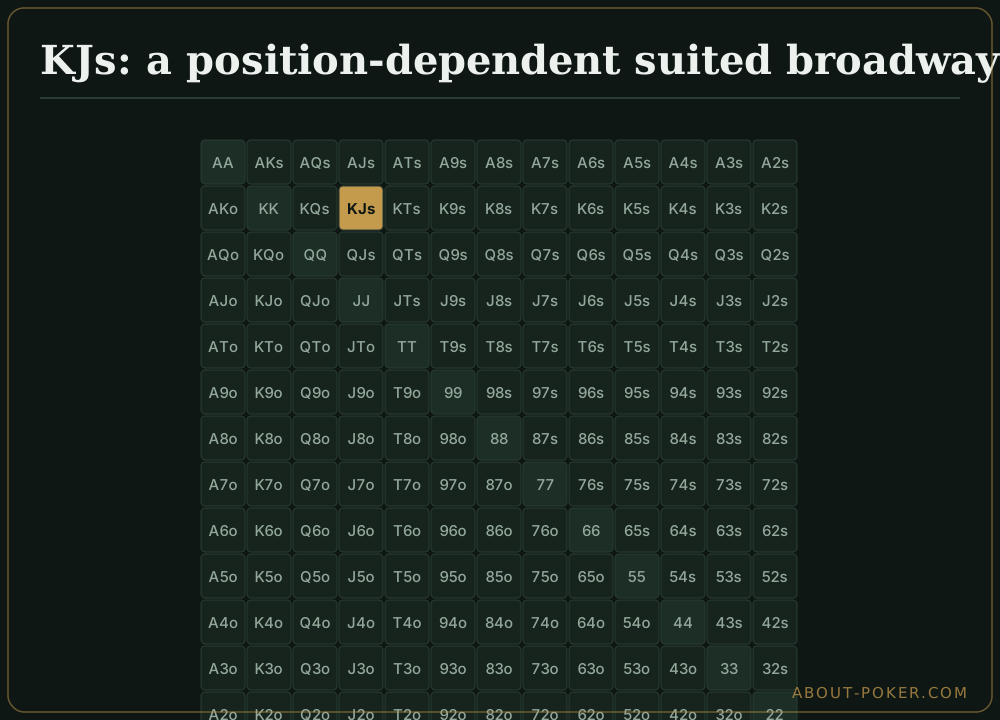
Against late-position opens, KJs makes a good semi-bluff 3-bet. It holds a king and a jack, which block some of your opponent’s strong broadways (AK, KQ, KJ, AJ), and it has a suited body that can flop draws when called. That combination — blockers plus backup equity — is what solvers look for in a light 3-bet range hand.
Against tight early-position raisers, do the opposite: flat or fold. Their opening range is packed with the premiums and dominating broadways you least want to run into, so blasting a 3-bet just isolates you against hands that beat you.
A worked example
You open K♦J♦ from the button to 2.5bb and the big blind calls. The flop comes K♠8♣4♥ — top pair with a jack kicker on a dry board.
Bet for value. Against a big-blind defending range you are ahead of every worse king (KT, K9, K7 suited), all the underpairs, and the many missed hands that floated. Size around a third to half pot to keep those worse holdings in. The hands that dominate you — AK and KQ — are a small part of a wide blind-defense range, which contains far more weak kings and pairs. So value-bet, get paid by the worse Kx, and only slow down if a tight opponent applies real pressure that points at AK or a set. This is the everyday spot where KJs earns: dominating the field, not the top of it.
Playing the draws and respecting domination
KJs shines when it makes its big draws. With Q-T on the board you have the nut straight; on QTx or AQx boards you often hold an open-ender to the nuts, and in your suit you draw to the second-best flush. Those are the hands worth building a big pot around, so barrel your strong draws as semi-bluffs and get value when they complete.
The discipline is the flip side: one pair with the jack kicker is good, not great. On king-high boards you beat most of the range but lose to AK; on jack-high boards your top pair is more fragile against overcards. Against a narrow, aggressive line, be willing to fold what looks like a decent top pair, because the ranges that pile in chips are exactly the ones that have you out-kicked.
Understanding the domination trap
Domination is the single concept that separates winning KJs play from losing it, so it is worth being precise. A hand “dominates” yours when it shares one of your cards and out-kicks you — AK dominates KJ because it holds a king with a better kicker, and any Kx you make top pair against AK is drawing to roughly three outs. The same is true of AJ on a jack-high board and KQ when a queen or king pairs. The trap is that these dominating hands look identical to the many worse hands you beat until the money goes in. Your job is to bet for value against the wide field of worse kings and pairs while folding when a narrow, aggressive line points specifically at the dominating part of the range. Put simply: KJs makes money by beating the field, and loses money by paying off the top of it.
How opponent type changes the plan
Against a loose, station-type player, KJs climbs in value: they call with a huge span of worse kings and pairs, so you value-bet thinly and rarely need to bluff. Against a tight, aggressive regular, respect their raises and barrels — their range is weighted toward exactly the AK, AJ, KQ, and big pairs that dominate you, so a “good” top pair is often a fold when they pile in chips. Against a passive player who rarely raises, you can value-bet with confidence and fold when they wake up with aggression, because their raise almost always means a hand that beats one pair. Reading which of these you face before you commit chips matters more with a dominated hand like KJs than with a hand that is either clearly ahead or clearly behind.
A quick decision checklist
- 6-max, most seats? Standard open; only borderline under the gun.
- Full-ring early position? Often a fold.
- Facing a wide late-position open? 3-bet as a blocker-heavy bluff.
- Facing a tight early open? Flat or fold; do not isolate into premiums.
- Flopped top pair on a dry king-high board? Value-bet the worse kings.
- Flopped a strong straight or flush draw? Barrel as a semi-bluff.
- Facing heavy aggression with one pair? Be ready to fold your kicker.
Play KJs as a strong-but-dominated broadway: open it in position, 3-bet it as a blocker-heavy bluff against wide ranges, flat or fold against tight ones, chase its straight and flush draws hard, and never marry a one-pair hand against a range that beats your kicker.
Frequently asked
Is king-jack suited a good hand?
It is a solid but not premium hand. KJs is a strong suited broadway that opens from most positions and flops well — top pairs, straight draws, and the second-best flush. Its weakness is domination by AK, AJ, KQ, and AA/KK, so it plays better as an open and a selective 3-bet than as a hand you stack off with lightly.
Should you 3-bet KJs?
Selectively. KJs is a good 3-bet-bluff against late-position opens because it has blockers to strong broadways and a suited hand to fall back on. Against tight early-position raisers, flatting or folding is usually better, since their range is heavy with the exact hands that dominate you.
Can you play KJs from early position?
At full-ring early seats KJs is borderline and often folded; in 6-max it is a standard open from most positions except sometimes under the gun. Position matters because KJs is dominated by many of the hands that call an early-position raise, so it prefers spots where it can take initiative in position.