How to Play King-Jack Offsuit (KJo)
KJo is a middling offsuit broadway that opens from middle and late position but folds up front. Learn where KJo plays, when to fold it, and how to play it postflop.
On this page · 6 sections
King-jack offsuit (KJo) is a hand that looks prettier than it plays. Two broadway cards make it tempting, but with no suit and a gap between the cards, KJo relies almost entirely on making top pair — and its top pair is dominated by a long list of hands people love to play. It’s a fine open in the right seats and a trap in the wrong ones, so position and opponent tendencies matter more than the raw two-card strength.
Where KJo belongs preflop
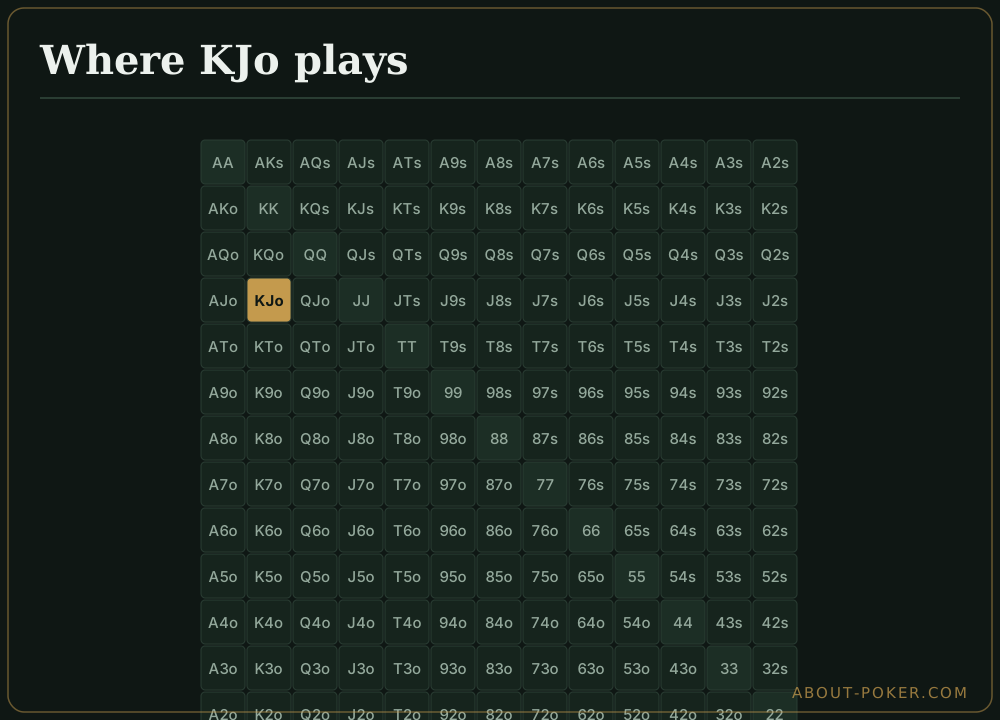
By position, KJo is a middle-and-late open:
- Early position (full ring / UTG at 6-max): fold in tight games. You’re opening into too many players who hold dominating broadways and aces. It’s a borderline open only in loose 6-max pools.
- Middle position: a standard open. The range has tightened enough that KJo fits comfortably.
- Cutoff and button: an easy open. Late position lets you steal blinds and realize equity in position when called.
- Small blind: open (raise) rather than limp when it folds to you.
- Big blind: defend widely against most opens; KJo is a comfortable big-blind call.
For the exact borders, anchor yourself in the preflop opening ranges and see how KJo shifts from an early-position fold to a routine late open in poker ranges by position.
The domination problem
KJo’s weakness is a familiar one for offsuit broadways: domination. When you flop top pair with the king, you’re often behind AK, KQ, or a big pair; when you flop top pair with the jack, AJ, KJ’s better kickers, and QJ can all have you beat. Because it’s offsuit, KJo can’t fall back on a flush, and the K-J gap means it makes fewer straights than connected broadways like KQ or JT.
The practical consequence is that KJo wants to play in position and heads-up, where it can control the pot and get to cheap showdowns. Multiway, out of position, it’s a hand that bleeds chips guessing whether its dominated top pair is good.
Facing a raise
When someone raises in front of you, KJo becomes a call-or-fold hand far more than a 3-bet. Against a tight opener, 3-betting only folds out the hands you beat and gets action from AK, AQ, KQ, and big pairs that crush you. Against a wide late-position opener or in blind-versus-blind, KJo is ahead of the range and can 3-bet for value or as a semi-bluff. The framework for these decisions is covered in defending against 3-bets.
In position with a good price, calling a single raise is fine — you flop top pairs and broadway draws and can realize your equity. Out of position against a tight raiser, folding is usually best.
A worked example
You open K♠J♦ from the button and the big blind calls. The flop comes K♥ 9♣ 5♠ — you’ve flopped top pair, decent kicker.
The big blind checks. You bet for value and protection: a wide big-blind defending range contains many worse kings, nines, and draws that will pay you. The big blind calls. Turn is the 3♦, a blank. You bet again, continuing to charge worse hands and deny equity. River is the 2♣. Now think about what calls a third bet: worse kings, stubborn middle pairs, busted draws that turned into bluff-catchers. A moderate value bet is correct against this wide, capped range — the big blind rarely has KQ or a set here because they’d usually have raised or played back earlier. Top pair in position against a capped range is exactly where KJo makes money.
Contrast that with the same K♥ 9♣ 5♠ flop after a tight UTG player 3-bet you preflop and you called out of position. Now their range is loaded with AK, KQ, and QQ+, and your top pair is a likely loser. Same flop, opposite situation — proceed cautiously and be ready to fold.
Postflop in one paragraph
When KJo flops top pair, bet for value against wide or capped ranges but pot-control against ranges heavy in bigger kickers and sets. When it flops a broadway draw — say a queen-high or ten-high board giving you an open-ender or gutshot to the nuts — it becomes a good semi-bluffing hand. When it flops middle pair or worse, it’s usually a give-up or a one-and-done bluff. The through-line is that KJo makes dominated top pairs, so you win the most by extracting thin value in position and losing the least by not stacking off out of position.
Where to go next
KJo is a solid late-position hand that punishes players who overplay it up front or against strength. Tighten your opens with preflop opening ranges, learn the seat-by-seat borders in poker ranges by position, and connect the framework at the preflop strategy hub.
Frequently asked
Is KJ offsuit a good hand?
KJo is a decent but easily dominated hand. It opens from middle and late position and defends the big blind well, but it's a fold from early position at a full table. Its top pairs are frequently second-best against AK, AQ, KQ, and AA/KK.
Should I 3-bet with KJ offsuit?
Only against wide ranges. KJo can 3-bet a loose late-position opener or in blind vs blind, where you're ahead. Against a tight early open it's usually a fold, because 3-betting only isolates you against the hands that dominate it.
Can I call a raise with KJ offsuit?
In position with a good price you can call a single raise, since KJo flops top pairs and broadway draws. Out of position against a tight raiser it's often a fold — you'll be dominated too often and struggle to realize your equity.