How to Play Queen-Seven Offsuit (Q7o)
Queen-seven offsuit is a bottom-of-range button steal and mostly a fold. Learn the few spots where Q7o opens, why it flops dominated pairs, and when to muck it.
On this page · 7 sections
Queen-seven offsuit (Q7o) is one of those hands that looks like it has “two big-ish cards” and mostly costs money. The queen is a high card, but a seven kicker with no flush and a two-gap in the middle makes Q7o a hand that flops dominated pairs and weak draws. There is a sliver of a spot where it opens — a button steal against tight blinds — and outside that sliver it is a fold. The main skill with Q7o is not overrating the queen.
Where Q7o belongs
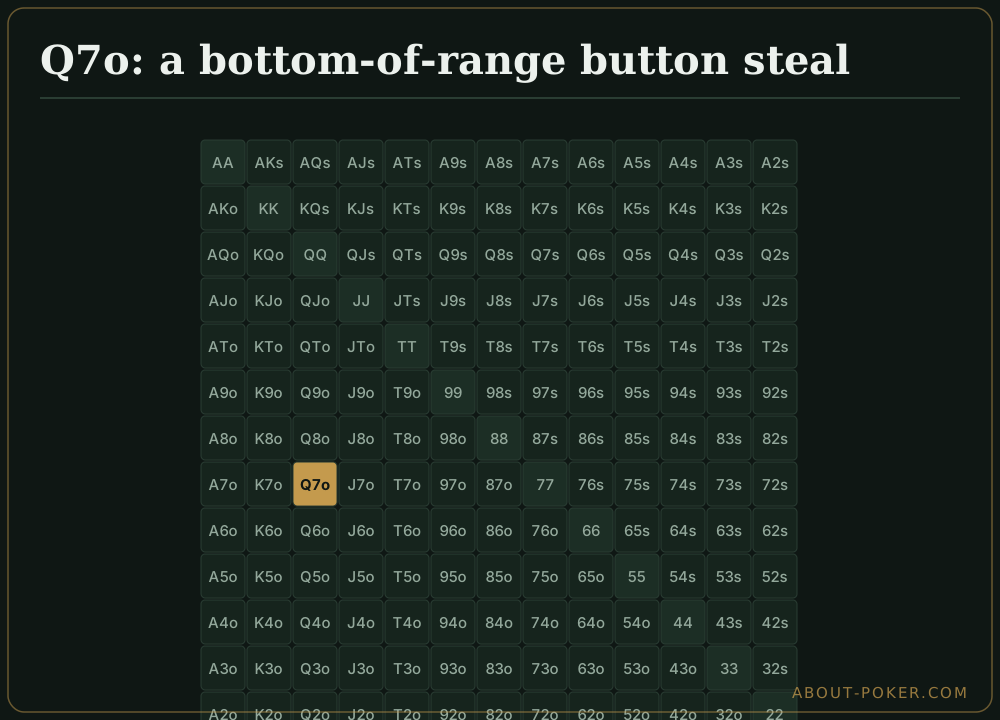
Q7o is a button steal at the very bottom of the range. Open it only from the button, and only when the blinds fold too much, so that the value comes from picking up dead money rather than from showing down. In practice it sits at the edge of your preflop opening ranges — a hand you open for fold equity, dropped entirely against sticky blinds.
From the cutoff and everything earlier, fold it at a full-ring or 6-max table. Too many hands left to act have Q7o dominated, and it plays poorly out of position. This is exactly what poker ranges by position captures: two cards that are a thin button open and an easy fold from every earlier seat.
Why the gap and kicker hurt
Q7o’s problem is that its made hands are almost all second-best. Flop a queen and you likely run into QT, QJ, KQ, or AQ — every one of them outkicks your seven. Flop a seven and you have a soft middle pair that folds to a bet. The one-and-a-half-gap between the cards also means Q7o rarely makes a strong straight draw; a Q-7 needs very specific boards to connect for a big draw.
So Q7o is a small-pot-only hand. Open it to steal, bet a made pair once for thin value if you must, and never build a big pot with it. It is not a 3-bet candidate: it has no value that wants to inflate the pot and no flush to make it a credible bluff.
Defending the blinds with Q7o
Q7o can appear at the very bottom of your big-blind defending range against a min-raise steal, where the pot odds are generous and the queen dominates the weakest hands in a wide opening range. This is the same blind defense logic used with any marginal hand — you call the cheap price to see a flop and play carefully after. Against a normal 2.5x open, or from the small blind, Q7o is usually just a fold.
A worked example
You open Q7o on the button to 2.5 big blinds and the big blind calls. The flop comes Q-9-4 rainbow. Top pair, weak kicker — the trap flop. You bet a third of the pot and get called. Against a range with Q9, Q4, 99, 44, better queens, and gutshots, your seven kicker is behind much of what continues. Bet once for thin value, then check or fold to pressure. The instinct to “protect” top pair by firing three streets is exactly how Q7o loses a pot it should have kept small.
If the board misses you completely — say A-K-5 — a single continuation-bet as a bluff can work because your hand has no showdown value anyway. But the default with Q7o is restraint: steal when you can, give up when you meet resistance, and never let a dominated queen cost you a stack.
How the spot changes by stack depth and format
Q7o’s thin edge is entirely situational, so the surrounding conditions decide whether it is even a hand.
- Deep stacks (100 big blinds and up). This is where Q7o is at its worst. Deep play magnifies domination: the times you flop top pair and get action, you are usually the one being value-owned by a better queen. Keep the open frequency low and give up quickly postflop.
- Short stacks (roughly 10 to 18 big blinds). In tournaments, Q7o improves as a button or small-blind open-shove because you remove postflop domination entirely and win the blinds and antes uncontested a healthy share of the time. A queen-high hand with a live seven is comfortably inside many short-stack shoving ranges even though it is a fold with a deep stack.
- 6-max vs. full ring. In 6-max the button faces only two blinds and the open is more defensible. In full-ring the ranges behind you are tighter and stronger on average, so even the button steal tightens up and Q7o often drops out.
The domination math, made concrete
The reason Q7o loses money when played too widely is worth quantifying. When you flop a pair of queens, count the hands in a typical calling range that beat you: AQ, KQ, QJ, QT all have you outkicked, and Q>7 in the opener’s range dominates you at showdown far more often than you dominate them. Your seven only “wins the kicker” against Q6, Q5, Q4, Q3, Q2 — hands most players would not have called or opened with. So the realistic split on a queen-high flop is that your top pair is behind or tied against most of the queens you get action from. That is the definition of a trap hand, and it is exactly why the plan is one thin value bet and then restraint.
A three-line checklist
- Button, folded to me, blinds fold too much? A low-frequency open is fine. Otherwise fold.
- Facing a raise? Fold — or, at most, a bottom-of-range big-blind call at a great price. Never 3-bet.
- Flopped a queen? Bet once for thin value, then keep the pot small and fold to aggression.
Frequently asked
Can you open queen-seven offsuit?
Only from the button, and only against blinds that fold too often. Even there Q7o sits at the very bottom of the opening range. From the cutoff and everything earlier at a full table it is a straightforward fold — too many hands behind you dominate it.
Should you 3-bet Q7o?
No. It has no value that wants a bigger pot and, without a flush, it is a poor bluff as well. Against a raise, Q7o is either a fold or, at most, a bottom-of-range big-blind defend.
Why is Q7o so weak?
Because both of its likely top pairs are dominated. Flop a queen and QT, QJ, KQ, AQ have your kicker beaten; flop a seven and you have a weak middle pair. With no suit and a gap between the cards, it makes second-best hands and thin draws.