How to Play Ten-Three Suited (T3s)
Ten-three suited is a fold from almost every seat. Learn why T3s is a trap hand, the one cheap big-blind spot where it is defensible, and how to play it postflop.
On this page · 7 sections
Ten-three suited (T3s) is one of the weakest hands in the deck that still has a suit going for it. It is a wide four-gapper — the ten and three are miles apart — with a bottom kicker, so it makes almost no straights, very weak top pairs, and only the occasional flush. For nearly every decision you will ever face, the correct play with T3s is to fold. This article is mostly about why that is true, and about the one narrow exception.
Where T3s belongs (basically nowhere)
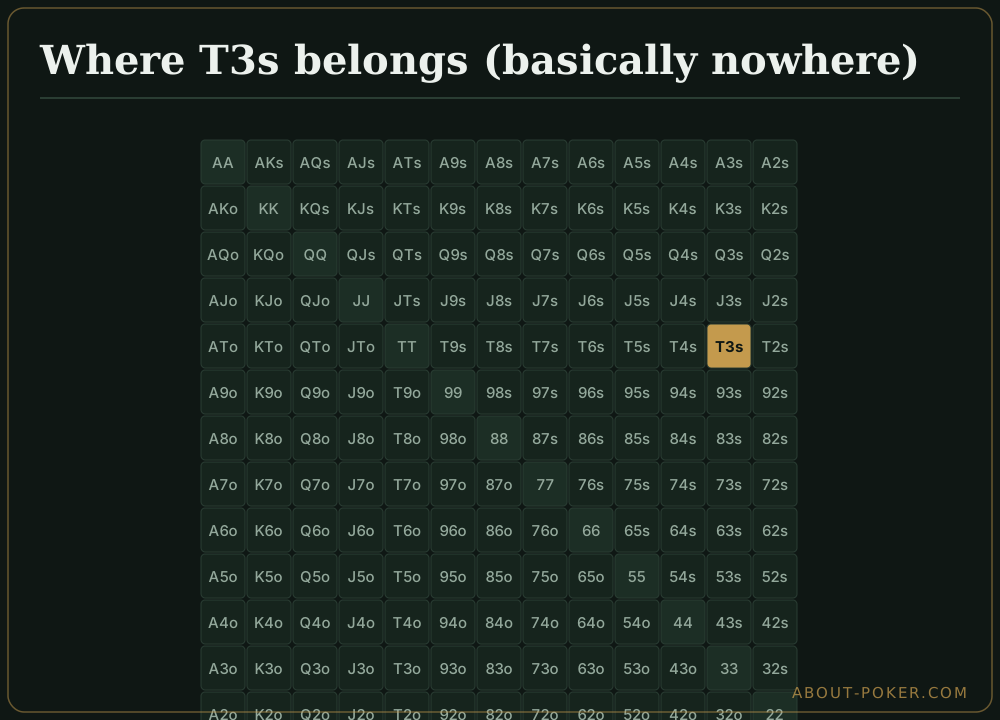
T3s is not an opening hand from any position. Early, middle, cutoff, and button ranges all leave it out in any sound strategy. Unlike a suited connector or a suited ace, T3s does not have the connectivity or the kicker strength to steal profitably even from the button. It sits well outside the widest preflop opening ranges, and raising it is simply spewing chips.
If you have seen T3s appear on some very loose range charts and wondered whether you should be opening it, the answer is no — those are outliers, not standard play. Poker ranges explained covers how to tell a genuine bottom-of-range hand from a hand that just does not belong in the range at all. T3s is the latter for opening purposes.
The one defensible spot
The only place T3s is even arguable is big-blind defense against a small raise at a great price. When you are closing the action and getting a big discount, you can defend an extremely wide range, and T3s scrapes in at the very bottom because it costs almost nothing to see a flop and can flop a flush draw. This is the outer boundary of wide blind defense — you are calling on price alone, not on the hand’s merit.
The discipline here is absolute: continue only on a strong draw or a big made hand, and fold everything else on the flop. No floating, no bluffing a ten-high, no calling raises on later streets without real equity.
A worked example
You defend T3s (Th-3h) in the big blind against a min-raise. The flop is Kh-7h-2c. You have a flush draw — nine hearts complete it — which is roughly 35% equity by the river against one pair. That is a real hand to continue with: check-call and play for your flush.
Now the ordinary outcome: the flop is Qs-9d-5c. Ten-high, no pair, no draw. Check and fold, instantly. And even when you pair your ten — say the flop is Td-8c-4s — you have top pair with the worst possible kicker, a hand that is dominated by any better ten and hard to get value with. That is why T3s makes so little even when it “hits”: its best pairs are still weak.
Why “suited” fools so many players
The single most common leak with a hand like T3s is treating the shared suit as a green light. It is worth being precise about how little the suit is actually worth. Two suited cards flop a flush draw only about 11% of the time, and complete a flush by the river only around 6.5% of the time when you do not already have four to a flush on the flop. Being suited adds roughly two to four percentage points of raw equity over the offsuit version of the same hand — real, but nowhere near enough to turn a fold into a raise. When you also make the flush, a ten-high or three-high flush can still lose to a bigger one, so even the payoff card is not a guaranteed winner.
Put differently: the suit is a small tiebreaker on an already losing hand. It nudges T3s from “unplayable” to “unplayable except at a bargain price.” It never promotes it into an opening hand.
How T3s compares to nearby hands
It helps to see where T3s sits relative to hands people actually do play, so you can calibrate the fold.
- T3s vs. T7s. Both are suited tens, but T7s is only a three-gapper and its seven kicker and connectivity make far more straights and stronger pairs. T7s can be a legitimate button steal; T3s cannot.
- T3s vs. 43s. The suited connector 43s is weaker in high-card strength but far better connected, so it makes many more straights and plays its equity more smoothly. Small connectors beat wide-gap tens for the same “cheap flop” role.
- T3s vs. A3s. The suited ace has the nut-flush blocker, can make top pair with a strong kicker, and opens several seats earlier. T3s has none of that upside.
In every comparison T3s comes out behind, which is exactly why it sits below the opening threshold that all of these hands clear.
A short decision checklist
- Am I being asked to open or cold-call T3s? Fold — always.
- Am I in the big blind, closing the action, at a big discount? A call is optional and bottom-of-range only.
- On the flop, do I have a flush draw, an open-ended straight draw, or a strong made hand? If not, fold to any bet.
- Did I only pair my ten with the three kicker? Treat it as a weak, pot-control hand and never build a big pot.
Bottom line on T3s
T3s is a fold in essentially every situation. Do not open it from any seat, do not cold-call raises with it, and treat big-blind defense as optional and price-driven only. When you do end up seeing a flop with it, chase real draws and fold your air without hesitation. The value of studying a hand this weak is the lesson it teaches: being suited is not a reason to play. Cut hands like T3s from your range and you eliminate one of the classic low-stakes leaks.
Frequently asked
Should you play ten-three suited?
Almost never. T3s is a fold from every opening seat, including the button in most solid ranges. It is a wide four-gapper with a bottom kicker, so it makes very few straights and weak top pairs. Being suited is its only asset.
Is T3s ever a call?
Only in the big blind against a small raise at a very generous price, and even then it is optional and at the very bottom of your range. It wants a cheap flop, a strong draw, and a fast fold when it misses.
Why is T3s worse than most suited tens?
The gap between the ten and the three is huge, so straights are rare, and the three is a bottom-tier kicker that loses nearly every showdown. Compared to T7s or T6s, T3s makes far fewer strong hands and has almost no showdown value.