How to Play Pocket Eights (88)
Pocket eights is a solid but tricky middle pair that sets-mines against raises and flops overcards half the time. Learn how to play 88 preflop and postflop.
On this page · 7 sections
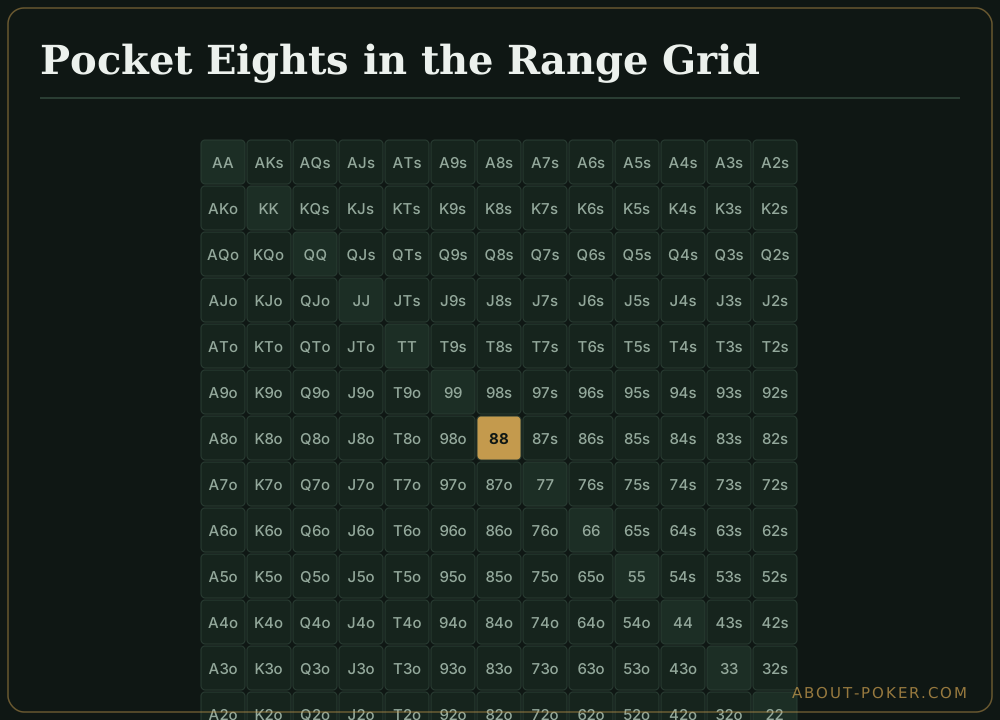
Pocket eights (88) is a genuine pocket pair, which already puts it ahead of most starting hands, but it’s a middle pair — right at the seam between the pairs you play for value and the pairs you play to flop a set. It’s a comfortable favorite against two random overcards, yet the flop brings at least one card higher than an eight about three times out of four. That tension defines the hand: 88 opens everywhere, but how you continue depends entirely on the board and the strength of the opposing range.
Where 88 belongs preflop
Unlike the weak offsuit hands, 88 is strong enough to open from every seat:
- Early through late position: a standard open. It’s ahead of a huge chunk of the field and makes money by opening.
- Small blind: open (raise) when it folds to you.
- Big blind: defend widely; 88 is near the top of your defending range.
The interesting decisions come when someone raises before you or over you. For the seat-by-seat opening borders, anchor to the preflop opening ranges — 88 is comfortably inside all of them.
Set-mining versus 3-betting
When you face an open, 88 has two good options and the right one depends on the opener’s range:
- Against a tight early-position raise, 88 is often behind — it’s up against a range heavy with bigger pairs (99–AA) and AK. Here, calling to set-mine is usually better than 3-betting. You’re not thrilled to build a big pot when you’re likely behind; instead you call, and if you flop a set (about 11.8% of the time), you win a large pot. 3-betting just isolates yourself against the hands that beat you.
- Against a wide late-position open, 88 is ahead and can 3-bet for value, folding out overcards and getting called by worse. It can also mix in as a light 3-bet.
This “call the tight range, attack the wide one” logic is the same principle that governs the middle pairs generally. Compare how pocket jacks — a higher but still overcard-prone pair — navigates the same trade-off, and lean on defending against 3-bets when it’s your open that gets attacked.
How stack depth changes the plan
Set-mining only pays when the stacks are deep enough to reward the times you hit. The standard guide is the “rule of 10 to 20”: you want to be able to win at least 10 to 20 times your preflop call when you flop a set, because you only flop it about one time in eight. At 100 big blinds deep, calling a 3-bet with 88 to set-mine is comfortable — the implied odds are there. At 40 big blinds, the same call is far worse, because even stacking your opponent barely covers the times you miss and fold. As stacks get shorter, 88 shifts from a set-mine to more of a get-it-in-or-fold hand: at 15 to 20 big blinds it becomes a straightforward re-shove over a late-position open, since you can no longer play a deep postflop game and your raw equity as a favorite over most shoving ranges does the work.
Position multiplies all of this. In position you realize more of your equity, control the size of the pot on overcard flops, and get an extra street of information before committing. Out of position — especially defending from the blinds — 88 is harder to play, so you lean more on flatting and pot control and less on speculative bluff-3-bets.
Reading the opponent type
The single biggest input to how you play 88 preflop is the range you are up against, so classify your opponent before you act. Against a tight, nitty regular who only 3-bets TT+ and AK, treat 88 as a pure set-mine or a fold — do not war with a range that has you dominated. Against a loose-aggressive player who 3-bets a polarized range full of bluffs, 88 climbs sharply in value: you can call down lighter and even 4-bet-bluff or 4-bet for thin value in some spots, because a big chunk of their range is worse than your pair. Against a calling station who never folds preflop, lean toward set-mining and straightforward value — your fold equity is gone, so stop bluffing and start hitting.
A quick decision checklist
- Facing an open? Wide late-position raise: 3-bet for value or flat. Tight early raise: flat to set-mine or fold if too shallow.
- Deep (80bb+)? Prioritize set value and pot control.
- Short (under ~25bb)? Get it in over wide ranges; fold to obviously stronger ones.
- Flopped a set? Build the pot — you are ahead of overpairs and top pair.
- Flopped an underpair on a high board? One street of value at most; do not stack off.
Playing the overcard flops
The hard part of 88 is the two-thirds-plus of flops with an overcard. On a board like K-7-3, your eights are now an underpair, and you have to decide whether one bet’s worth of continuation is enough or whether to control the pot. The rule of thumb: bet or continue when the overcard is unlikely to have helped your opponent and you have position; slow down and pot-control when the board is high and coordinated. Don’t turn a modest pair into a big pot without a set.
A worked example
You open 8♣8♦ from the cutoff, and the button — a tight regular — 3-bets. You know his 3-betting range is mostly TT+ and AK. Against that, 88 is a small underdog and out of a big-pot future, so flatting to set-mine is cleaner than 4-betting into a range that crushes you. You call. The flop comes 8♠ 5♥ 2♦ — you’ve flopped a set. Now the pot-building begins in your favor: you’re ahead of his overpairs, and you can get stacks in. Against those exact overpairs, note the preflop math — 88 is roughly a 19% underdog to a bigger pair (e.g., 88 vs QQ ≈ 19% / 81%) — which is precisely why you’d rather see a cheap flop and win big when you hit than commit chips while behind.
Open 88 from everywhere, choose set-mining against tight ranges and value 3-bets against wide ones, and respect the overcard flops. It’s a solid, honest hand — as long as you don’t confuse it with a premium.
Frequently asked
Is pocket eights a good hand?
88 is a solid middle pocket pair that opens from every position and is a comfortable favorite against two overcards. Its weakness is that it flops an overcard most of the time, so it plays more like a set-mining and pot-control hand than a premium.
Should I 3-bet with pocket eights?
Sometimes. 88 can 3-bet for value against wide late-position opens and works as a light 3-bet or set-mining call against tight ranges. Against a very tight early open, calling to set-mine is often better than 3-betting into a range full of bigger pairs.
How often does pocket eights flop a set?
About one time in eight — roughly 11.8% of flops give you a set or better. That is why set value is central to how you play 88 when the pot could get big against stronger ranges.