99 Poker Nickname & Meaning
99 — pocket nines — is nicknamed Wayne Gretzky, Phil Hellmuth, or the German Virgins. Here's where the names come from and how to play pocket nines.
On this page · 7 sections
99 is poker shorthand for pocket nines — two nines in the hole. It’s a genuine middle pair: strong enough to raise for value, but low enough that plenty of higher cards can hit the board. It also carries some of the most fun nicknames in the game.
Wayne Gretzky — and the other names
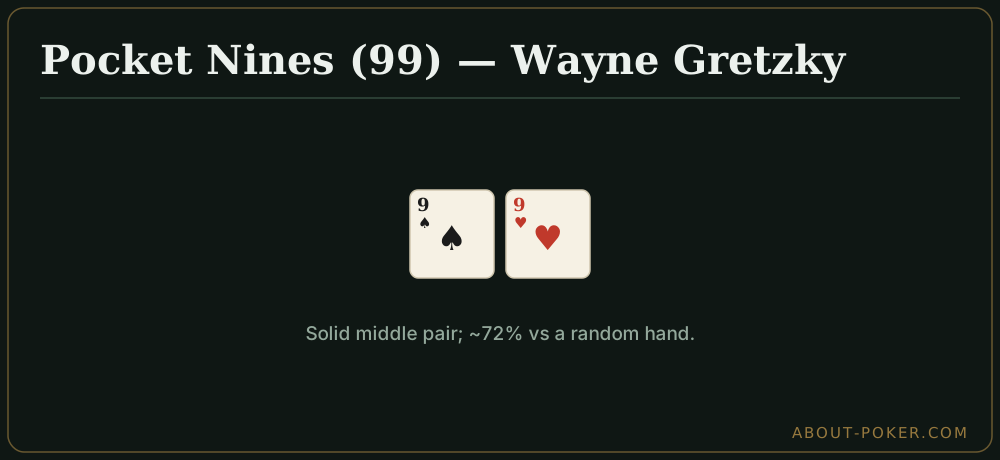
The best-known nickname for 99 is Wayne Gretzky, after the hockey legend who wore jersey number 99. A few others you’ll hear:
- Phil Hellmuth — the poker Hall of Famer whose signature “lucky” hand is nine-nine.
- The German Virgins — a pun on the German word “nein, nein” (no, no).
- Popeyes — an older, playful nickname.
- The Nines — plain and always understood.
Wayne Gretzky and Phil Hellmuth are the two you’ll hear most at the table.
How strong is 99, really?
Pocket nines is a solid middle pair. It beats every lower pair and every unpaired hand before the flop, winning about 72% of the time against a random holding. The catch is the number of ranks above it: there are five — ten, jack, queen, king, and ace.
With five overcard ranks live, at least one higher card will appear on the flop the large majority of the time. So nines rarely flop an overpair. Much of their profit comes instead from flopping a set — which happens roughly 11.8% of the time with any pocket pair — or from applying pressure before the flop and controlling the pot afterward.
Worked example: nines in a 3-bet pot
You open with 9♠ 9♦ and a tight player 3-bets. You choose to call in position. The flop comes Q♥ 7♣ 3♠.
Your nines are now an underpair to the queen. Against a tight 3-bettor’s range — which is packed with big cards and overpairs — this is a bluff-catcher at best. If your opponent continuation-bets and keeps firing, folding is often correct. But the story changes completely on a flop like 9♣ 5♦ 2♥: you’ve flopped a set and can play for stacks.
That’s the essence of pocket nines. Against strong ranges they’re vulnerable to overcards, so you lean on set value and disciplined pot control. Against weaker, wider ranges you can play them more aggressively as the best hand. The full decision tree lives in how to play pocket nines.
Set-mining math with nines
Because nines flop an overpair so rarely, a big slice of their long-run profit comes from flopping a set and stacking a worse hand. It helps to know the arithmetic. Any pocket pair flops a set — or better — about 11.8% of the time, or roughly one in 8.5 flops. That’s the “one-in-8.5” rule worth memorizing.
The practical consequence is a rule of thumb called set-mining: when you’re calling a raise primarily hoping to flop a set, you want the implied odds to justify it. A common guideline is that you’d like the effective stacks to be at least 10 to 15 times the size of the call, because you only hit one in 8.5 times and you won’t always get paid when you do. With nines this matters less than with small pairs, because nines also make a strong overpair on low flops and can occasionally win unimproved. But whenever you flat a 3-bet with them out of position, set value is doing much of the heavy lifting, and thin implied odds are a reason to fold instead.
How nines change by stack depth
Stack depth reshapes the whole plan. Deep — say 150 big blinds or more — nines lean harder toward set-mining and pot control, because a single set can win an enormous pot and the downside of an overpair getting stacked by a bigger pair is severe. You call more, 3-bet a touch less for value, and avoid bloating pots with a hand that’s often an underpair by the river.
Short — 20 big blinds or fewer, common in tournaments — nines flip toward outright aggression. Now there’s little room to maneuver postflop, so their raw equity as a top-of-the-deck pair takes over. Nines become a strong open-shove and a happy call against most shoving ranges: against a random hand they’re a 72% favorite, and even against two overcards like AK they’re a slight favorite in the classic race. The shallower you get, the more you simply want to get the money in before the flop and let the pair race.
Using the term at the table
You’ll hear these nicknames in lines like “picked up the Gretzkys and flopped a set,” or “had nine-nine, the German Virgins, and the flop came all high.” Say “nines” or “the Gretzkys” and everyone knows the hand.
Nines are the pair where discipline pays. Raise them before the flop, set-mine when the price is right, and don’t fall in love on high boards. For the complete strategy, see how to play pocket nines, and browse more table talk in the poker slang guide.
Keep going
99 is the fun-nicknamed middle pair that rewards good judgment. Learn more vocabulary in the poker terms glossary, explore colorful table talk in poker slang explained, and master the play in how to play pocket nines.
Frequently asked
What is the nickname for pocket nines (99)?
Common nicknames include Wayne Gretzky (who wore number 99), Phil Hellmuth (whose signature hand is 9-9), and the German Virgins (a play on 'nein, nein').
Why is 99 called Wayne Gretzky?
Because the hockey legend Wayne Gretzky famously wore jersey number 99. The pair of nines borrowed his number as a nickname.
How strong is 99 in poker?
Pocket nines is a solid middle pair. It beats all lower pairs and unpaired hands before the flop, but it must contend with five higher ranks, so overcards flop often.
Should you play pocket nines aggressively?
Usually yes before the flop — raising or often 3-betting is standard. After the flop, nines play best as a set-mining and pot-control hand because higher cards appear frequently.