How to Play Pocket Nines (99)
Pocket nines are a strong middle pair that open from any seat but face constant overcards. Learn how to raise, call 3-bets, set-mine, and play 99 postflop.
On this page · 6 sections
Pocket nines (99) are a strong middle pair — clearly ahead of a random hand, always worth opening, but caught in the awkward zone where overcards arrive on most flops. They win about 72% heads-up against a random hand, yet they are only a pair of nines, so the way you play them depends heavily on whether you are the aggressor and what the board brings. Handled well, 99 is a reliable earner; handled carelessly, it turns into an overpair you overvalue.
Where 99 belongs preflop
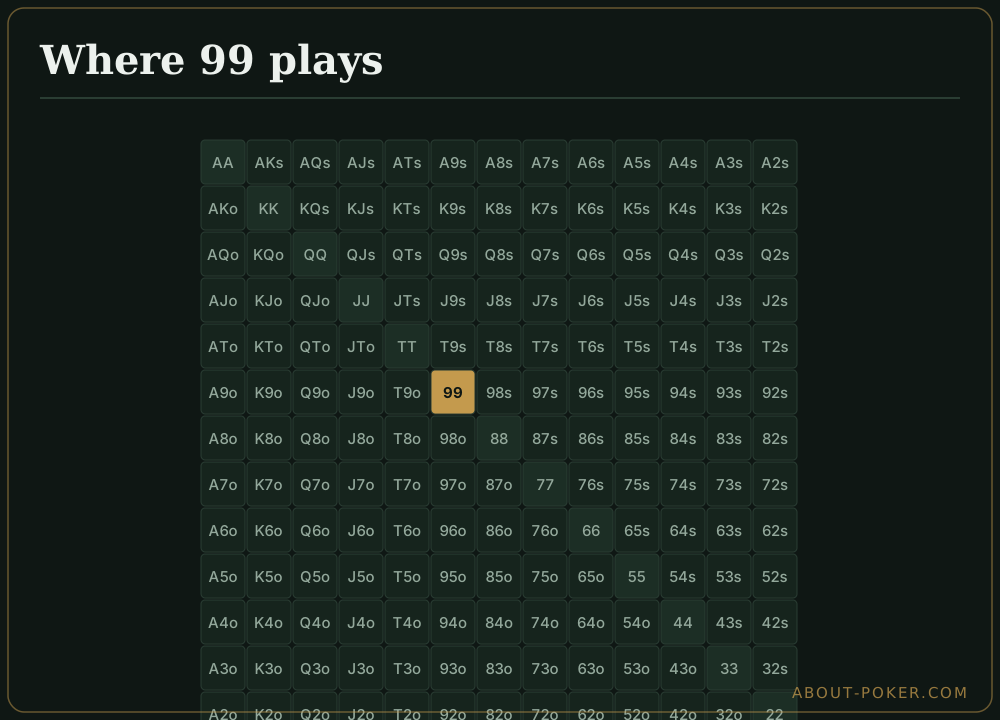
By seat, pocket nines are a comfortable open from everywhere:
- Early and middle position: open (raise). 99 is strong enough to lead the pot from any seat, though it plays more cautiously than the big pairs when it gets action.
- Cutoff and button: a clear open, and one of the pairs you are happy to play a bigger pot with in position.
- Small blind: open as a raise against folded action.
- Big blind: defend widely and re-raise selectively against late steals.
Because 99 opens universally, the more interesting decisions come when someone raises before you. Ground the opening logic in the preflop opening ranges and compare how the bigger pairs behave in how to play pocket jacks.
Facing a raise: call, set-mine, or 3-bet
Pocket nines have three useful responses to an open:
- Call: the default against most opens, especially in position. You keep the pot manageable, realize your pair equity, and retain the chance to flop a set.
- Set-mine: when stacks are deep and the raiser is likely to pay off, calling purely to flop a set is profitable. You flop a set roughly one time in eight (about 11.8%), so you want deep implied odds — around 15-to-1 — to justify a call made only for the set.
- 3-bet: an occasional value/semi-bluff line against late-position opens. Against a tight early raiser, prefer calling; 3-betting invites a 4-bet that pushes 99 off a chunk of its equity. See how these decisions fit together in the 3-bet range breakdown.
The overcard problem
The recurring challenge with 99 is that overcards flop often. Any ten, jack, queen, king, or ace on board gives an opponent a chance to have paired higher than your nines. On a large share of flops at least one overcard appears, which means your overpair is frequently no longer the best hand.
This is why 99 is a pot-control hand more than a stack-off hand when you miss the set. When you flop an overpair on a board like 9-high or lower, you can bet with confidence. When the board comes with two or three overcards, your pair of nines is often reduced to a bluff-catcher, and your job is to keep the pot small rather than pile chips into a spot where you are frequently behind.
A worked example
You open 9♠9♦ from the cutoff and the button calls. The flop comes 9♣ 6♥ 2♠ — you have flopped a set of nines, the payoff card for playing pocket pairs.
This is a dry, disconnected board where your set is nearly always best. You bet for value, and the button calls with a pair or a floating hand. The turn is the K♦; you bet again, and now you might even get paid by a king that just improved. The river is the 3♣, and you size up for value one more time. A flopped set on a dry board is the whole reason you set-mine — you win a big pot from hands that would never have paid off if you had 3-bet preflop and scared them away.
Contrast that with a flop of Q♥ J♣ 7♦ against the same caller. Now your nines are an underpair to two overcards; against a range that connects with this board, 99 is a check-and-evaluate hand, not a build-the-pot hand.
Postflop in one paragraph
When 99 flops a set, it is a monster on most textures — bet for value and be willing to stack off, slowing only on the most coordinated boards. When it flops an overpair (board all lower than nine), bet for value with confidence. When overcards appear, treat 99 as a bluff-catcher: control the pot, do not commit stacks, and be ready to fold to sustained aggression. The single biggest leak with pocket nines is treating an underpair to the board like a premium overpair.
Where to go next
Pocket nines are a universal open and a strong set-mining candidate, but a middle pair that respects overcards. Compare the higher pairs in how to play pocket jacks, tighten your opens with preflop opening ranges, and connect it all through the preflop strategy hub.
Frequently asked
Are pocket nines a good hand?
Yes, 99 is a solid hand — it is roughly a top-8% holding and wins about 72% heads-up against a random hand. It opens from every seat and calls many 3-bets, but it is a middle pair, so overcards on the flop are common and you should not marry it as an overpair.
Should I 3-bet pocket nines?
Sometimes. 99 works as an occasional value 3-bet against late-position opens and as a call against opens from any seat. Against a tight early-position raiser it is usually a call or set-mine rather than a 3-bet, because it does not want to bloat the pot and get 4-bet off its equity.
What is set-mining with pocket nines?
Set-mining means calling a raise cheaply, hoping to flop a set (three nines) and stack an opponent. You want to be roughly 15-to-1 deep in implied odds to call purely for the set, since you flop a set only about one time in eight, so set-mining pays off best when stacks are deep.