JJ Poker Nickname & Meaning
JJ — pocket jacks — is nicknamed Fishhooks, Hooks, or the Brothers. Here's where the names come from and why jacks are poker's most frustrating pair.
On this page · 7 sections
JJ is poker shorthand for pocket jacks — two jacks in the hole and one of the most notorious hands in Texas Hold’em. It’s genuinely strong yet famous for causing headaches, and it has earned some memorable nicknames along the way.
Fishhooks — and the other names
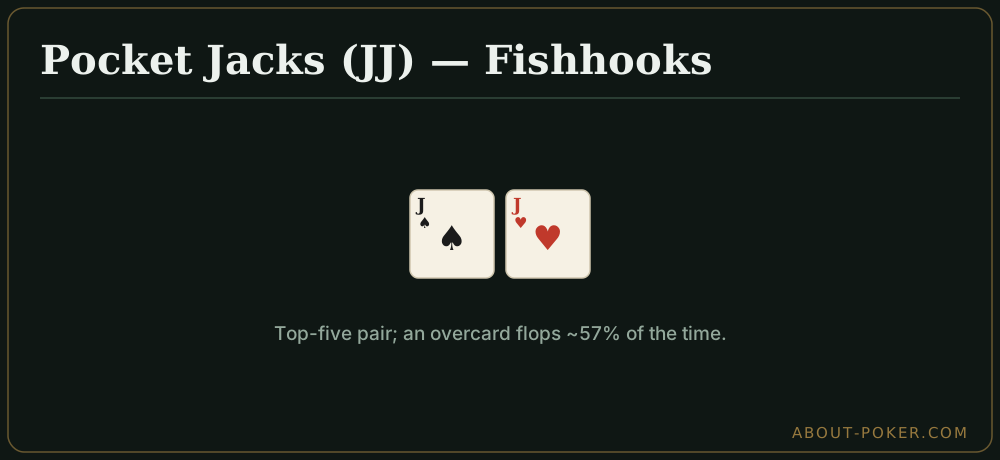
The signature nickname for JJ is Fishhooks, or just Hooks. The reason is visual: the letter J curves like a fishhook, and two of them look like a matched pair of hooks. Other names you’ll hear:
- The Brothers — two jacks, like a pair of siblings.
- Jaybirds — a play on the J sound.
- Kid Dyn-o-mite — an older, playful nickname.
- The Jacks — plain and always understood.
Fishhooks is by far the most common at the table.
How strong is JJ, really?
Pocket jacks is a premium pair — it ranks inside the top five starting hands and crushes every lower holding before the flop. Against a random hand it wins about 77% of the time. The problem isn’t the hand’s raw strength; it’s what happens after the flop.
There are three ranks above a jack — ace, king, and queen. If your opponent could hold any of them, at least one overcard will appear on the flop roughly 57% of the time — more often than not. That single statistic explains the hand’s whole reputation: you flop an overpair less than half the time, so jacks constantly force uncomfortable decisions.
Worked example: jacks meet an overcard
You raise with J♥ J♠ and get one caller. The flop comes A♦ 8♣ 3♥.
This is the classic jacks dilemma. You still have a pair, but the ace is exactly the card you feared. A continuation bet may still be correct — many opponents float with hands that missed — but if you get raised or called down on an ace-high board, your jacks are often behind. Contrast that with a flop of 9♠ 6♦ 2♣: now your jacks are a strong overpair and you can bet for value with confidence.
The lesson: jacks are strong preflop but demand a plan for the majority of flops that bring a higher card. Getting the pre-flop action right — often 3-betting rather than flat-calling — keeps you from playing a bloated pot out of position with a hand that dislikes overcards. See the full approach in how to play pocket jacks.
Why jacks earned their frustrating reputation
The word “frustrating” attaches to jacks for a specific mathematical reason, not superstition. Consider the three ways a jacks hand typically goes wrong. First, the overcard flop: an ace, king, or queen arrives, and now any opponent holding one of those cards has you beaten with a single pair. Second, the set-under-set trap: when you do flop a set of jacks, a player with queens, kings, or aces who also flops a set beats you, and you rarely see it coming. Third, the cooler preflop: when the money goes in before the flop against a wider range, jacks are only a slight favorite against overcard hands like ace-king (about 57 to 43) and a big underdog to the higher pairs. None of these are flaws in the hand — they are simply the price of holding the fourth-best pair in a game where three higher ranks exist.
Set that against how a lower pair like pocket sevens behaves. Sevens flop an overpair almost never, so you already expect to be cautious and the hand rarely surprises you. Jacks flop an overpair a little under half the time, so they feel like they should win — and that mismatch between expectation and result is exactly what makes them sting.
How to play them depends on the action in front of you
The single biggest adjustment with jacks is reading the strength of the action before you commit chips. When you open-raise and everyone folds to a single caller in position, jacks are usually the best hand and you play them straightforwardly for value. But the calculus changes with pressure:
- Facing a raise then a re-raise (a squeeze or 4-bet): jacks lose value fast, because the ranges that keep re-raising are weighted toward queens-plus and ace-king. Against a very tight 4-bettor, jacks are often just a call or even a fold at deep stacks.
- Against a loose, aggressive opponent: jacks gain value, because that player’s re-raising range includes many worse pairs and non-pair bluffs. Here you get the money in happily.
- Multiway: the more players in the pot, the more likely someone holds an ace, king, or queen, so jacks shed value quickly and prefer a raise that thins the field.
This is why “3-bet rather than flat-call” is the common advice: raising narrows the field, denies overcards a cheap look at the flop, and often takes the pot down before the board can bring the card you fear.
Using the term at the table
You’ll hear Fishhooks in lines like “I had the Hooks and the flop came ace-high, story of my life,” or “raised with jacks and finally the board stayed low.” Say “jacks,” “the Hooks,” or “Fishhooks” and everyone knows the hand.
Jacks are the pair that separates disciplined players from tilters. Play them aggressively before the flop and stay alert to overcards after it. For the complete strategy, see how to play pocket jacks, and browse more table talk in the poker slang guide.
Keep going
JJ is the strong-but-frustrating pair every player knows well. Learn more vocabulary in the poker terms glossary, explore colorful table talk in poker slang explained, and master the play in how to play pocket jacks.
Frequently asked
What is the nickname for pocket jacks (JJ)?
The most common nickname is Fishhooks, because the letter J is shaped like a fishhook. You'll also hear Hooks, the Brothers, and Jaybirds.
Why are jacks called Fishhooks?
Because the curved shape of the letter J resembles a fishhook. Two jacks side by side look like a pair of hooks, and the name stuck.
How strong is JJ in poker?
Pocket jacks is a strong hand — a top-five starting pair — but it's tricky because three higher cards (ace, king, queen) can appear on the board, which happens on more than half of all flops.
Is JJ a good hand?
Yes, jacks are a premium pair and almost always worth raising. Their reputation for being frustrating comes from how often an overcard flops, not from any weakness before the flop.