K9 Poker Nickname & Meaning
K9 is nicknamed the Canine (or Dog/Fido). What king-nine means, where the nickname comes from, and why this king is a classic domination trap.
On this page · 8 sections
K9 — king-nine — is nicknamed the Canine, a pun on the K-9 police-dog designation. It comes with a whole kennel of alternates — the Dog, Fido, Mongrel, Rex — all built on the same joke. Behind the playful name sits a genuine trap: K9 is exactly the kind of king that looks strong and quietly loses stacks.
Where “the Canine” comes from
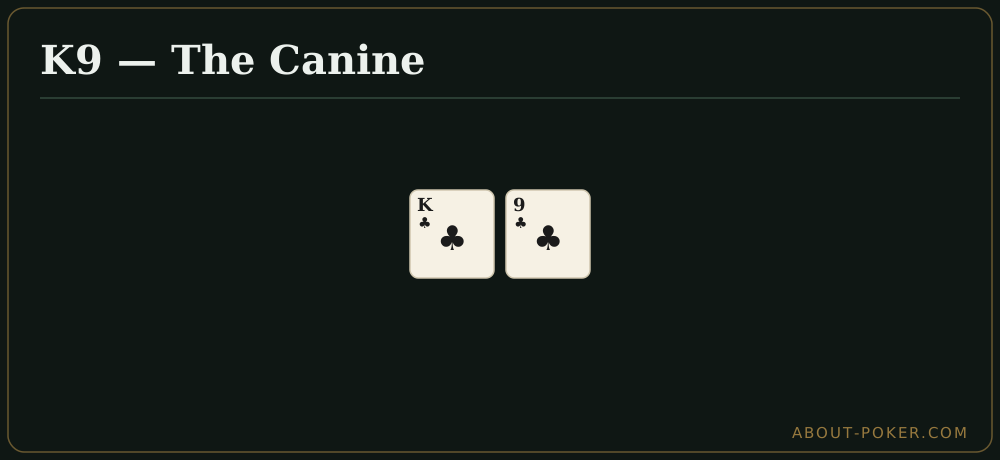
The nickname is pure wordplay. K-9 is the standard label for police and military dog units, and said aloud, “K-nine” is a homophone for canine. Poker players took the king (K) and the nine (9) and ran straight to the dog jokes — hence Fido, Rex, the Mongrel, and the Dog. It’s a phonetic pun in the same family as Kojak for KJ, where the card letters spell out a name.
What king-nine is worth
K9 is a one-big-card hand: a strong king paired with a weak, disconnected nine.
- Kicker trouble runs deep: When you flop top pair with the king, K9 is out-kicked by AK, KQ, KJ, and KT. That’s a lot of hands that beat you on a king-high board.
- Poor connectivity: The king and nine are four apart, so K9 has weak straight potential — it can’t easily make a straight using both cards.
- The nine rarely helps: A pair of nines is a middling holding, and the king overcard doesn’t rescue it often.
- Suited adds value: K9 suited picks up flush potential and plays notably better than K9 offsuit.
Worked example: the second-best king
You open K♣ 9♣ from the cutoff and the big blind, a solid regular, calls.
Flop: K♥ 6♦ 2♠. Top pair, king-high — it feels great. But consider the hands your opponent keeps calling with on a king-high board: KQ, KJ, KT, and better. Against K♦Q♦, you hold top pair nine-kicker while they hold top pair queen-kicker — you’re out-kicked and drawing to essentially three nines, roughly 12% equity to improve to two pair or trips. That’s the Canine’s core weakness: it flops top pair, then discovers its kicker is beaten by exactly the hands that want to keep betting. Firing three streets for value here is a common way to lose a big pot with a “strong” king.
How to play king-nine
Discipline and position keep the Canine out of trouble:
- Late position is its home. Open K9 from the cutoff and button, where fewer opponents can have a dominating king.
- Fold it early. From up front, K9o is a fold and even K9s is marginal.
- Don’t overplay top pair. One or two value bets is usually enough; slow down against real aggression on a king-high board.
- Prefer suited. K9s can defend blinds and steal more freely thanks to its flush potential; K9o should be much tighter.
The Canine versus the better kings
K9 sits several rungs below the strong king hands. Where KJ (Kojak) already has kicker issues, K9 has them worse — its nine loses to more kickers and connects to fewer straights. Treat the Canine as a late-position steal rather than a hand you commit chips to, and it’ll stop biting you. The name is fun; the kicker math is not, so respect it.
How the Canine changes by opponent type
The same K9 plays very differently depending on who’s across from you, and adjusting is where the real money is made.
- Versus a tight, straightforward player: a bet on a king-high board is a red flag. Tight players don’t fire into you with worse kings — they have KQ, KJ, or a set. When a nit puts money in on a king-high flop, believe them and get away cheaply. K9’s best outcome here is a small pot or a fold.
- Versus a loose, calling-station opponent: this is where the Canine earns. Loose players pay off top pair with worse kings, second pair, and weak draws, so a king-high flop with K9 becomes a legitimate two-street value hand. Bet for value; don’t slow down out of fear.
- Versus an aggressive bluffer: don’t fold top pair to a single raise. Aggressive opponents attack king-high boards because they know your kicker is often weak. Against a habitual barreler, K9 can call down one or two streets — you’re bluff-catching, not value-betting.
The mistake most players make is treating K9 the same against everyone: firing three streets against the nit and folding to the bluffer. Reverse that instinct and the hand behaves.
A quick K9 decision checklist
Before you put chips in with the Canine, run through this:
- Position: Am I in the cutoff, button, or blinds? If earlier, fold K9o.
- Suited or offsuit? K9s can steal and defend wider; K9o wants a much tighter leash.
- Who called? A tight caller narrows toward hands that beat me; a wide caller opens up value.
- How many streets? Plan for one or two value bets on a king-high board, not three, unless the opponent is a station.
- Facing a raise on a king board? Default to caution — better kings, two pair, and sets dominate that raising range far more often than bluffs.
Run that list and the Canine stops costing you stacks. It’s a serviceable late-position hand, not a made hand you marry.
Keep going
K9 is the Canine — a good-looking king with a bad kicker and a classic domination trap. Play king-nine suited from late position, fold king-nine offsuit up front, and don’t fire big with top pair nine-kicker into strength. Browse the full poker glossary for more nicknames.
Frequently asked
What is the nickname for K9 in poker?
King-nine is nicknamed the Canine, a play on the letters and number K-9. It's also called the Dog, Fido, Mongrel, or Rex, all riffing on the same police-dog pun.
Why is K9 called the Canine?
K9 (or K-9) is the standard designation for police and military dog units, and 'K-nine' sounds like 'canine.' The pun on the card's rank and number gave king-nine its doggy family of nicknames.
Is K9 a good poker hand?
K9 is a mediocre one-high-card hand and a classic domination trap. The king looks strong, but K9 is out-kicked by every better king (AK through KT), so it makes second-best pairs often.
Should you play king-nine?
Play it selectively from late position. K9 suited is a reasonable steal and blind-defense hand; K9 offsuit should be folded from early and middle position and rarely defended against 3-bets.