KJ Poker Nickname & Meaning
KJ is nicknamed Kojak. What king-jack means, where the nickname comes from, and why this broadway hand is easier to overplay than it looks.
On this page · 8 sections
KJ — king-jack — carries the nickname Kojak, after the bald, lollipop-sucking TV detective. It’s a solid-looking broadway hand that beginners tend to overplay, because it feels premium but sits a clear notch below the truly strong holdings.
Where “Kojak” comes from
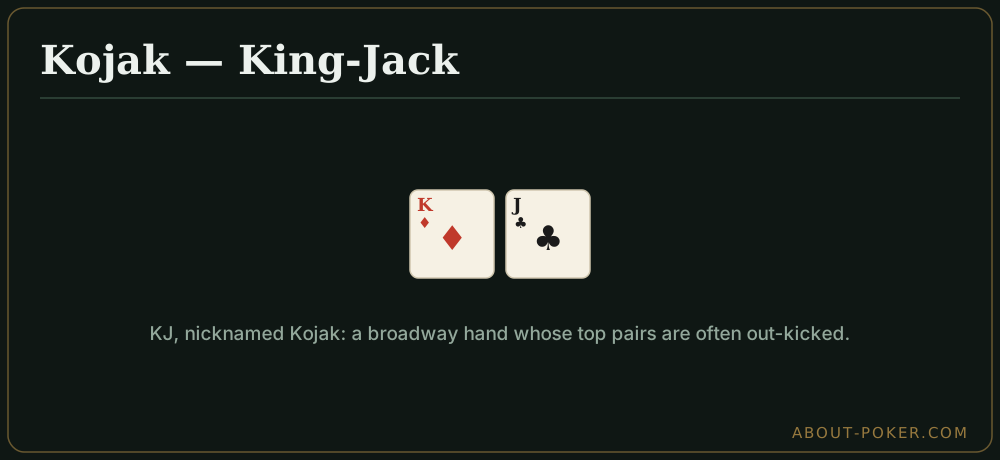
The nickname is pure phonetics. The two card letters — K and J — said together sound like “Ko-jak,” and poker players ran with the reference to the 1970s series Kojak, starring Telly Savalas as the tough New York detective. Like Ajax for ace-jack, it’s a nickname born from sounding out the letters rather than any property of the hand.
What king-jack is worth
KJ is a broadway hand — both cards are in the Ten-through-Ace range — so it can make strong straights and two decent pairs. But it’s the weakest of the “two big broadway” combinations that start with a king, and its kicker troubles run deep.
- Dominated a lot: When you flop top pair, KJ is out-kicked by AK, KQ, and any bigger king. When you pair the jack, it’s out-kicked by AJ and QJ.
- Straight potential: KJ makes broadway (T-J-Q-K-A) and needs a queen to connect the two cards, so its straight draws are real but gappy.
- Suited matters: KJs adds flush equity and is meaningfully stronger than KJo.
Where KQ is a genuinely strong hand, KJ is a step down — closer to a speculative broadway holding than a premium one.
Worked example: the domination trap
You raise from middle position with K♦ J♣ and the button, a solid player, calls.
Flop: K♠ 8♥ 3♦. Top pair, and it looks good. But think about the button’s calling range: it’s full of hands like KQ, AK, and pocket pairs. Against K♥Q♥ you hold top pair jack-kicker while they hold top pair queen-kicker — you’re out-kicked and drawing to three jacks, roughly 12% equity to improve. Against AK you’re in even worse shape.
That’s the KJ problem in miniature. It flops top pair often, but its kicker is beaten by exactly the hands that want to keep playing. Kojak makes a lot of second-best pairs, so betting three streets for value with it is a common way to lose a big pot.
How to play king-jack
Position and discipline are everything with KJ:
- Late position is its home. Open-raise KJ from the cutoff and button, where fewer players can have you dominated.
- Tighten up early. From up front, KJo is often a fold and KJs a marginal open. The stronger the table, the more you fold KJ early.
- Don’t overplay top pair. One or two value bets is plenty; slow down against real aggression on a king-high board.
- Prefer suited. KJs can call raises and flat 3-bets that KJo should decline, thanks to its flush and straight potential.
Kojak versus the stronger kings
The king-based hands form a ladder: KQ, then KJ, then KT and below. Each step down weakens the kicker and the straight potential. KQ can stand up to 3-bets and value-bet confidently; KJ has to be more selective, folding more often and betting more cautiously. Treat Kojak as a good-in-late-position hand rather than a premium, and it’ll stop costing you stacks.
Suited versus offsuit: two different hands
Players lump KJs and KJo together as “Kojak,” but they belong in different tiers, and treating them the same is a common leak.
KJ suited is a genuinely playable broadway. The flush adds equity and, crucially, playability — it can peel flops, chase draws, and continue in spots where the offsuit version has to fold. That extra out means KJs opens from earlier positions, defends against more raises, and can even flat some 3-bets in position where KJo cannot. When KJs makes a flush it also holds a strong redraw, so its worst-case outcomes are far less bleaky.
KJ offsuit is a step down. Strip away the flush and you’re left with a dominated top-pair machine: it flops top pair often, but that pair is out-kicked by exactly the hands willing to build a big pot. KJo wants late position, a folded-to-you situation, and a quick exit when the board gets scary. Against an early-position open it’s usually a fold, while KJs can sometimes continue for value or as a flat.
Facing 3-bets with Kojak
The 3-bet is where KJ separates the disciplined from the loose. When you open and get 3-bet, KJo is generally a fold — you’re dominated by the value part of most 3-betting ranges (AK, AQ, KQ, QQ+) and you flop dominated top pairs. Calling out of position with KJo just to “see a flop” is a classic way to donate.
KJs, by contrast, can call some 3-bets in position, because its flush and straight potential give it a way to win a big pot rather than merely make second-best pairs. Even then, be selective: flat the smaller 3-bets that leave good stack-to-pot ratios, and fold to large re-raises from tight players. The stronger and more aggressive the 3-bettor, the more both versions of Kojak lean toward folding — a rule that gets sharper the deeper the stacks, since domination costs more when there’s more behind. Compare this with the way KQ can stand up to 3-bets with confidence, and you’ll feel exactly how much weaker KJ is.
Keep going
KJ is Kojak — a broadway hand that’s easy to overvalue and easy to out-kick. Raise it in late position, fold it more up front, and don’t fire big with top pair jack-kicker into strength. Compare it to the stronger KQ, study ranges for king-jack suited, and browse the full poker glossary for more.
Frequently asked
What is the nickname for KJ in poker?
King-jack is nicknamed Kojak, after the 1970s TV detective. The name comes from the letters K and J read together — 'Ko-jak.'
Why is KJ called Kojak?
It's a pun on the card letters. K and J sound out to 'Kojak,' the bald detective played by Telly Savalas in the classic TV series. It's one of poker's more playful nicknames.
Is KJ a good poker hand?
KJ is a decent broadway hand but easy to overvalue. It's playable from later positions and gets dominated by AK, AQ, AJ, KQ, and any bigger king or ace, so it needs care.
Should I raise or fold KJ?
Raise it from late position and the cutoff or button; tighten up from early position. Facing a raise, KJo is often a fold, while suited KJ can continue more freely.