How to Play King-Nine Offsuit (K9o)
K9o is a weak, easily dominated offsuit king. Learn the few late-position spots where it opens, why it folds elsewhere, and how to avoid kicker trouble postflop.
On this page · 6 sections
King-nine offsuit (K9o) is the weaker sibling of K9 suited. It keeps the king’s high-card value and the awkward nine kicker, but loses the one feature that made the suited version worth playing: the flush. That single change pushes K9o down from a routine late-position open into a hand you fold far more often than you play.
Where K9o belongs preflop
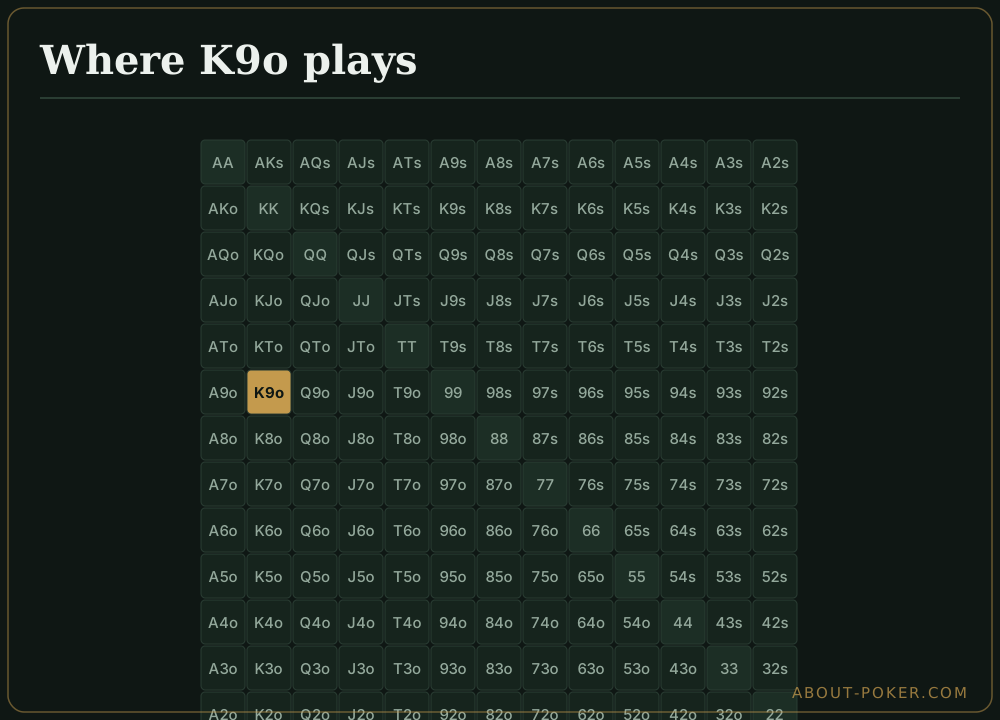
By seat, K9o sits near the very bottom of an opening range:
- Early and middle position: fold. You are opening into a full field of players who can hold A-K, K-Q, K-J, and pocket pairs, all of which dominate you. There is no upside that justifies the risk.
- Cutoff: a marginal open at short-handed tables, a fold at a full ring. It is right on the border, so lean toward folding when players behind are active.
- Button: a standard open. The range has widened enough that K9o clears the bar, and stealing the blinds in position is the main source of its value.
- Small blind: open with a raise against folded action rather than limping. You do not want to play a dominated hand out of position for a discount.
- Big blind: defend selectively against late opens. The price helps, but out-of-position play with a dominated king is thin.
If the borders feel fuzzy, ground yourself in the preflop opening ranges and how they widen seat by seat in poker ranges by position.
The domination trap
The core problem with any offsuit king is domination. When you make top pair with the king, the pot often plays out one of two ways: you are ahead of a weaker holding that will not pay much, or you are crushed by a better king that will stack you. The nine is a placeholder kicker — it rarely improves your hand and almost never wins on its own.
The suited version at least makes a second-nut flush to bail it out. K9o has none of that. Its equity is purely high-card and top-pair, both of which are fragile. That is exactly why K9o opens later than K9s does and folds in every seat where the field is wide.
Facing a raise: mostly fold
When someone else has opened, K9o becomes a fold-or-big-blind-defend hand:
- Facing an open from any position: fold. You are dominated by the opener’s kings and aces, you have no flush draw, and you will be guessing on king-high boards.
- In the big blind vs a late open: defend a fraction of the time at a good price, but be ready to give up when you miss.
- As a 3-bet: essentially never for value, and only rarely as a light bluff with the king blocker. Better bluff candidates exist; see how they are chosen in the 3-bet range breakdown.
A worked example
You open K♠9♦ from the button and the big blind calls. The flop comes K♥ 8♣ 4♠ — you have flopped top pair, weak kicker.
You bet, the big blind calls. Now you have to slow down. On the turn 6♦, betting again invites raises from better kings (K-Q, K-J) and gets called by nothing worse that will keep paying. This is a pot-control spot: check back or make a small bet, and be prepared to fold to serious pressure. Your top pair looks strong, but the nine kicker means you are often flipping a coin against the hands willing to put in a lot of money.
Contrast that with the same K♠9♦ played from under the gun. You would be opening into eight players who can wake up with a better king, and even when you flop that same top pair you would face the whole table’s action with a dominated hand. Same cards, far worse spot — which is precisely why K9o is a button hand, not an early-position one.
Postflop in one paragraph
K9o’s best flops are the ones where it makes top pair in position and can control the pot, or the ones where a nine gives it a marginal second pair that it can showdown cheaply. It has no flush draw, so semi-bluffing potential is limited to the occasional gutshot or backdoor straight. When it misses entirely, king-high has almost no showdown value, so treat those as one-and-done bluff-or-fold hands. The recurring theme is caution: with a dominated king and a dead kicker, avoid building big pots unless the board is genuinely favorable.
Where to go next
K9o is a narrow, positional steal hand — fine on the button, a fold nearly everywhere else. Compare it directly with the stronger K9 suited, anchor the seat-by-seat logic in poker ranges by position, and connect it all through the preflop strategy hub.
Frequently asked
Is K9 offsuit a good hand?
No, K9o is a below-average hand. Without the flush potential of its suited counterpart, it relies on a king that is frequently dominated and a nine kicker that almost never wins the pot on its own. It only opens from very late position and the small blind, and defends selectively in the big blind.
Should I open K9 offsuit?
Only from the button, the small blind (as a raise), and sometimes the cutoff at a short table. From early and middle position it is a clear fold, because too many players behind hold better kings and aces that dominate it.
Can I call a raise with K9 offsuit?
Usually not. K9o plays poorly against a raise: it is dominated by the exact hands that opened, has no flush draw to fall back on, and is hard to realize equity with out of position. Fold it against most opens and defend it only in the big blind at a good price.