T2 Poker Nickname & Meaning
T2 is nicknamed Doyle Brunson, the hand he won two WSOP titles with. What ten-two means, the legend behind the name, and why it's still a fold.
On this page · 8 sections
T2 — ten-two — is nicknamed the Doyle Brunson, and it may be the most famous bad hand in poker history. It’s the hand the two-time World Series of Poker champion won back-to-back Main Events with, a coincidence so unlikely that ten-two now bears his name forever — even though it’s a hand you should almost always fold.
Where “Doyle Brunson” comes from
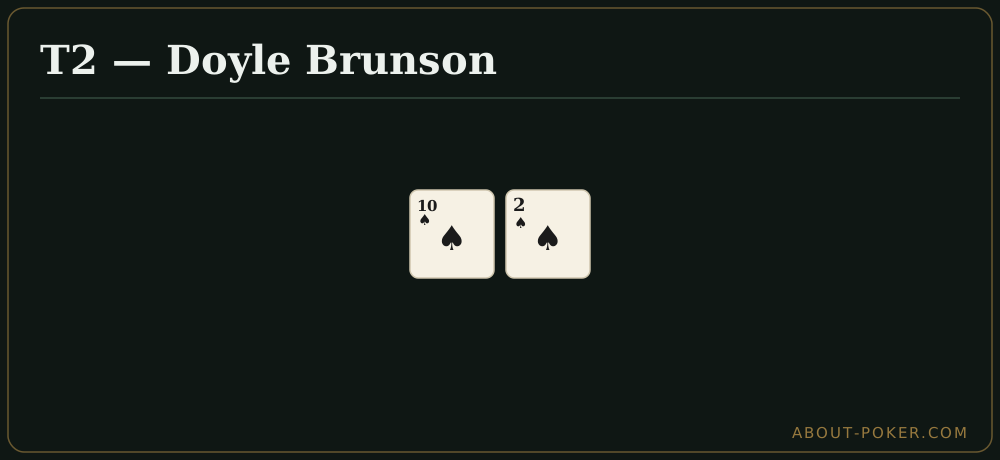
The story is real poker legend. Doyle “Texas Dolly” Brunson won the WSOP Main Event in 1976 and 1977, and on the final, tournament-ending hand of both years he was holding ten-two. In 1976 he made a full house against Jesse Alto; in 1977 he made a full house again against Gary “Bones” Berland. Winning the biggest tournament in poker two years running with the same off-shaped hand — and hitting a boat both times — turned ten-two into “the Doyle Brunson.” It’s one of the rare nicknames rooted in an actual event rather than wordplay like The Hammer for 72.
What ten-two is worth
Behind the legend, ten-two is a genuinely weak hand:
- Big gap: The ten and the two are eight apart, so ten-two essentially cannot make a straight using both cards — the gap is too large.
- Modest high card: A ten is easily dominated by any bigger broadway hand, and the deuce is dead weight.
- Suited barely helps: T2 suited can back into a flush, but T2 offsuit has almost nothing — no straight structure and no flush.
The hand’s greatness on two famous nights came entirely from the board, not from any inherent strength.
Worked example: recreating the legend
Suppose you’re all in preflop with T♠ 2♠ against A♥ K♦, much as an underdog situation would look. Ten-two suited has roughly 34% equity against ace-king — a clear underdog, winning about one time in three.
Flop: T♦ 2♥ 6♣. Now, like Brunson, you’ve flopped two pair — tens and deuces. Your equity leaps to a strong favorite, and if a ten or a deuce arrives on the turn or river you complete a full house, exactly as he did. The lesson isn’t “play ten-two.” It’s that even a weak hand can win when the board cooperates — and that Brunson’s back-to-back full houses were a spectacular, non-repeatable stroke of variance.
How to play ten-two
Don’t let the legend cloud your judgment:
- Fold it preflop. As a value hand, ten-two has no place in your opening range from any position.
- Suited over offsuit, barely. If you ever play it, ten-two suited is the only version with a shred of upside, and even then only as a rare loose steal.
- Never chase. With no straight structure, ten-two flops thin and should be given up cheaply when it misses.
- Enjoy the history, not the hand. Raise it for fun at a home game if you like, but recognize it’s variance, not strategy.
Doyle Brunson versus the truly awful
Ten-two sits low on any hand chart — weaker than most connectors and suited broadways — but it’s not quite the worst; that title belongs to 72, The Hammer. What makes ten-two special isn’t its strength but its story: the reminder that poker rewards courage and runs on variance, and that even the best players win big pots with hands that “should” be folded. Respect the history, fold the cards.
Why the legend still gets misread
The Doyle Brunson story is retold so often that it has quietly warped how some players think about ten-two. Two mistakes crop up constantly at the table.
The first is treating the nickname as a license to gamble. Because ten-two “won the Main Event twice,” players talk themselves into open-limping or even raising it, imagining they’re channeling Texas Dolly. But Brunson wasn’t opening ten-two as a strategy — in 1976 and 1977 he arrived at those final hands through position, chip pressure, and reads, and the specific cards were incidental. He’d be the first to tell you ten-two is a fold; the fame is about the board running perfectly, not the holding.
The second mistake is overvaluing it once it flops something. Say you loosely play ten-two and flop a single pair of tens. Your kicker is a two — the worst possible — so any opponent with a ten has you dominated, and any bigger pair crushes you. The hand that made Brunson famous was a full house, not top pair. Flopping middling made hands with ten-two is a trap: you’re rarely ahead of a range that wants to keep betting, and you have no backup equity to bail you out.
Where ten-two ranks
On a standard preflop hand-strength chart, ten-two sits near the bottom. Its problems are structural, not situational:
- No straight from both cards: with a four-gap between the ten and the deuce, you can’t use both hole cards in a straight — you’d need four specific board cards.
- A dominated high card: a ten is beaten by every jack, queen, king, and ace kicker, so even when it pairs, it’s frequently second-best.
- A dead low card: the deuce contributes almost nothing except the rare, board-dependent two pair or full house that made the legend.
Ten-two is stronger than 72, The Hammer, which can’t make a straight at all and has the lowest high card of any hand, but both live in fold territory. The gap between “famous” and “good” has never been wider than it is with ten-two.
Keep going
T2 is the Doyle Brunson — a fold with the greatest résumé in poker. Learn the WSOP legend, but muck ten-two offsuit as a rule and treat ten-two suited as a rare exception. Browse the full poker glossary for more nicknames.
Frequently asked
What is the nickname for T2 in poker?
Ten-two is nicknamed the Doyle Brunson (or 'Texas Dolly'), after the legendary player who won back-to-back WSOP Main Event titles in 1976 and 1977 while holding ten-two on the final hand both times.
Why is T2 called Doyle Brunson?
Doyle Brunson won the 1976 and 1977 World Series of Poker Main Events with ten-two, making a full house on the final hand each year. The extraordinary coincidence made ten-two forever his hand.
Is T2 a good poker hand?
No. Ten-two is a weak, gappy hand despite its famous history. It has poor straight structure and a modest high card, and it should be folded in almost every situation.
Should you play T2 because Doyle Brunson did?
No. Brunson winning with ten-two twice is a legendary fluke, not a strategy. Ten-two is a fold as a value hand; its fame comes from history, not from being a good holding.