What Is Rainbow Board in Poker?
A rainbow board has three different suits and no flush draw. Here's what the term means, an example, and why dry rainbow flops favor the aggressor.
On this page · 6 sections
A rainbow board is a flop showing three different suits — for example K♠ 8♥ 3♦. Because no two cards match, there’s no flush draw on the flop, which makes the board dry: fewer draws are possible, the texture is stable, and the hand is less likely to swing wildly on later streets. Rainbow flops are the friendliest texture for a made hand, and understanding why is a cornerstone of solid post-flop play.
The exact definition
The word rainbow refers to the variety of suits. A rainbow flop has one card of each of three suits, so it’s impossible for anyone to hold a flush draw with two matching cards — there simply aren’t two cards of the same suit on the board. Contrast that with a two-tone board, where two cards share a suit and a flush draw is immediately live.
Rainbow describes the flush dimension only; it says nothing about straights or pairs. A rainbow board can still be connected (like 9♠ 8♥ 7♦, which allows straight draws) or paired. But when people call a board “dry,” they usually mean rainbow and disconnected — a texture with almost no draws at all, like K♠ 8♥ 3♦.
A worked example
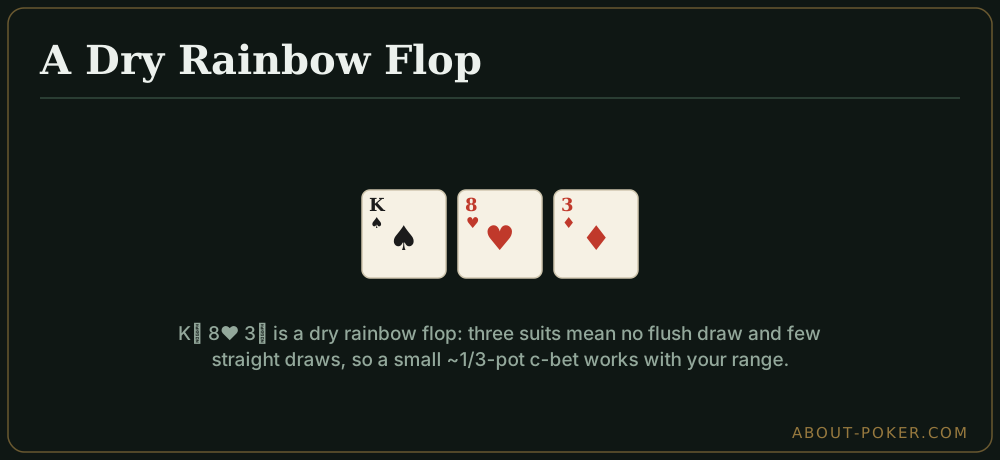
You raise before the flop with A♥ K♣ from late position and the big blind calls. The flop comes K♠ 8♥ 3♦ — a dry rainbow board. You’ve flopped top pair with top kicker.
This is close to an ideal spot. There’s no flush draw because the board is rainbow, and the disconnected ranks mean straight draws are minimal — a hand like J-10 has only a gutshot at best. Your opponent rarely has a strong draw to continue with, so you can bet small, around a third of the pot, as a continuation bet. The small size does the job because there are no draws to charge; you’re mostly betting to deny the equity of weak overcards and to build the pot with your strong hand.
If the turn comes another blank, like the 2♣, nothing has changed — the board is still dry, your top pair is still strong, and you can keep applying pressure. Compare that to a two-tone flop, where a flush card on the turn could flip the whole hand. The rainbow texture is what lets you bet with confidence and size down.
Why rainbow boards favor the aggressor
Dry rainbow boards, particularly ones with a high card, tend to favor the preflop raiser. Here’s the logic. The player who raised before the flop has more high cards and strong pairs in their range, so a King-high or Ace-high rainbow flop connects better with the raiser than with the caller. And because there are no flush draws and few straight draws, the caller has fewer semi-bluffing hands to fight back with.
This combination — a range advantage plus a lack of draws for the opponent — is why the small continuation bet is so effective on dry rainbow boards. You can bet a large portion of your range for a small size, pick up the pot often, and rarely face a raise, because your opponent simply doesn’t have the draws to apply pressure with.
Rainbow versus two-tone versus monotone
The three flop textures line up by how many suits appear and how much danger the flush angle carries:
- Rainbow (three suits): no flush draw, the driest texture, made hands are safest and bets can be small.
- Two-tone (two suits): one flush draw live, moderate wetness, size up to charge the draw.
- Monotone (one suit): a flush may already be made, the wettest texture, extreme caution required.
Recognizing rainbow instantly tells you the flush threat is off the table, which simplifies every decision that follows.
Common mistakes
- Over-betting a dry board. With no draws to charge, huge bets waste value — a small continuation bet accomplishes the same thing more cheaply.
- Forgetting straights still exist. Rainbow only removes the flush threat. A connected rainbow board like 9-8-7 still allows straight draws, so don’t treat every rainbow board as bone-dry.
- Ignoring backdoor flushes. A rainbow flop can’t make a flush by the river unless two running cards of one suit arrive. It’s rare, but on the turn a board can become two-tone, reintroducing a flush draw.
A quick checklist
- Three suits = no flush draw. The board is dry on the flush dimension.
- Bet small on dry high-card boards. You hold the range advantage and face few draws.
- Still check for straights. Rainbow removes flushes, not connectedness — read the ranks too.
Rainbow boards are where a made hand can relax and a small bet does the most work. For more board-texture terms, browse the full poker glossary.
Frequently asked
What does rainbow board mean in poker?
A rainbow board is a flop with three cards of three different suits, such as K♠ 8♥ 3♦. Because no two cards share a suit, there is no flush draw on the flop, which makes the board drier and less likely to change dramatically on later streets.
Is a rainbow board good for the preflop raiser?
Usually yes. Dry rainbow boards, especially those with a high card, favor the preflop aggressor because their range contains more strong top-pair hands. This is why small continuation bets work so well on rainbow flops — few draws exist to fight back with.
Can you make a flush on a rainbow flop?
Not from a flush draw that was live on the flop, because a rainbow flop has no two cards of the same suit to draw to. The only way is a backdoor flush — two running cards of the same suit on the turn and river — which is rare and requires both later cards to cooperate.
What's the difference between rainbow and two-tone?
A rainbow board has three different suits and no flush draw. A two-tone board has two cards of the same suit, creating a live flush draw. Rainbow boards are drier and safer for made hands; two-tone boards are wetter and require larger bets to charge the draw.