What Is Redraw in Poker?
A redraw is a draw to improve a hand you have already made. Learn how redraws add equity, why they matter most in Omaha, and how to use them to commit chips.
On this page · 6 sections
A redraw is a draw to make an even better hand when you have already made a good one. If you flop a straight and also hold a flush draw, the flush draw is your redraw, it is your chance to redraw to something stronger. Redraws are one of the most important concepts in Omaha and matter in Hold’em too, because they tell you whether a made hand is safe to commit chips with or dangerously exposed to being outdrawn.
What a redraw is
The difference between a draw and a redraw is timing. A plain draw is when you have not yet made anything and are hoping to complete a hand. A redraw is when you already hold a made hand but still have live cards to improve. The made hand is your floor; the redraw is your upside and your protection.
Think of it as insurance with a bonus. If your opponent has the same made hand as you, the redraw lets you pull ahead. If your opponent is drawing to beat you, the redraw gives you extra ways to stay ahead. Either way, holding a redraw makes your made hand dramatically more valuable than the same hand without one.
Why redraws dominate Omaha
Pot-Limit Omaha (PLO) is a game where made hands collide constantly. Two players making the same straight on the same board is routine. When that happens, the pot is decided by the redraw. The player who also holds a flush draw or a set that can boat up will scoop; the player with the bare straight can only chop, and often gets freerolled.
This is why Omaha strategy prizes hands that make the nut version of a hand plus a redraw. A combo draw that turns into a made straight with a flush redraw is a stack-off machine. A bare, redraw-less straight, even the current nuts, is a hand you must play with caution because it has nowhere to go but backward.
Types of redraws
Redraws come in several strengths, roughly from weakest to strongest:
- Flush redraw. You have a straight and hold two cards to a flush. Any flush card improves you.
- Nut flush redraw. The same, but to the best possible flush, far more valuable because you never make a losing flush.
- Boat redraw. You have a straight or flush and also hold a pair or set that can fill up to a full house, which beats straights and flushes.
- Higher straight redraw. You share a straight but can improve to a bigger one.
The best made hands carry the best redraws. A set with a flush draw, for example, is a made hand plus a strong redraw, and it can commit against almost anything.
A worked example
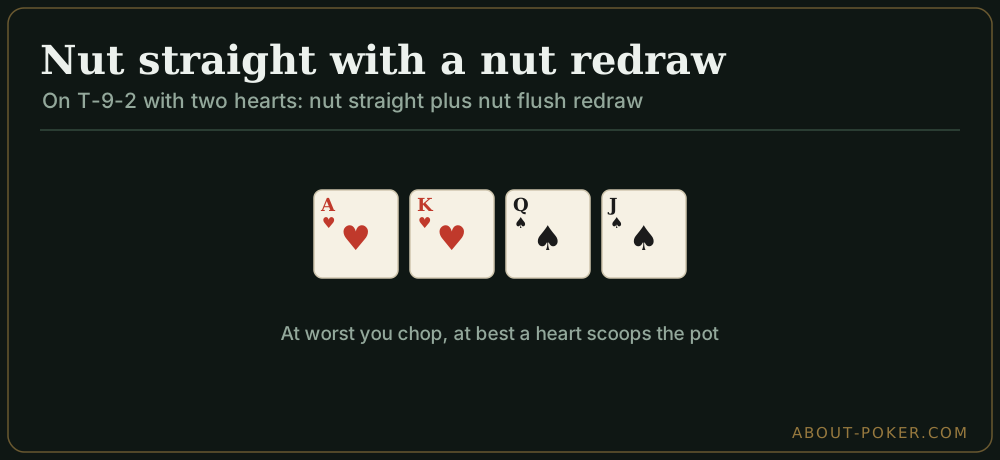
You hold Ah Kh Qs Js in Omaha and the flop comes Ts 9h 2h. You have flopped the nut straight, king-queen-jack-ten-nine. That is already a strong made hand, but notice you also hold Ah Kh, giving you the nut flush redraw in hearts.
Now the reason this matters: another player could easily have the same king-high straight with different cards. Against that opponent you are tied, but your heart redraw means any heart on the turn or river wins you the whole pot while you can never lose. You hold the nut straight plus the nut redraw, one of the most committable hands in Omaha. You can get all the money in, because at worst you chop and at best you scoop.
Compare that to holding a bare king-high straight with no heart redraw. You have the same made hand but none of the safety, and against aggression you are the one at risk of being outdrawn or freerolled.
Common mistakes with redraws
- Overcommitting with bare made hands. A straight with no redraw on a two-flush board is far weaker than it looks. Slow down when you have nothing behind your made hand.
- Undervaluing your own redraw. If you make a hand and hold the nut redraw, that is a green light to build the pot. Do not just call when you can put in a raise.
- Ignoring redraw quality. A non-nut flush redraw can make you a second-best hand. Prioritize nut redraws when deciding how much to commit.
- Forgetting boat redraws. Holding a pair alongside your straight or flush gives you full-house outs that can win against other made hands. Count these when you assess your equity.
Quick checklist
Whenever you make a hand, immediately ask: What is my redraw, and is it to the nuts? A made hand plus a nut redraw is a hand you can commit with confidence. A made hand with no redraw is one to protect and play cautiously, especially in Omaha. Learning to read redraws instantly is one of the biggest steps toward playing made hands correctly and stacking opponents when the money goes in.
Frequently asked
What is a redraw in poker?
A redraw is a draw to improve a hand you have already made. For example, if you flop a straight but also hold a flush draw, the flush draw is your redraw. Redraws add equity and protection, letting you play made hands more aggressively.
What is the difference between a draw and a redraw?
A draw is when you have not yet made a hand and are trying to complete one. A redraw is when you already have a made hand but can still improve to an even better one. The redraw is your safety net and your upside if an opponent catches up or already has you tied.
Why are redraws so important in Omaha?
In Pot-Limit Omaha, players frequently make the same straight, so the winner is often decided by who has the redraw to a flush or full house. A made hand with a strong redraw can commit chips confidently, while a made hand with no redraw is vulnerable.