What Is Stack Off in Poker?
To stack off is to get all your chips in on a single hand. Learn what stacking off means in poker, which hands justify it, and how to avoid stacking off light.
On this page · 6 sections
To stack off means to get all of your chips into the pot on a single hand — usually built across several streets of betting until one player is all in. Stacking off is the biggest decision in poker: there is nothing left to fold, no future street to save yourself. Because it commits everything, it should be reserved for hands strong enough that you genuinely want the money in against your opponent’s range.
New players often stack off far too loosely, committing their whole stack with hands like top pair whenever a big pot forms. Learning which hands are worth stacking off with — and which are traps — is one of the highest-leverage skills in the game.
What “Stacking Off” Really Means
“Stack off” refers to the whole sequence of getting all in, not just the final bet. You might raise, bet the flop, bet the turn, then call a river shove — that entire line is “stacking off.” The phrase carries a tone of finality and often a hint of doubt: players say “I stacked off with top pair” the way you might admit to a risky bet you are not sure about.
The key concept behind every stack-off is effective stack size — the smaller of the two stacks, because that is the most anyone can win or lose. Deeper effective stacks mean stacking off risks more, so your hand needs to be stronger to justify it.
When Stacking Off Is Correct
You should stack off whenever your hand beats enough of your opponent’s all-in range to make getting the money in profitable. Broadly, that means:
- Strong made hands — sets, straights, flushes, and better, which crush most calling ranges.
- Big draws with good equity — a combo draw with 12 or more outs can be a profitable get-in even as a slight underdog.
- Premium overpairs in the right spots, especially shallower.
The deeper the stacks, the more the range of hands worth stacking off narrows toward the nuts, because your opponent’s willingness to commit 100+ big blinds usually means real strength. Reading their range is the whole game here.
A Worked Example
You hold Qs-Qc and open-raise 100bb deep. A solid player 3-bets, you 4-bet, and they shove. Queens are a premium hand, but against a tight 5-bet-shoving range that is heavy on aces and kings, you are often flipping or behind. Against a range of exactly AA, KK, and AK, queens are roughly a coin flip to a small favorite — and against just AA and KK, you are a clear dog (about 18 percent vs. aces, about 18 percent vs. kings). Whether stacking off queens is correct depends entirely on how wide they shove.
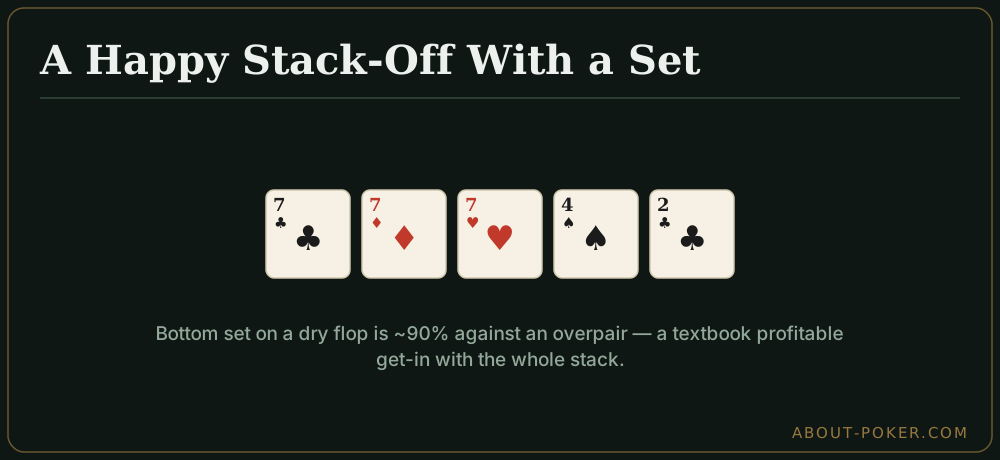
Now a clean spot: you have 7c-7d and flop 7h-4s-2c for a set. Money goes in on the flop against an overpair. Your set is around 90 percent to win against a single pair. That is the textbook stack-off — a hand so far ahead of your opponent’s committing range that you want every chip in the middle.
Stacking Off Light
Stacking off light means committing your whole stack with a weaker hand than the situation justifies — getting it in with top pair against a range full of sets and two pair, or with an overpair into a board that smashes the caller’s range. It is one of the most expensive leaks in poker because the mistake is maximum size: you lose a full stack, not a small pot.
The cure is honest range reading and respect for pot commitment. Before firing the bet that commits you, ask whether your hand beats the hands that will actually get all in with you — not the bluffs you hope are there, but the value hands the line represents.
Common Stack-Off Mistakes
The classic errors are overvaluing one-pair hands, ignoring how the board hits your opponent’s range, and failing to account for stack depth. A hand that is a happy stack-off 20bb deep can be a disaster 200bb deep against the same action, because deep money means the aggressor rarely holds air. Another trap is drifting into a stack-off by accident — betting street after street without ever deciding whether you are willing to get it in, then feeling “committed” on the river.
Quick Checklist Before You Stack Off
- Does my hand beat the range that actually gets all in here?
- How deep are the effective stacks, and does that raise the bar?
- Does the board hit my opponent’s range harder than mine?
- Did I plan to commit, or am I sliding into it hand by hand?
Answer those before the chips go in, and you will stack off with the right hands — and fold the traps that would have cost you everything.
Frequently asked
What does stack off mean in poker?
To stack off means to get all of your chips into the pot on a single hand, usually across multiple streets. Stacking off is the biggest commitment in poker, so it should be reserved for hands strong enough to want all the money in against your opponent's range.
When should you stack off in poker?
Stack off when your hand beats enough of your opponent's all-in range to make getting the money in profitable — typically strong made hands, big draws with good equity, or premium holdings. The deeper the stacks, the stronger your hand needs to be.
What does stacking off light mean?
Stacking off light means committing all your chips with a weaker hand than the spot justifies — for example, getting it in with top pair against a range full of sets and two pair. It is a common and expensive leak.