Handling Straddles
A straddle doubles the blind and halves your stack in big blinds. Learn how to adjust ranges, sizing, and stack-off points to beat straddled cash games.
On this page · 6 sections
Straddles show up constantly in live cash games and increasingly in online action tables. A straddle changes the math of the whole hand: it doubles the stakes, halves your effective stack in big blinds, and rewards players who adjust while punishing those who play their normal game. Handling straddles well is a live-cash edge that most recreational players never bother to learn.
What a straddle actually changes
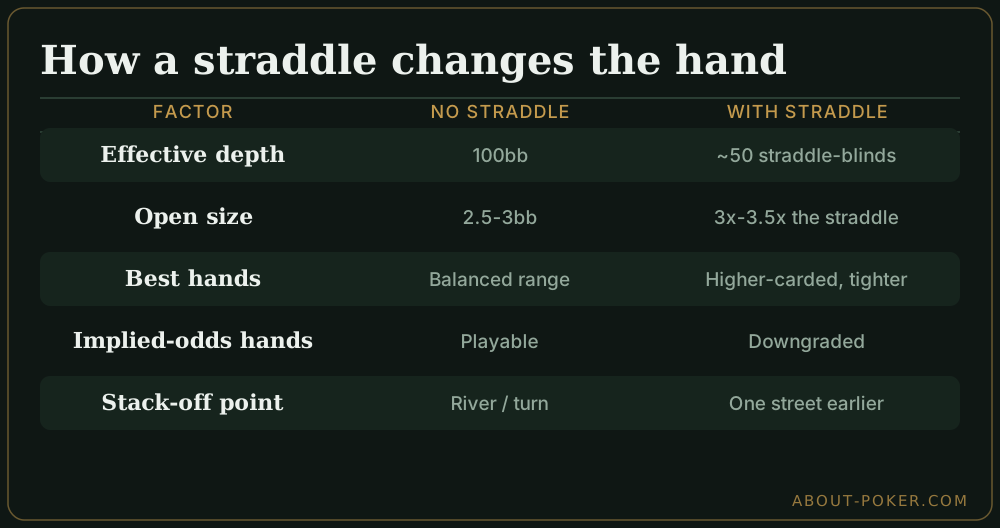
A standard straddle is a blind bet of 2x the big blind, posted by the player to the left of the big blind before the cards come out. It buys that player the option to act last preflop. The knock-on effects are what matter:
- Stacks shrink in big-blind terms. A 100bb stack is now effectively 50 straddle-blinds deep. Everything plays shallower.
- The pot is bigger preflop, so postflop bets are larger relative to remaining stacks, and stack-off points arrive faster.
- Positions shift. The straddler is now the effective big blind for betting purposes and acts last preflop.
This is the single most important concept: a straddle is a stack-depth adjustment. Everything else follows from it. If you understand how deep stack cash game strategy differs from short-stack play, just run it in reverse — a straddle makes a deep game play like a mid-stack game.
Adjusting your ranges
Because you’re effectively shallower, hands that rely on implied odds lose value. Small pairs set-mining and suited connectors need deep stacks to pay off; when everyone is 50bb deep relative to the straddle, those hands make less. Tighten them.
Conversely, high-card strength goes up in value. Big offsuit broadways and premium pairs play better shallow because you’re happier getting stacks in with top pair or an overpair. In practice, against a straddle you want a range that is slightly tighter and higher-carded than your normal open.
Sizing up your raises
Here’s a mistake that costs players real money: they open to “3bb” while forgetting the straddle is the real blind. If the big blind is 2 and the straddle is 4, a min-open over the straddle is 8, not 6. Many rooms require you to raise to at least double the straddle. Because the pot already has the straddle plus the blinds in it, a raise that’s a small multiple of the straddle gives everyone a great price to call.
The fix: size relative to the straddle, and often a touch larger. Opening to 3x-3.5x the straddle keeps your fold equity intact and stops the field from flatting cheaply. For more on how live sizing differs from online defaults, see live cash game poker strategy.
A worked example
The game is 2/5. The under-the-gun+1 player straddles to 10. You’re on the button with A-Q offsuit and everyone folds to you. Effective stacks are 500 (so 100bb, but only 50 straddle-blinds).
You raise to 35 (3.5x the straddle). The straddler calls; blinds fold. Pot is roughly 87. Flop comes Q-8-3 rainbow — top pair, top-ish kicker. The straddler checks. You bet 45 into 87. He calls. Turn is a 6; he checks, you bet 110, he calls. River is a 2; he checks.
Now count the stacks: after these bets you each have around 310 behind into a pot near 400. Because the straddle made everything shallow, you’re near a natural stack-off with top pair good kicker against a passive straddler’s calling range. A third barrel here is a thin value bet, not a nut-peddling spot — the compressed stacks turned a “deep” hand into a get-it-in-by-the-river hand. That acceleration is exactly what the straddle engineers.
When should you straddle yourself?
Rarely, and only for specific reasons. Straddling is putting money in blind, usually out of position, so it’s -EV in a vacuum. Legitimate reasons include:
- Creating action at a table full of weak players who will splash chips in the bigger pot
- A UTG straddle that buys you last preflop action for the round
- A Mississippi/button straddle where you get last action from a late seat — the only truly positionally sound straddle
If you’re the strong player at a soft table, a straddle can increase your hourly by inflating pots you’ll win more often. If the table is tough, straddling just hands the regulars a bigger pot to outplay you in.
Common straddle mistakes
- Playing your normal opening range. Tighten and high-card up; you’re effectively shallower.
- Raising in blind-multiples, not straddle-multiples. A “3bb” open is a tiny raise over a straddle. Size up.
- Chasing implied-odds hands. Set-mining and suited connectors need depth you no longer have.
- Straddling to “look loose.” Vanity straddles at tough tables just donate.
- Forgetting the faster stack-off. Marginal made hands reach commitment points a street earlier than in an unstraddled pot.
Handled correctly, a straddled table is a profit opportunity: the recreational players keep playing their standard game into shallower stacks, and you collect by tightening up, sizing right, and knowing that the money goes in sooner. For deeper mechanics of these pots, read playing straddled pots.
Frequently asked
What does a straddle do to the game?
A straddle is a voluntary blind bet, usually double the big blind, posted before cards are dealt. It doubles the effective stakes for that hand and, crucially, halves everyone's stack measured in big blinds, so hands play shallower and stack-off decisions come faster.
Should you straddle in a cash game?
From a pure EV standpoint, usually not — you're committing money blind and out of position. Straddling can be worthwhile to create action against weak players, or as a UTG straddle that buys last preflop action, but recreational straddling just increases your variance.
How should you adjust ranges against a straddle?
Because stacks are effectively half as deep, tighten speculative hands that rely on implied odds (small pairs, suited connectors) and lean on high-card strength. You should also raise larger relative to the big blind, since a standard open in straddle chips is a smaller multiple of the pot.
What is a Mississippi straddle?
A Mississippi straddle can be posted from any position, most powerfully from the button, and gives the straddler last action preflop from a late seat. It's the most positionally advantageous straddle and is legal in many live rooms but not all — always check house rules.