How to Beat 10NL Cash Games
Beat 10NL by combining a value-heavy core with real preflop discipline and light 3-betting. Opening chart, a worked hand, and the leaks that keep grinders stuck.
On this page · 8 sections
To beat 10NL — the $0.05/$0.10 online cash level — you keep the value-first engine that crushed the lower micros and add two new gears: sharper preflop discipline and selective 3-betting. The field still overfolds and overcalls in predictable ways, but you’ll meet more regulars, so choosing good tables and applying pressure to the right players becomes part of your edge.
What changes at 10NL
The pool is a mix of recreational callers and a larger group of tight regulars than you saw at 5NL. Against the recreationals, nothing changes: value bet big and often. Against the regs, you start using position and 3-bets to attack their weaknesses. Carrying forward the read-the-caller skill from beating 5NL is exactly what lets you decide when to value bet and when to apply pressure.
Opening ranges for 10NL
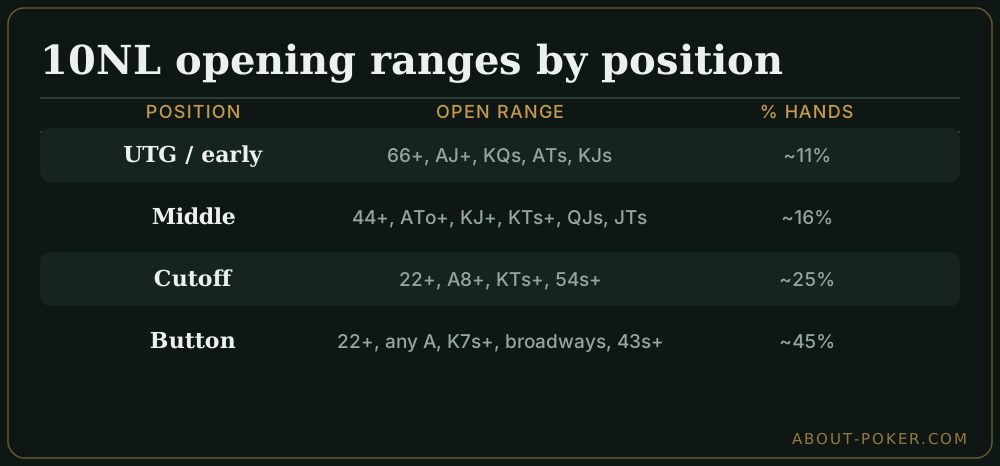
Raise-first-in, and lean on position hard:
| Position | Open range (approx.) | % of hands |
|---|---|---|
| UTG / early | 66+, AJ+, KQs, ATs, KJs | ~11% |
| Middle | 44+, ATo+, KJ+, KTs+, QJs, JTs | ~16% |
| Cutoff | 22+, A8+, KTs+, suited connectors 54s+ | ~25% |
| Button | 22+, any A, K7s+, most broadways, 43s+ | ~45% |
Isolating limpers still matters, but at 10NL you also want a clean strategy for open-raises versus regs — which means adding 3-bets.
Add selective 3-betting
At 10NL you can start 3-betting in cash games with intent. Build a value 3-bet range (QQ+, AK, sometimes JJ/AQ against wide openers) and, against regs who fold too often, add a few light 3-bets with hands like A5s, KJs, or suited connectors that have blockers and playability. Against pure stations, keep 3-betting linear and value-only — they call too much for a bluff 3-bet to work.
A worked hand
A tight-ish reg opens to 2.5bb from the cutoff. You hold AhKs on the button. You 3-bet to 8bb for value. The reg calls. Pot is about 17.5bb.
- Flop: Kd 9c 4s. Top pair, top kicker. You c-bet 8bb (about half pot into a 3-bet pot). Reg calls.
- Turn: 2h. Still the best hand almost always. You bet 18bb. Reg calls — likely a worse king, a pair like 99 (a set here), or a draw peeling.
- River: 6d. You bet 30bb for value. The reg calls with KQ, KJ, or a stubborn pocket pair.
You turned a strong hand into a big pot by 3-betting preflop rather than flat-calling. In a single-raised pot, top pair top kicker wins less; by building the pot early with position and initiative, you extract far more.
Table select and protect your rate
At 10NL, seat and table selection starts to move your winrate meaningfully. Sit to the left of the loose, spewy players so you act after them with position. Avoid tables stacked with tight regs where there’s little money to win. A good seat at a bad-for-them table is worth more than any single strategy tweak.
C-betting with a plan
At 10NL you should stop c-betting every flop on autopilot and start thinking about board texture. On dry, high boards that favor your raising range (A-7-2, K-9-4), c-bet small and often — the reg has few pairs and folds a lot. On wet, connected boards that hit the caller’s range (9-8-7, J-T-6), slow down: check back marginal hands, and only barrel with real equity or genuine value. Against a station, ignore texture and just bet when you have a hand — they call regardless, so a bluff c-bet on any board is lighting money on fire.
Common 10NL leaks
- Never 3-betting, so regs open into you risk-free.
- 3-bet bluffing stations who won’t fold anyway.
- Playing every table the same instead of adjusting to reg-heavy vs fish-heavy pools.
- Overfolding to reg aggression and paying off their value bets while folding your bluff-catchers.
- Ignoring position by calling too wide out of the blinds.
Your 10NL checklist
- Keep value betting big against callers.
- Build a value 3-bet range; add light 3-bets versus folders.
- Isolate limpers and play in position.
- Table-select and sit left of the fish.
- Don’t 3-bet bluff or barrel-bluff stations.
- Keep a 30-plus buy-in roll and review your bigger pots.
10NL rewards the same value discipline as the lower micros, now paired with preflop aggression and smart seat selection. Get those right and 25NL is the next climb.
Frequently asked
What is a good winrate at 10NL?
A good regular runs 6–10bb/100 at 10NL ($0.05/$0.10 blinds), or roughly $6–$10 per hundred hands. The pool is still exploitable but a bit tougher than 5NL, so table selection starts to matter for maximizing your rate.
Should I 3-bet more at 10NL?
Yes, selectively. You can start 3-betting for value against regs who open wide, and add a few light 3-bets against players who fold too often. Against pure stations, keep 3-betting linear and value-heavy since they won't fold to pressure.
How many buy-ins for 10NL?
Thirty buy-ins is $300 at 10NL and is a sensible minimum. If you want extra comfort through the variance of micro grinding, 40–50 buy-ins gives you more room to play without stress.