How to Beat 100NL Cash Games
Beat 100NL — the low-stakes gatekeeper — with near-solver ranges, deep-stack awareness, and relentless table selection. Opening chart, a worked river hand.
On this page · 7 sections
To beat 100NL — the $0.50/$1 online cash level and the gateway to mid-stakes — you play near-solver fundamentals, exploit reads only where they clearly exist, stay sharp on deeper-stack dynamics, and treat table selection as a core skill rather than an afterthought. The field is genuinely competent. Your edge is small and technical, so consistency and game selection matter as much as any single decision.
The 100NL field
Most 100NL regulars have studied. They c-bet with balanced ranges, defend blinds correctly, and won’t hand you stacks for free. Recreationals still appear and remain your primary profit source, but you can’t lean on them the way you did in the micros. The disciplined, balanced reg game you built at 50NL is now the baseline, and you layer precise exploits on top only when a specific opponent is clearly deviating.
Opening ranges for 100NL
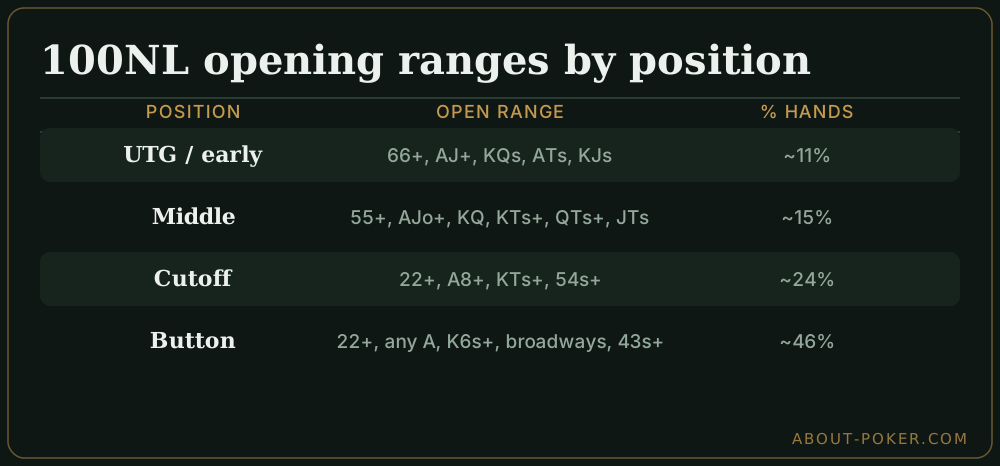
Solid, near-GTO, position-driven:
| Position | Open range (approx.) | % of hands |
|---|---|---|
| UTG / early | 66+, AJ+, KQs, ATs, KJs | ~11% |
| Middle | 55+, AJo+, KQ, KTs+, QTs+, JTs | ~15% |
| Cutoff | 22+, A8+, KTs+, suited connectors 54s+ | ~24% |
| Button | 22+, any A, K6s+, most broadways, 43s+ | ~46% |
Deviate from these only with a reason: widen versus a nitty table, tighten from early position if the players behind 3-bet aggressively.
Play the deeper game well
At 100NL and above, effective stacks often run deeper than 100bb, and the implied-odds math shifts. Speculative hands — suited connectors, small pairs set-mining, suited aces — gain value because stacking a reg deep is worth more. But deep stacks also punish one-pair overcommitment, so top pair goes down in relative value when 200bb are in play. Studying deep-stack cash strategy is directly worth money here, because the biggest pots decide your winrate.
A worked hand
You open AcAd from the cutoff to 2.5bb, 150bb effective. A competent reg calls on the button. Pot ~6.5bb.
- Flop: Kd 9h 4s. You c-bet 3.5bb for value and protection; the reg calls.
- Turn: 7c. You bet 9bb. The reg calls — plausibly a king, a draw, or a floating pair.
- River: 2h. Board bricked. You have an overpair. Against a reg you now size for thin value — about 14bb (roughly half pot) — because a bigger bet folds out the KQ/KJ/K-x that pays a smaller one, while a raise from the reg would mostly beat you. If the reg raises all-in, folding aces is often correct at 100NL: a competent player’s river check-raise-jam almost never contains a bluff you beat.
That last line is what separates 100NL winners from micro grinders: the discipline to bet thin for value and to fold an overpair when a strong opponent commits. Stack sizing dictates the whole hand — 150bb deep, you never wanted to bloat this into a stack-off with one pair.
Table select like a pro
At 100NL, table and seat selection can be the difference between a winning and a losing month. Hunt for tables with a recreational player and sit to their left. Leave games that are all regs — there’s no money to be won trading small edges with peers while paying rake. Your buy-in decisions, seat choices, and quitting discipline are strategy, not logistics.
Common 100NL leaks
- Overcommitting one pair deep and stacking off in spots where you’re behind.
- Ignoring stack depth and misapplying 100bb heuristics at 200bb.
- Playing reg-only tables for negligible edge after rake.
- Failing to fold to competent river aggression.
- Neglecting study — at this level, off-table work is your winrate.
Your 100NL checklist
- Play near-GTO baseline ranges; exploit only clear deviations.
- Adjust hand values for deeper effective stacks.
- Value bet thin, fold to strong river raises.
- Table-select and seat-select every session.
- Keep a 50-plus buy-in roll and move down on a bad run.
- Study relentlessly — the field does.
100NL is the last low-stakes checkpoint before mid-stakes. Combine clean fundamentals, deep-stack awareness, and ruthless game selection, and you’re ready to climb.
Frequently asked
What is a good winrate at 100NL?
A strong 100NL regular runs about 3–6bb/100 ($0.50/$1 blinds), roughly $30–$60 per hundred hands. Winrates are thinner than at lower stakes because the field is competent, so volume and table selection do a lot of the work.
Is 100NL hard to beat?
It's the gatekeeper to mid-stakes. Most regs play solid, near-GTO fundamentals, so a small technical edge plus disciplined game selection is what separates winners from break-even players. It's very beatable, but not by autopilot.
How many buy-ins do I need for 100NL?
Fifty buy-ins ($5,000) is a common minimum given the tougher field and larger swings. Many pros keep more, and treat dropping below the threshold as an automatic move down to protect the roll.