Playing 200 Big Blinds Deep
How to play 200 big blinds deep in cash games: tighten your stack-off range, value implied odds, weaponize position, and avoid one-pair traps.
On this page · 6 sections
Playing 200 big blinds deep means there is roughly twice the standard stack sitting behind the flop, and that single fact reshapes almost every postflop decision. At 100bb you can get all the money in over three modest bets; at 200bb you need three large bets, and each one gives your opponent a chance to represent a monster. The core adjustment is simple to state and hard to execute: the hands that stack off comfortably at 100bb — top pair, overpairs, one-pair holdings — stop being stack-off hands, while hands that make the nuts quietly soar in value.
Why the extra stack rewrites everything
The mechanical reason deep play is different is stack-to-pot ratio (SPR). If a single-raised pot goes to the flop at around 6bb with 100bb behind, your SPR is about 16. With 200bb behind it is roughly 33. A high SPR means the pot is small relative to the money that can still go in, so one-pair hands are dangerous — you cannot get it in profitably, and the deeper you get, the more the range that stacks you off is nutted. Understanding stack-to-pot ratio is the single most useful lens for deep play, because it tells you immediately whether a hand wants to build a pot or keep it small.
Adjust your preflop ranges
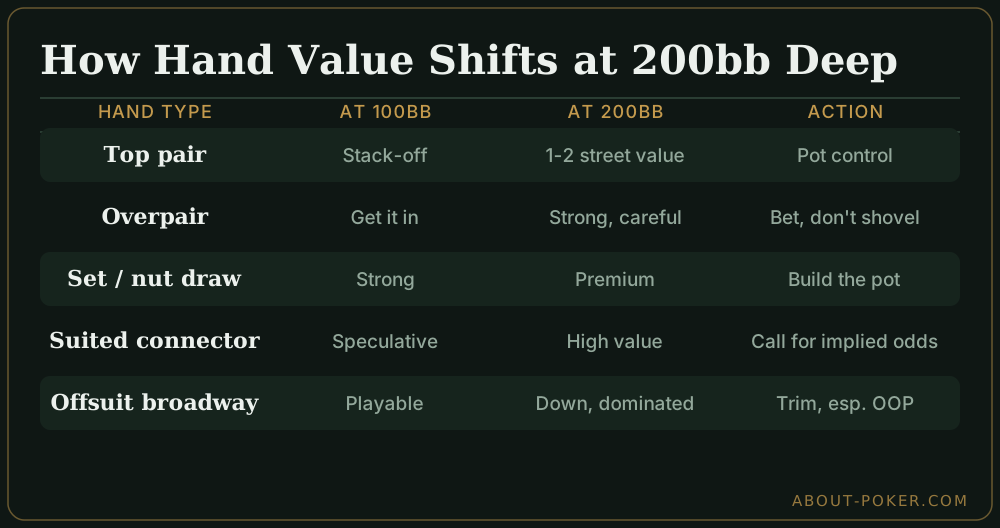
Deep stacks reward hands that can flop the nuts and dominate an opponent’s continuing range. Suited aces, suited connectors, and pocket pairs all go up in value because their payoffs are enormous when they hit: a set or a flush stacks an overpair, and 200bb is exactly the payoff you want. Offsuit broadways like KJo and AQo go down slightly — they make top pair, and top pair is a trap hand at high SPR. When you 3-bet, lean more polarized and prioritize position. Cold 3-betting out of position with a linear range of dominated hands is one of the biggest deep-stack leaks.
A worked example
You cover the table with 200bb. A tight regular opens to 3bb in the cutoff, and you call on the button with 7c6c. The flop comes 8c-5d-2h — an open-ended straight draw with a backdoor flush. Villain c-bets 4bb into 7.5bb. At 100bb you would just call and hope; at 200bb, calling is even better because your implied odds are enormous. If you hit your straight on a card like 9c or 4x, you can win a huge pot against an overpair that will never fold when 190bb are still behind. This is the whole point of deep play: your speculative hand is now worth calling because the payoff dwarfs the price. Compare that to holding AhTh on 8-5-2 — top pair, decent kicker, and a hand you should pot-control rather than blow up the stacks with.
Position is worth more when deep
Position always matters, but its value compounds with stack depth because there are more streets where information is worth money. In position you get to see your opponent act on flop, turn, and river before committing, and you can realize your equity on speculative hands far more often. Out of position, those same speculative hands whiff their implied odds because you have to guess. This is why professionals tighten up out of position and open up on the button when deep — the same principle behind why position is important in poker, amplified. When in doubt deep, fold the marginal out-of-position spot and take the in-position one.
Common deep-stack mistakes
The biggest error is stacking off with one pair. Players anchor to their 100bb instincts — “top pair top kicker is the nuts” — and pay off nutted ranges. A close second is overplaying overpairs; a bare aces or kings hand is a strong one-pair holding, not a hand to shovel 200bb into on a wet board. Third is calling 3-bets out of position with dominated hands, which forces you to play a bloated pot with a capped, reverse-implied-odds range. Fourth is ignoring blockers and board texture on the river, where the last big bet is where deep pots are won and lost. If you want the broader framework, our guide to deep stack cash game strategy covers the fundamentals, and playing overpairs drills the specific trap of overvaluing big pairs.
A quick deep-stack checklist
Before you commit a big chunk of 200bb, run through this: Is my hand the nuts or near-nuts, or am I about to stack off one pair? Am I in position with information, or guessing out of position? What is my SPR, and does it justify getting it in? Does the river bet or raise I face represent a range that beats me? If you are stacking off with one pair, out of position, on a wet board, against a tight player’s raise, you are almost certainly making a mistake. Deep-stack poker rewards patience and nut-hunting — you win a few gigantic pots and lose a lot of small ones, and that math is hugely profitable when you keep your one-pair losses small.
Frequently asked
What changes when you play 200 big blinds deep?
The extra street of betting behind the flop is the whole story. With 200bb you can put in a pot-sized bet on flop, turn, and river and still have chips, which means one-pair hands become far riskier to stack off with and speculative hands that flop the nuts go way up in value.
Should you 3-bet more or less when very deep?
Slightly less linear, more polarized and positional. Cold 3-betting offsuit broadways out of position bleeds money when deep because you play a big pot with a dominated one-pair range. Suited hands with nut potential and pairs that can set-mine gain value.
Is top pair good 200bb deep?
Top pair is a one- or two-street value hand, not a stack-off hand. Committing 200bb with one pair requires your opponent to have a range wide enough to pay you, which good players rarely do. Pot-control it.