Playing a Straddled Pot in Position
How to play a straddled pot in position: recalculate effective stacks in big blinds, isolate wide, punish the shortened stacks, and print with position.
On this page · 6 sections
A straddle is a voluntary blind — usually double the big blind, posted before the deal by the player to the left of the big blind (or on the button in some rooms) — and it turns an ordinary hand into a bigger, shallower, more chaotic pot. When you get to play that pot in position, it is one of the most profitable spots in live cash poker. The dead money is larger, the stacks are effectively shorter, and your positional edge is worth more per hand because more players are seeing flops with weak, uncapped-but-random ranges. The key is to stop thinking in big blinds and start thinking in straddle-blinds.
Recompute your stack depth first
The single most important adjustment is arithmetic. If the big blind is $2 and someone straddles to $4, your $200 stack was 100bb but is now only 50 straddle-blinds effective. The game just got shorter. That means strong hands want to get in more money more freely, set-mining implied odds shrink because there is less behind, and the value of nut-flush and set potential drops slightly relative to raw showdown value. Whenever you sit at a table with a live straddle, mentally relabel every stack in the new large blind. Our guide to handling straddles walks through this recalculation in more detail, and the mechanics vary by room, especially with a button straddle.
Isolate wide and punish the field
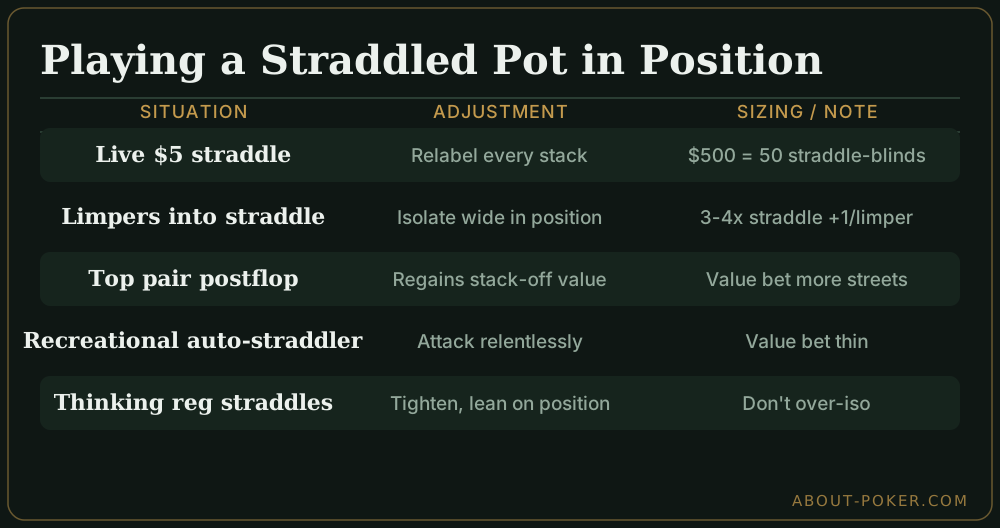
Straddled pots attract limpers and loose callers who want to see a cheap flop relative to the bigger blind. In position, that field is a gift. You can iso-raise a wide range of playable hands — suited broadways, suited aces, big offsuit cards, and pairs — to isolate a weak limper and take the pot down or play heads-up in position with the betting lead. Because the straddle already inflated the pot, your fold equity is high and the reward for taking it down preflop is larger. Size your raise off the straddle: a good default is about 3-4x the straddle, plus one straddle per limper. Over a $5 straddle with two limpers, raising to roughly $25-30 is standard.
A worked example
The blinds are $2/$5, the under-the-gun player straddles to $10, and two players limp for $10. You are on the button with As-Jd and a $500 stack — now only 50 straddle-blinds. You iso-raise to $45 (about 3.5 straddles plus a bit for the limpers). Both limpers fold and the straddler calls. The flop is Jc-8h-3d, giving you top pair top kicker, and the pot is roughly $105. The straddler checks. You bet $60. Because effective stacks are shortened, you are much closer to getting it in with this hand than you would be 100bb deep in an unstraddled pot — two more streets of betting and the money is in. You bet $60 on the flop, and a $150 turn bet on a blank sets up a river shove or leaves a trivial commit. Shorter effective stacks turn top pair back into a stack-off hand.
Adjust to the specific straddler
Not all straddles are equal. A recreational player who straddles every button is usually loose and passive postflop — attack relentlessly and value-bet thin. A skilled regular straddling to create action is trying to leverage position and a shortened game against you, so tighten up if they are behind you and lean on your own position when you have it. Against a table that limps into every straddled pot, isolate aggressively; against a table that 3-bets your isos, tighten your iso range and let your value hands get paid. Reading the straddler’s tendency is often worth more than any preflop chart.
Common mistakes in straddled pots
The most frequent leak is failing to recompute stack depth and then playing a shortened game with a deep-stack mindset — pot-controlling top pair when you should be committing, or set-mining with a pair when there is no longer the implied odds to justify it. A second mistake is over-limping in position instead of raising: you surrender your fold equity and the dead straddle money. A third is under-sizing the iso off the big blind rather than the straddle, letting three players call and killing your positional edge in a multiway pot. For the fundamentals of the format, see our overview of playing straddled pots.
Straddle-pot checklist in position
Relabel every stack in straddle-blinds before you act. Isolate limpers wide, sizing off the straddle plus one per limper. Value-bet more streets and thinner, because effective stacks are shorter and top pair regains stack-off value. Read whether the straddler is a recreational auto-straddler or a thinking regular, and lean harder on the former. Above all, remember that position plus dead money plus a shortened game is the most profitable combination in the room — the straddled pot in position is a spot to press, not to play scared.
Frequently asked
How does a straddle change effective stack depth?
A straddle doubles the big blind, so a stack that was 100 big blinds is now only 50 straddle-blinds deep. Always recompute your stack in terms of the new large blind, because the game is effectively shorter and you should get money in more freely with strong hands.
Should you play more or fewer hands in a straddled pot in position?
More. The larger dead money in the pot and your positional advantage mean you can profitably isolate and steal with a wider range than in an unstraddled pot, especially against limpers and passive players who over-fold to raises.
What sizing should you use when raising over a straddle?
Size relative to the straddle, not the big blind. A standard iso is about 3-4x the straddle plus one straddle per limper. So over a 5bb straddle with one limper you would raise to roughly 18-25bb.