AA vs KK: Preflop Odds & Equity
AA is about an 82% favorite over KK all-in preflop — a 4.5-to-1 dog for the kings. Here are the exact aces-vs-kings equities and where KK's outs come from.
On this page · 7 sections
You look down at K♠ K♥, get the money in preflop, and villain rolls over A♣ A♦. This is the nightmare — the classic cooler. Your kings are a big underdog, winning only about 18% of the time, and you’re drawing almost entirely to a lone king. From the aces’ side, it’s one of the most profitable spots in poker: ~82% to win, close to a 4.5-to-1 favorite. One matchup, one number to remember.
The headline equity
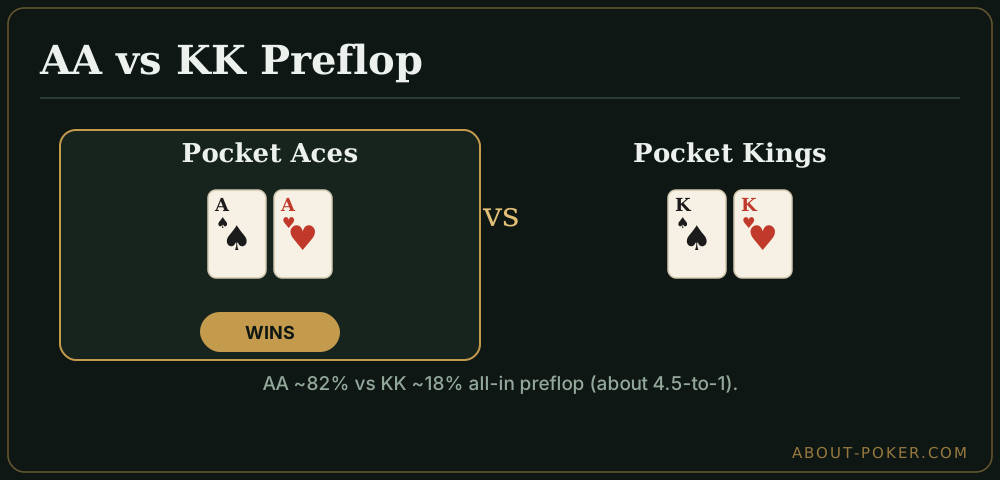
All-in preflop, pocket aces are roughly an 82% favorite over pocket kings, and the kings win about 18%. Expressed as odds, that’s close to 4.5-to-1 in favor of the aces.
| Matchup | AA equity | KK equity |
|---|---|---|
| AA vs KK (all-in preflop) | ~82% | ~18% |
The exact figure drifts by a fraction of a percent depending on whether the kings share a suit with the aces, but the answer you should carry to the table is a clean 82/18.
Where the kings’ 18% comes from
Kings are behind from the moment the cards are dealt — beaten by rank, not by any board yet to come. So what is KK actually drawing to?
- Flop a set of kings: this is the main out. Holding a pocket pair, you flop a set (or better) about 11.8% of the time — roughly one flop in 8.5 — because you’re hoping one of the two remaining kings lands among the three flop cards.
- Runner-runner straights and flushes: rare, but they fill in the rest of the equity.
Add the set math to those backdoor run-outs and you land at kings’ ~18%. Even after flopping a set, you still have to fade the aces improving right back over you — but a set of kings against aces is usually good enough to stack off.
Why it feels worse than the number
An 82/18 favorite still loses nearly one time in five, so aces cracked by kings will happen regularly over a career. The sting comes from the situation, not the odds: both hands are premium, so the stacks almost always go in, and the loser did nothing wrong. This is the difference between playing well and running well. Understanding equity is what stops a lost cooler from turning into tilt — you were an 82% favorite, and 18% still happens.
A worked example
Effective stacks are 100 big blinds. You open A♠ A♥, an opponent three-bets, you four-bet, and they jam. You snap-call and they show K♦ K♣. You’re an 82% favorite for a 200-big-blind pot.
Your expected value here is enormous: 82% of the time you scoop the whole pot, 18% of the time you lose it. Over the long run, getting aces all-in against kings preflop is essentially free money — you’d take that spot every hand if you could. The 18% you’ll lose isn’t a mistake; it’s the tax on being human. This is exactly the kind of spot the preflop all-in odds framework is built to evaluate.
The range problem
The one caveat: you rarely know villain has kings. When you hold aces, you almost never need to worry about being behind — nothing beats you preflop. But when you hold the kings, the question flips: how often is villain’s shove actually aces? Aces are only 6 combinations out of everything a raiser can hold, while hands you crush (AK, QQ, lower pairs) make up far more. Counting those combinations is what tells you kings are still a clear get-it-in against an unknown range, even though they’re an 82% dog to the one hand you fear.
How the equity shifts once the board runs out
The 82/18 number is a preflop snapshot. The moment three cards hit the felt, the matchup collapses toward a binary — one side is now almost certainly dead. That is worth understanding because it changes how you think about the money going in on later streets.
- A blank flop (no king, no obvious straight or flush texture) pushes the aces from 82% to roughly 91-92%, because the kings have burned one of their three chances to hit a set and gained nothing. By the turn a dry board leaves KK drawing to essentially two outs on the river — around 4-5%.
- A king on the flop flips the entire hand. Now the kings hold a set and are around 96% to win, and the aces are the ones drawing thin, needing running cards or an ace. This is the run-out that produces the biggest pots, because the aces have no reason to slow down and the kings have no reason to stop.
- A coordinated board (say two of a suit that matches neither hand, or a connected texture) barely moves the needle in isolation, but it opens the door to the runner-runner outs that make up the tail of KK’s 18%.
The practical takeaway: with aces you should be happy to commit on almost any flop that isn’t king-high, and the rare king-high flop is exactly where a disciplined player can sometimes save a bet by reading the sudden reversal.
A quick decision checklist
When you find yourself in an AA-vs-KK spot, run through this:
- Holding aces: get the money in, always, preflop. Nothing in a realistic range is ahead of you, and you are an 82% favorite against the single scariest hand you can face.
- Holding kings: ask how often is this exactly aces? Against an unknown, aggressive range, the 6 combos of aces are a small fraction of everything you beat, so you get it in. Against a player who only ever stacks off with AA, kings can occasionally be a laydown — but those players are rare, and folding kings preflop is a mistake far more often than it is correct.
- Either hand postflop: watch for the king on the flop. That single card is the difference between 91% and 4%.
Lock in the single anchor — AA is ~82% over KK — and the aces-vs-kings cooler stops being a mystery. With aces you’re printing; with kings you’re usually still getting it in, because the 6 combos of aces are swamped by everything else in a realistic range. Build the surrounding skills through equity, combinatorics, and the poker odds & math hub.
Frequently asked
What are the odds of AA vs KK preflop?
Pocket aces are about an 82% favorite over pocket kings all-in preflop, with kings winning roughly 18% of the time. That's close to a 4.5-to-1 edge for the aces.
How often do kings beat aces?
About 18% of the time, or a little less than one hand in five. Almost all of that comes from KK flopping a set of kings — hitting a third king on the board.
Why is AA vs KK such a famous cooler?
Both hands are premium, so the money almost always goes in preflop, and the kings are drawing nearly dead. Losing with kings to aces feels brutal precisely because you played it perfectly and were still an 82% underdog.
Can suit change the AA vs KK equity?
Only slightly. If the kings share suits with the aces, KK's flush outs are partly blocked, nudging its equity down a fraction of a point. In practice the matchup is always quoted as roughly 82/18.