AJ vs KQ: Preflop Odds & Equity
AJ is about a 59% favorite over KQ all-in preflop — two big cards versus two big cards, with the ace tipping the balance. Here are the exact AJ-vs-KQ equities.
On this page · 7 sections
You get A♠ J♦ all-in against K♣ Q♥. This isn’t a coinflip — it’s two big-card hands where one clearly outranks the other. AJ is about a 59% favorite, KQ around 41%. The reason is simple and worth internalizing: when neither hand pairs a pocket, the highest card usually decides it, and an ace beats a king.
The headline equity
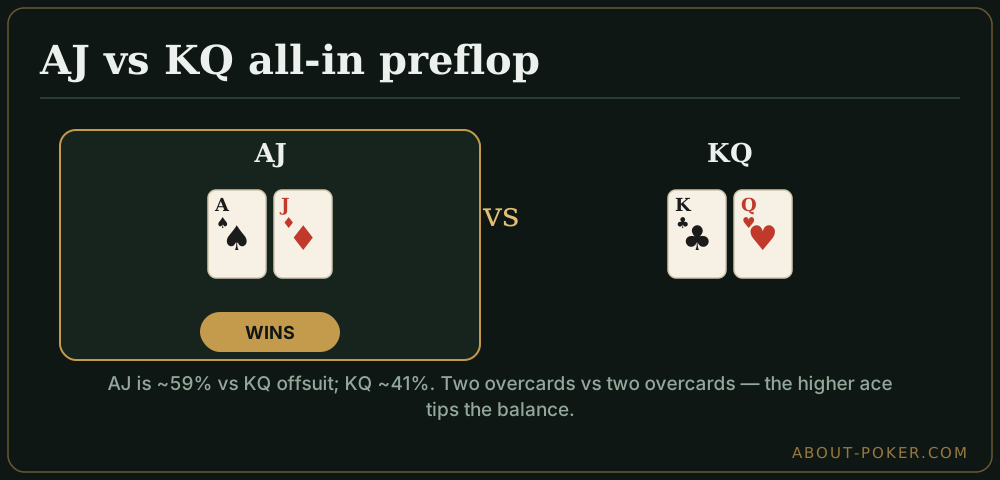
All-in preflop, AJ is about a 59% favorite over KQ when both are offsuit, with KQ winning around 41%. Suiting either hand nudges the number a point or two, but the ace-high hand stays firmly ahead.
| Matchup | AJ equity | KQ equity |
|---|---|---|
| AJ vs KQ (both offsuit) | ~59% | ~41% |
| AJ vs KQ (both suited) | ~58% | ~42% |
The anchor: two overcards versus two overcards, with a top-card edge, runs roughly 59/41 — a real favorite, not a flip.
Where the edge comes from
Neither hand starts with a pair, so both are drawing to improve. The difference is which improvement matters:
- AJ pairs its ace: three aces remain. Whenever an ace hits, AJ makes top pair with the best kicker in play, and KQ is almost always drawing thin.
- AJ pairs its jack: the jack is lower than KQ’s cards, but it still often wins on boards where KQ misses entirely.
- KQ pairs its king or queen: six outs to a pair, but a paired king can still lose to a paired ace, so some of KQ’s “outs” only win when AJ misses too.
That asymmetry — AJ’s ace out-kicks everything KQ makes — is what turns a superficially even fight into a 59/41 edge. Counting these live-but-not-clean outs is the nuance behind the poker outs framework.
Why it’s not a true race
A pair versus two overcards is close to 50/50 because the pair is a made hand. Here, neither side is made, so the hand with the better high cards wins the “who pairs highest” battle more often. KQ isn’t dominated the way it would be against AK, but it’s fighting uphill on every ace-high board. Understanding that distinction — dominated versus racing versus flipping — is central to equity.
A worked example
Effective stacks are 30 big blinds. You open A♠ J♦, an aggressive player three-bet jams K♣ Q♥, and you call. You’re a 59% favorite for the pot.
Say the pot after the shove is 62 big blinds. Your call prints: 59% of the time you take it down, 41% of the time you don’t. Notice this is a better spot than a coinflip — you’d rather get AJ in against KQ than pocket nines in against AK, because 59% beats 54%. Recognizing that a top-card edge outperforms a race is exactly what the preflop all-in odds framework helps you see.
How the board changes the equity
The 59/41 number is the all-in figure, but in a real hand you rarely get it in blind and see all five cards. It’s more useful to know how the edge shifts as the board comes. The key insight is that AJ’s advantage is front-loaded: it’s largest before any cards are dealt and shrinks the moment KQ connects.
Watch a few flops. If the flop comes ace-high — say A-8-3 — AJ has hit top pair and jumps to around 90% or better, because KQ now needs to spike a king or queen and then dodge AJ’s remaining pairs and improvements. If the flop instead comes king-high or queen-high, the picture inverts: KQ takes the lead, often into the 80s, and AJ is the one drawing to its three aces or three jacks. And on a total blank like 8-6-2 rainbow, the hands revert close to their preflop shares, with AJ still slightly ahead because the ace still wins the “highest card” battle if the board bricks out.
This is why AJ over KQ is a favorite rather than a lock. Roughly speaking, one of the two hands pairs up by the river a large fraction of the time, and when it’s KQ that pairs first, all of AJ’s preflop edge evaporates. The 59% simply reflects that AJ wins that race a bit more than half the time.
Comparing it to the domination cases
It’s worth placing this matchup on a spectrum so the 59/41 has context. Against a hand it truly dominates — like AJ versus A9, where they share the ace — AJ is around 70% because A9 is often drawing to just three nines. Against a hand that dominates it — AJ versus AK — AJ falls to about 25%, since AK has the ace out-kicked and shares the jack blocker only weakly. KQ sits in between those extremes: it isn’t sharing a card with AJ, so it has a full six outs to pair, but its cards rank lower, so it loses the high-card tiebreak. That combination — live but out-ranked — is precisely what produces a 59/41 split rather than a 70/30 rout or a 50/50 flip. Fitting new matchups onto this scale is a fast way to estimate equity at the table without a solver. For a related two-big-cards spot, compare the pair-versus-overcards dynamic in QQ vs AKs.
The takeaway
AJ versus KQ is a clean example of the top-card principle: with no pairs in play, the higher cards win more often, and an ace does the heavy lifting. Lock in the anchor — AJ is ~59% over KQ — and remember it’s a favorite, not a flip, so you can lean into these spots when the pot odds are right. Build the surrounding skills through equity, counting outs, and the poker odds & math hub.
Frequently asked
What are the odds of AJ vs KQ preflop?
AJ is roughly a 59% favorite over KQ all-in preflop when both are offsuit, with KQ winning about 41%. Suiting either hand shifts it a point or two, but the ace-high hand stays clearly ahead.
Why is AJ favored over KQ?
Neither hand has a pair, so the winner usually pairs the highest card. AJ's ace outranks KQ's king, so whenever an ace or a jack pairs, AJ is likely ahead. That top-card advantage is worth almost 20 points of equity.
Is AJ vs KQ a coinflip?
No. Unlike a pair versus two overcards, this is two overcards versus two overcards where one side has the better cards. AJ is about 59/41, a meaningful favorite rather than a true 50/50 race.
Does suitedness change AJ vs KQ much?
Only a little. A suited hand gains a couple of points of flush equity. If both are suited the matchup stays near 58/42 in AJ's favor; the ace-high edge dominates the suit effect.