AA vs QQ: Preflop Odds & Equity
AA is about an 82% favorite over QQ all-in preflop — a 4.5-to-1 dog for the queens. Here are the exact aces-vs-queens equities and where QQ's outs come from.
On this page · 7 sections
You open Q♠ Q♥, get the money in, and villain tables A♣ A♦. Same cooler, different lower pair. Your queens win only about 18% of the time, drawing mostly to a third queen, because the aces have you beaten by rank before a card hits the felt. From the aces’ side it’s the familiar printing spot: ~82% to win, close to a 4.5-to-1 favorite.
The headline equity
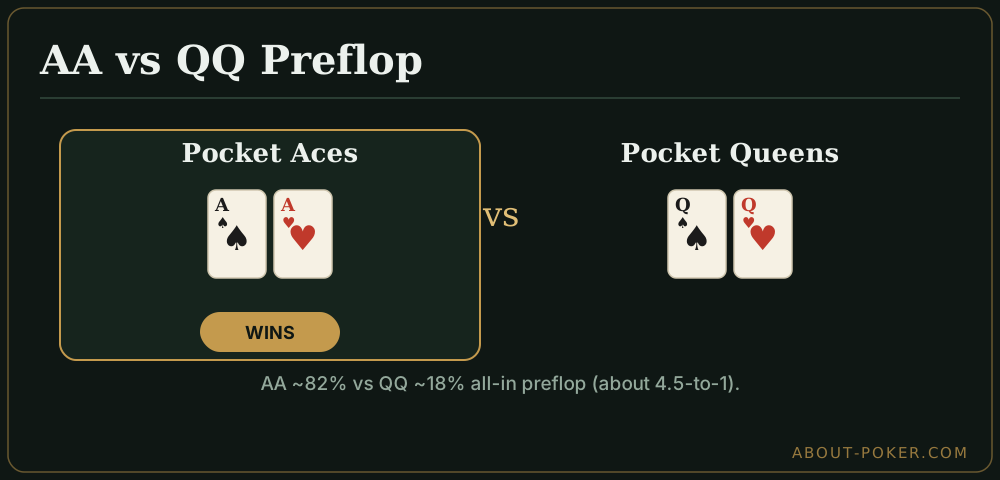
All-in preflop, pocket aces are roughly an 82% favorite over pocket queens, and the queens win about 18%. As odds, that’s close to 4.5-to-1 for the aces.
| Matchup | AA equity | QQ equity |
|---|---|---|
| AA vs QQ (all-in preflop) | ~82% | ~18% |
If that number looks familiar, it should — it’s essentially identical to AA vs KK. Any big underpair against aces lands near 18%, because the mechanics are the same: beaten by rank, drawing mainly to a set.
Where the queens’ 18% comes from
Queens are behind from the deal. Their outs are limited:
- Flop a set of queens: the main out. With a pocket pair you flop a set (or better) about 11.8% of the time — roughly one flop in 8.5 — since you need one of your two remaining queens among the three flop cards.
- Runner-runner straights and flushes: rare, but they round out the equity.
Note what QQ does not get that some players imagine: it has no overcards to the aces, so it can’t improve by pairing a higher card. Everything hinges on hitting a queen. Add the set math to backdoor run-outs and you get ~18%.
Why it’s the same story as kings
AA vs KK and AA vs QQ are both ~82/18 for one reason: against aces, it doesn’t much matter whether the underpair is kings, queens, or jacks. None of them can out-rank the aces, and all of them are drawing to essentially the same set-plus-scraps outs. This is a useful piece of equity shorthand — one number, ~18%, covers every big pair that runs into aces. The rank of the loser barely moves the needle.
How the board changes the equity
That ~82/18 is the number the moment the cards are on their backs, before any community cards. It shifts fast once a flop appears, and knowing the direction helps you read a run-out.
- A queen flops: QQ makes a set and vaults into a big favorite, roughly 90%-plus, because now the aces are the ones drawing thin — they need a third ace or a specific runner-runner to survive.
- No queen, no draws (say K-7-2 rainbow): the aces are close to a lock, usually 95%-plus. QQ is back to needing one of its two remaining queens.
- A coordinated board that misses both (J-T-9 with a flush draw): the aces stay ahead but the number sags, because QQ picks up a straight draw with the jack-ten around it. Equity is fluid, not frozen at 82.
The practical takeaway: with aces you are almost never in trouble, but a paired queen or a very connected board is when your enormous preflop edge shrinks the fastest. With queens, you are hunting for that one card that flips the whole hand.
A worked example
Effective stacks are 100 big blinds. You open A♠ A♥, a player three-bets, you four-bet, and they jam Q♦ Q♣. You call. You’re an 82% favorite for a 200-big-blind pot.
Now flip seats. You hold the queens and face the shove. Should you call? The AA-fear is real, but aces are only 6 combinations of everything villain can hold. A typical jamming range also contains KK, AK, JJ, sometimes AQ — hands your queens either beat or flip against. Weigh those and queens are almost always a call. Folding QQ because “he might have aces” is one of the most common leaks in the game; the math from a preflop all-in analysis rarely supports it.
The range problem
With aces you never sweat the matchup — nothing beats you preflop. With queens, the whole decision is a counting exercise: how much of villain’s range is the AA and KK that crush you versus the AK, JJ, and AQ that don’t? Aces are 6 combos, kings another 6, but the hands queens beat or flip with usually outnumber them by a wide margin. Working through those combinations is exactly how you talk yourself off a bad QQ fold.
A quick decision checklist for QQ facing a shove
When you hold queens and someone jams, resist the reflex to fold “because aces.” Run this instead:
- Count the combos that crush you. Aces are 6 combos, kings another 6. That is 12 hands that have you badly beaten (against KK you are the ~18% dog).
- Count the combos you beat or flip. AK is 16 combos and you are a ~54% favorite over it. AJs, AQ, JJ, TT, and any suited-connector bluffs all fall on your side of the ledger. These usually outnumber the 12 that beat you by a wide margin.
- Weight by how the villain actually plays. A tight nit who only jams AA/KK is the rare exception where folding queens is right. A loose or short-stacked player shoving a wide range makes the call trivial.
- Convert to a rough equity. If a third or less of the shoving range is AA/KK, your queens are comfortably ahead of the range as a whole, and calling prints money over time.
The only time to fold is when the answer to step 1 dominates steps 2 and 3 — a genuinely tight range that is almost all aces and kings. That range rarely exists in practice.
Carry one anchor: AA is ~82% over QQ, the same as over KK. With aces you’re printing; with queens you’re usually still getting it in, because the 6 combos of aces don’t outweigh everything else you’re ahead of. Build the surrounding skills through equity, combinatorics, and the poker odds & math hub.
Frequently asked
What are the odds of AA vs QQ preflop?
Pocket aces are about an 82% favorite over pocket queens all-in preflop, with queens winning roughly 18% of the time. That's close to a 4.5-to-1 edge for the aces.
How often do queens beat aces?
About 18% of the time, a little less than one hand in five. Most of that comes from QQ flopping a set of queens; the rest is rare straights and flushes.
Is AA vs QQ the same odds as AA vs KK?
Almost exactly. Any big pocket pair against aces sits around 18% because the story is identical — the lower pair is beaten by rank and drawing mainly to a set. AA vs KK and AA vs QQ are both roughly 82/18.
Should you ever fold QQ preflop?
Only against a range that's almost entirely aces and kings, which rarely exists. Queens are strong enough to beat most of what people shove, so folding them to a single all-in is usually a mistake despite the AA fear.