AK vs JJ: Preflop Odds & Equity
Ace-king vs pocket jacks is a near coin flip — jacks are a slight ~56/44 favorite preflop. Here are the exact equities and why it is closer than it feels.
On this page · 7 sections
You get J♠ J♥ in, villain flips A♣ K♦, and the table calls it a flip. Fair enough — this is a race, and the jacks are the small favorite at about 56/44. Ace-king has two live overcards, but a made pair that only has to hold up keeps the edge. The whole matchup turns on one question: does ace-king pair up?
The headline equity
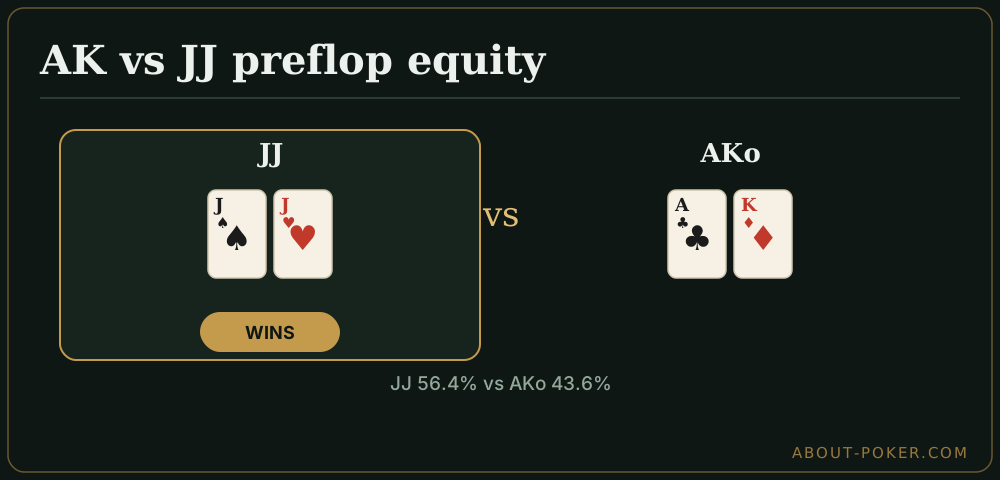
Every figure comes from a full board run cross-checked against a Monte Carlo simulation:
| Matchup | JJ equity | AK equity |
|---|---|---|
| JJ vs AKo (offsuit) | 56.4% | 43.6% |
| JJ vs AKs (suited) | ~54% | ~46% |
Jacks win a little more than half the time. Suited ace-king closes the gap with extra flush outs, but the pair stays ahead in every version.
Why jacks hold the edge
Jacks are a made pair; ace-king is not. To win, ace-king must improve, and to lose, the jacks just need the board to miss the big cards. That head start is why the pair is favored even though ace-king holds two of the strongest cards in the deck.
Count what ace-king is drawing to:
- Pair an ace: three aces remain.
- Pair a king: three kings remain.
- That’s six overcard outs, plus straights and flushes.
Six outs across five board cards means ace-king pairs at least one card roughly half the time — but not quite enough to overcome the jacks’ head start. The jacks also flop a set of their own about 11.8% of the time, which adds insurance on boards where ace-king does pair.
A worked example
Say the money goes in for a 100 big blind pot. Jacks own about 56.4 big blinds of equity, ace-king about 43.6. Now watch a flop rewrite it.
Flop A♦ 8♠ 4♥: ace-king pairs top pair and jumps to about 87% — the jacks are down to their two remaining jacks for a set, around 9%. Flip the flop to 7♣ 6♦ 2♠, which misses ace-king completely, and the jacks soar to roughly 90% while ace-king needs to catch one of six cards on the turn or river. That is the coin flip in motion: an even preflop split that resolves almost entirely on whether the flop brings an ace or a king.
Why this is not AK vs AA
The instructive contrast is against a bigger pair. Ace-king is 44% against jacks but only about 12% against aces. The difference is dead outs: against aces, one of ace-king’s overcards (the ace) is nearly gone, so it is really drawing to three kings plus scraps. Against jacks, both overcards are fully live. That single fact — six live outs vs three — is the gap between a coin flip and a beating. Counting those live cards is the heart of combinatorics.
The full ladder of AK matchups
Jacks are one rung on a ladder, and seeing the whole thing makes the race intuitive. Ace-king’s equity against each pair depends on exactly one thing: how many of its six overcard outs are still live.
| AK faces | AK equity | Live overcards |
|---|---|---|
| A pair below both cards (e.g. TT, 99) | ~46-47% | six (all live) |
| JJ or QQ | ~43-45% | six (all live) |
| KK | ~30% | three (aces only) |
| AA | ~12% | three (kings only) |
Against any pair below the king, ace-king is only a small dog — the classic race — because all six overcards can pair up. The moment the pair matches one of ace-king’s cards, half those outs die and the equity collapses. QQ is interesting: it is still a race like JJ, but a hair worse for ace-king because a queen on board can help the pair make a set on the same card that would otherwise be a blank. The takeaway is that “coin flip” describes the entire band of AK versus a pair from 22 up through QQ, and jacks sit right in the middle of it.
Why it feels like AK should be ahead
Players routinely misjudge this spot because ace-king looks dominant — it holds two of the top three ranks, and it crushes most of the hands people actually get it in with (dominated aces, dominated kings, worse suited connectors). But a pair is a made hand and ace-king is not. Equity is about who wins by the river, not who holds the prettier cards preflop. The mental correction is simple: unpaired big cards are a drawing hand against any pair, and a drawing hand with six outs is behind. Internalize that and you stop overpaying to race and start hunting for the fold equity or the price that actually tips a near-even spot in your favor.
From equity to a decision
At 56/44, this is a race, so the money is made in the margins — fold equity and pot odds — not the raw flip.
| Situation | Read | Line |
|---|---|---|
| You shove AK, called by JJ | ~44% | Slight dog, fine with fold equity |
| You call off with JJ vs AK | ~56% | Slight favorite; weigh stack risk |
| Tournament, short stacks | — | Fold equity often outweighs the thin edge |
Lock in the anchor — JJ is a ~56/44 favorite over AKo, ~54/46 vs AKs — and every jacks-vs-ace-king spot becomes a question of the surrounding math, not the flip. Since the equity is nearly even, whoever gets the fold equity or the price makes the money. Turn that into a real line with preflop all-in odds, sharpen your counting with combinatorics, and work through the poker odds & math hub.
Frequently asked
What are the odds of AK vs JJ preflop?
Pocket jacks win about 56% of the time against offsuit ace-king, with ace-king around 44%. Suited ace-king narrows it to roughly 54/46. It is essentially a coin flip with the pair slightly ahead.
Is AK a favorite over JJ?
No. The pair of jacks is the small favorite at about 56/44. Ace-king has to improve to win, and it only pairs up around half the time, so the made pair keeps a slight edge.
Why is AK vs JJ closer than AK vs AA?
Against jacks, ace-king has six clean overcard outs — three aces and three kings — plus straight and flush chances. Against aces, one of ace-king's overcards is dead, so its equity drops from about 44% to roughly 12%.
Should you race JJ against AK?
It depends on stack depth and fold equity. As a slight favorite, calling off is fine in cash games, but in tournaments the risk to your stack often makes fold equity from shoving more valuable than the thin edge.