AK vs AQ: Preflop Odds & Equity
Ace-king is about a 74/24 favorite over ace-queen preflop — a textbook domination spot with a shared ace. Here are the exact equities and the trap it sets.
On this page · 7 sections
You raise A♠ Q♦, get called, and someone shows up with A♣ K♥. You are not in a coin flip — you are dominated, roughly a 24/74 underdog, and about to lose three times out of four when the money goes in. Ace-king over ace-queen is the cleanest example of one of poker’s most expensive traps.
The headline equity
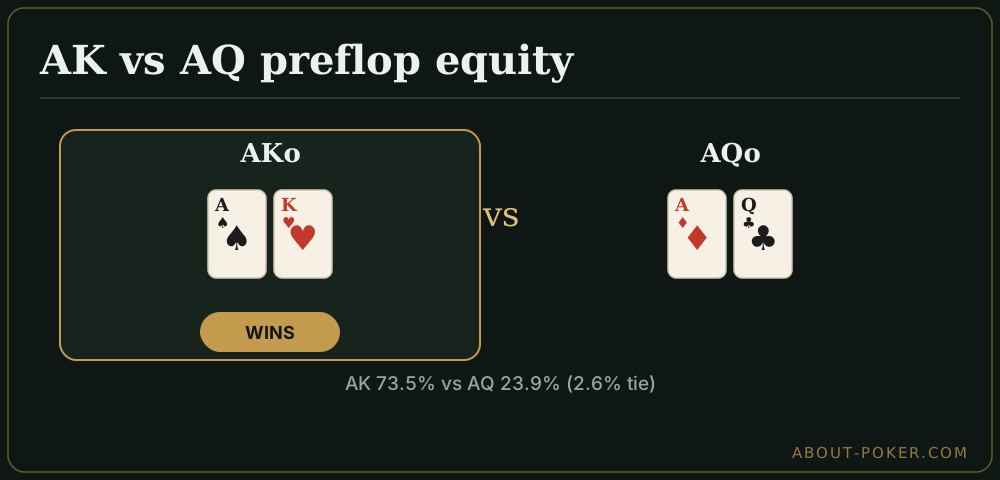
Every figure below comes from an exhaustive board run cross-checked against a Monte Carlo simulation:
| Matchup | AK equity | AQ equity | Tie |
|---|---|---|---|
| AKo vs AQo | ~73.5% | ~23.9% | ~2.6% |
Ace-king wins about three hands in four. The ~2.6% ties come from boards where a straight or flush plays for both hands and the shared ace is irrelevant.
Why the shared ace is the whole story
This is a domination matchup, and domination lives in the shared card. Both hands hold an ace, so when the board pairs an ace, both players make a pair of aces — the pot usually chops or comes down to the kicker, which is exactly where AK’s king beats AQ’s queen.
Trace what AQ is actually drawing to:
- Pair the ace: helps neither hand break away — the king outkicks the queen every time it matters.
- Pair the queen: three queens remain, and this is AQ’s main realistic out — but AK still has a live king that can pair over the top.
- Runner-runner straights and flushes fill the rest, plus a few ties.
So ace-queen is effectively drawing to three queens and a sliver of backdoor help. That is why it stalls near 24%.
A worked example
You open A♠ Q♦ from the cutoff, the big blind three-bets, you call, and the flop comes Q♥ 8♣ 3♠. You have top pair, top-ish kicker, and it feels great — so you call a bet, then a turn barrel. On the river you look down at second-best.
That flop is exactly the disaster for AQ. You paired your queen (about a 3-in-100 flop per specific queen, but any queen flop is roughly 13% across three cards) and now hold a hand strong enough to call two streets and weak enough to lose to the exact hand that raised you. If villain holds AK, you are drawing to two remaining queens — about 8% to improve to trips. The reverse implied odds on that queen are brutal: you win small pots and lose big ones.
The combinatorics that make it common
Domination spots feel rare but happen constantly, because big broadway cards cluster in raising ranges. If you hold AQ, an opponent’s raising range is thick with AK, AA, KK, and QQ — the hands that either dominate you or crush you. Counting combinations, AK alone is 16 combos before any card removal, and every one of them has you drawing thin.
This is why “I flopped top pair with AQ” is not the good news it feels like when the action gets heavy. The equity you think you have preflop is often already gone.
From equity to a decision
Knowing AQ is a 24% dog to AK reframes the whole hand:
| Your hand vs villain | Your win % | Rule of thumb |
|---|---|---|
| AK vs AQ | ~74% | Big favorite, apply pressure |
| AQ vs AK | ~24% | Dominated, pot control |
| AQ vs KK/QQ | ~30% or worse | Behind, proceed carefully |
| AQ vs a pair you beat | varies | Race or ahead |
Lock in the anchor — AK is ~74% over AQ — and the lesson writes itself: ace-queen is a fine opening hand and a dangerous calling hand against strength. Recognize when the shared ace is working against you. Build the surrounding skills through combinatorics, reverse implied odds, and the poker odds & math hub.
How the shared card changes the math
Domination is entirely about which card two hands share, and comparing spots makes the effect concrete. Line these up:
- AK vs AQ (shared ace): the loser’s best out is pairing the queen, three cards — about 24% for AQ. The shared ace neutralizes the most likely pairing card for both.
- AK vs KQ (shared king): similar shape. KQ is drawing mainly to a queen because the shared king again cancels out, leaving KQ near 25%.
- AK vs KJ (shared king, worse kicker): KJ falls further, roughly to the low 20s, because its live kicker (the jack) is a rank lower and completes fewer straights.
- AK vs QJ (no shared card): this is not domination — it’s a live race. QJ has two clean overcard-free ranks plus straight and flush potential, so it climbs to roughly 40%. Nothing is being cancelled out.
The pattern: the more the dominated hand’s outs are eaten by the shared card, the lower its equity. A shared ace against AQ is close to the worst case, which is why ~24% shows up over and over.
The blocker angle — the flip side
Domination is expensive when you’re on the wrong end, but the same structure is a weapon when you hold AK. Because you block two of the three aces your opponent could pair to chop, and your king dominates their queen, you can apply pressure with far more confidence. When you 3-bet AK and get called by a range full of AQ, KQ, and AJ, you’re not just ahead of each hand — you’re ahead of the cluster, and your card removal means many of the exact combos that would have you crushed (aces, kings) are less likely. That’s why AK is a premium 3-bet-for-value and 4-bet hand: it dominates the calling range and blocks the reraising range at the same time. Holding one ace and one king removes meaningful combinations from AA (down from 6 combos to 3) and KK (also to 3), so the scary hands get rarer precisely when you hold big slick. Read the mechanics in poker combinatorics — the card-removal math is what turns domination from a trap you fall into to an edge you press.
Frequently asked
What are the odds of AK vs AQ preflop?
Ace-king wins about 74% of the time against ace-queen, with roughly 24% for ace-queen and about 2% ties. That makes AK close to a 3-to-1 favorite. This is a classic domination spot.
Why is AK such a big favorite over AQ?
They share the ace, so pairing an ace splits the pot and helps neither hand pull ahead. When a king or queen matters, the king outranks the queen. AQ is left drawing mostly to a queen or a lucky straight or flush.
Does suited change AK vs AQ much?
A little. Suited versions add runner-runner flush outs. If AQ is suited and AK is not, AQ closes the gap by a couple of points, but AK stays a clear favorite in every combination.
Why is domination dangerous even when you hold AQ?
Because AQ often flops top pair with a queen and feels strong, then loses a big pot to the better kicker. That is reverse implied odds in action — you make a hand good enough to pay off, but not good enough to win.