AQ vs JJ: Preflop Odds & Equity
Ace-queen against pocket jacks is a race you are losing — AQ is only about a 43/57 underdog preflop. Here are the exact equities and how to play the spot.
On this page · 7 sections
You raise A♣ Q♦, the money goes in, and villain tables J♠ J♥. It feels like a flip, and it is close — but you are on the wrong side of it, at about 43/57. Ace-queen has two live overcards, yet the jacks are a made pair that only needs to survive. This is the same race as JJ-versus-AQ, viewed from the underdog’s seat.
The headline equity
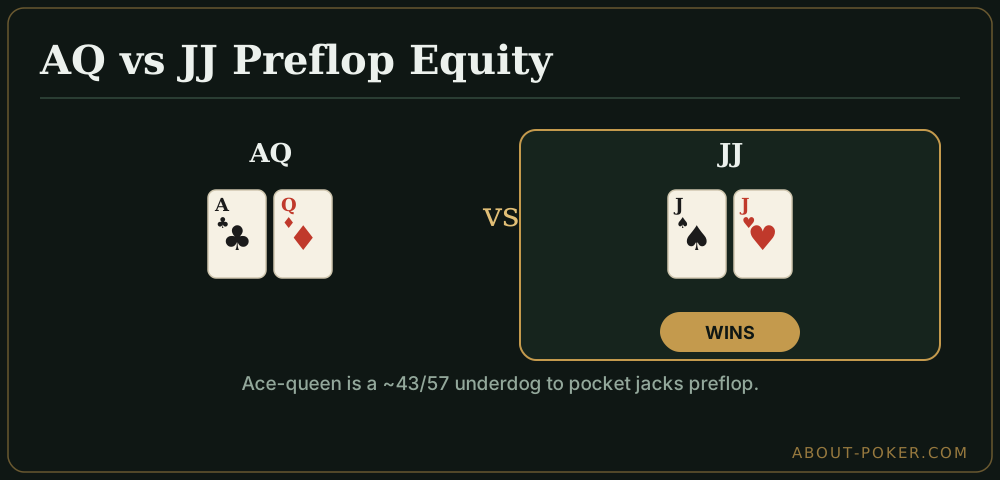
Every figure comes from a full board enumeration cross-checked against a Monte Carlo run:
| Matchup | AQ equity | JJ equity |
|---|---|---|
| AQo vs JJ | 43.0% | 57.0% |
| AQs vs JJ | ~45% | ~55% |
Ace-queen wins a little over two times in five. Suited ace-queen adds flush outs and closes the gap by a couple of points, but the pair stays ahead in both versions. Confirm it yourself by dropping the hands into the equity calculator.
Why AQ is behind
Jacks are a made pair; ace-queen is not. To win, ace-queen has to improve; to lose, the jacks just need the board to miss the big cards. That head start is why the pair leads even though ace-queen holds two premium cards.
Count what ace-queen is drawing to:
- Pair an ace: three aces remain.
- Pair a queen: three queens remain.
- That is six overcard outs, plus straight and flush chances.
Six outs across five board cards means ace-queen pairs at least one card roughly half the time — but not quite enough to overtake the jacks. And ace-queen has a hidden problem: even when it pairs, a jack on the board can give villain a set, so some of its “outs” are not as clean as they look.
A worked example
Say 100 big blinds go in for a 200 big blind pot. Preflop, ace-queen owns about 86 blinds of equity, the jacks about 114. Now watch a flop rewrite it.
Flop Q♦ 8♠ 4♥: ace-queen pairs top pair and jumps to roughly 87%, while the jacks fall to two remaining jacks for a set, around 9%. Change the flop to 7♣ 6♦ 2♠, missing ace-queen completely, and the jacks climb to about 90% while ace-queen must catch one of six cards on the turn or river. The 43% is an average across these swings — you either hit your overcard or you are drawing thin.
Why the “flip” costs you money
The trap in AQ-versus-JJ is treating a 43/57 spot as a true coin flip. It is not: over many all-ins you lose about 14 big blinds of expected value per 100 you commit, before rake. That is why great players avoid stacking off light with AQ and instead lean on fold equity — winning the pot when villain folds a hand like tens or ace-jack. Knowing exactly how live your six outs are, and how often a jack undercuts them, is pure combinatorics, and it is what turns a reckless call into a disciplined fold or a well-timed shove.
How position and opponent type change the spot
The raw 43/57 assumes the money is already in. In practice, whether ace-queen is a fold, a call, or a shove depends heavily on position and who is holding the jacks.
In position, ace-queen plays much better than the equity suggests. You see villain’s action first, you can pot-control when you miss, and you can barrel when an ace or queen arrives. Out of position, the same 43% is worth far less: you check-fold too often when you brick, and you cannot fully cash in the times you hit because a cautious opponent shuts down. The equity is identical; the realized value is not.
Opponent type matters even more against a shove. A tight, straightforward player who jams for value with jacks-or-better means your ace-queen is genuinely at 43% or worse against the top of their range — often a fold. A loose or aggressive player who shoves a wide range of pairs, ace-jack, king-queen, and suited connectors changes the math: against that blend, ace-queen can be a coin flip or even a favorite, and calling becomes correct. The number 43/57 is only the answer against exactly pocket jacks; against a range, you have to re-weight it. That re-weighting is the whole skill, and it is why the same two cards can be a snap-fold against one player and a snap-call against another.
A quick decision checklist
Before you commit with ace-queen against a possible pair, work through four questions:
- Am I the aggressor or the caller? As the aggressor you add fold equity to your 43%; as the caller you get only the raw equity and need a price to justify it.
- What is villain’s actual range? Against only jacks you are behind; against a wide shoving range that includes weaker aces and pairs, ace-queen is often ahead. Do not treat one hand as the whole range.
- What is my position? In position, brick-and-fold is cheap and hitting pays more. Out of position, discount your realized equity and lean toward folding marginal spots.
- What is the price? Getting 2-to-1 or better on a call closes most of the gap even at 43%; getting 1-to-1 on a raw underdog is a leak. Count the pot before you commit.
From equity to a decision
At 43/57 ace-queen is a live underdog, so the profit comes from being the aggressor, not the caller.
| Situation | Read | Line |
|---|---|---|
| You shove AQ, called by JJ | ~43% | Dog; needs fold equity to be good |
| You call off AQ vs a JJ shove | ~43% | Poor price unless deep or discounted |
| You raise AQ, villain folds JJ | 100% | The real source of value |
Lock in the anchor — AQ is a ~43/57 underdog to JJ, ~45/55 suited — and every ace-queen-versus-pair spot becomes a question of fold equity and price, not a hopeful flip. Build the full line with preflop all-in odds, sharpen your counting with combinatorics, and explore the poker odds & math hub.
Frequently asked
What are the odds of AQ vs JJ preflop?
Ace-queen wins about 43% of the time against pocket jacks, with the jacks around 57%. Suited ace-queen improves slightly to roughly 45/55. AQ is the underdog in every version.
Is AQ ahead of JJ?
No. Jacks are a made pair and only need to survive, while ace-queen must improve to win. That leaves AQ behind at about 43/57, a modest but real disadvantage.
How much does AQ win against JJ?
Ace-queen has six overcard outs plus straight and flush chances, so it wins over 40% of the time. It is a live underdog, not a hopeless one, which is why the spot plays like a coin flip.
Should you get all-in with AQ against JJ?
As a 43/57 underdog, calling off a shove needs a decent price. AQ performs better as the aggressor, where fold equity can win the pot outright without needing to hit the board.