AKs vs QQ: Preflop Odds & Equity
Suited ace-king is nearly a coinflip against pocket queens — about 46% equity to QQ's 54%. Here are the exact preflop numbers and why it's so close.
On this page · 7 sections
You have A♠ K♠, the money goes in, and villain shows Q♦ Q♣. Bad news and good news: you’re behind, but barely. Suited ace-king holds about 46% equity against pocket queens — a near-coinflip that the pair wins only about 54% of the time. This is the archetypal “race” in Hold’em, and AKs is about as good as an unpaired hand ever gets against a made overpair.
The headline equities
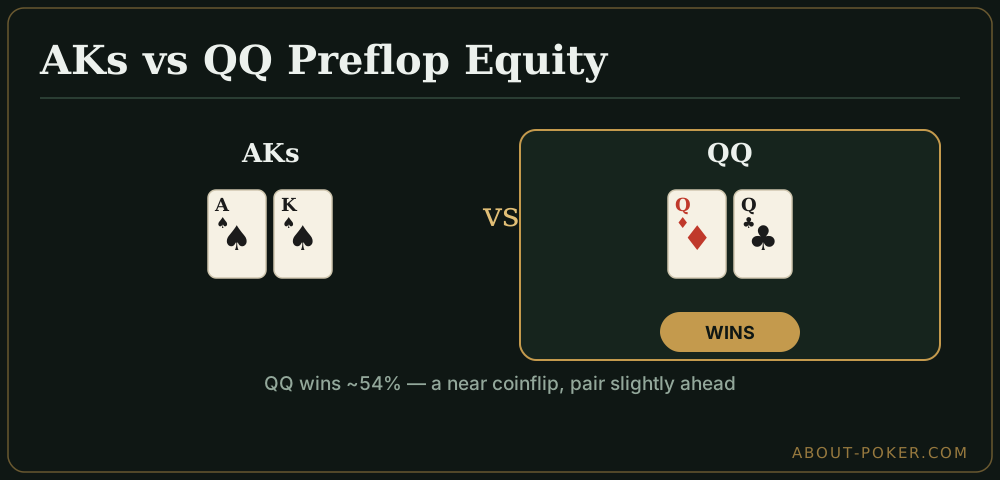
Every figure below comes from an exhaustive board run cross-checked with a Monte Carlo sim:
| Matchup | AK equity | QQ equity |
|---|---|---|
| AKs vs QQ (suited) | 46.0% | 54.0% |
| AKo vs QQ (offsuit) | 43.0% | 57.0% |
| AK vs QQ (mixed avg) | ~44% | ~56% |
Suited ace-king is a small dog, not a big one. The gap between the suited and offsuit versions — three points — is the same flush premium you see in every AK matchup. Against queens specifically, that premium is enough to drag AKs to within a few points of an even flip.
Why an unpaired hand gets so close
Pocket queens are made now, but ace-king is loaded with ways to catch up:
- Pair the ace: three aces live.
- Pair the king: three kings live.
- Flush: with two suited cards, AKs makes flushes queens rarely can.
- Straight: A-K reaches into Broadway straights.
Six clean overcard outs plus flush and straight coverage is a lot of equity for an unpaired hand. That’s why AKs climbs to 46% while a hand like AQ — one rung lower and often dominated — sits down at 28% against kings. The extra card strength and flush reach are the whole story. Compare this to KK vs AK, where the pair is two ranks higher and AK sinks all the way to 30-34%.
The suited premium, quantified
The only difference between AKs (46%) and AKo (43%) is flush outs. A♠ K♠ completes spade flushes that A♠ K♥ never makes, and those extra run-outs are worth three points of equity. Nothing about the aces, kings, or straights changes — flushes carry the entire gap, which is a useful reminder that suitedness is worth real money in close spots.
A worked example: the race pays off
Suppose you get AKs all in against QQ for 25bb each, 100 times, treating it as the clean 46% case with no dead money.
- You win 46 pots of 50bb (your 25 plus villain’s 25) = 46 × 25bb net = +1,150bb.
- You lose 54 pots of 25bb = −1,350bb.
- Net over 100 races: −200bb, or about −2bb per race.
So at exactly 46% with no extra money in the pot, the race is a small loser — which is exactly why fold equity and pot odds matter. Add any dead money, or any chance villain folds a better hand, and the equity edge flips positive fast. That conversion from raw equity to a profitable line is the whole subject of preflop all-in odds.
The range problem works in your favor
Against a raiser’s full range, AKs does far better than 46%, because queens are only one hand in that range. You’ll also run into:
- AQ, AJ, KQ: dominated hands you crush.
- TT, 99, and lower pairs: flips you’re often ahead in as the overcards.
- AK ties and worse: chops or clear wins.
Weight those in and AKs is a comfortable, profitable get-it-in against nearly any aggressive opponent — even though against pocket queens specifically it’s a small underdog. That’s why strong players never fold ace-king suited to a single raise-and-shove: the QQ combos you fear are swamped by the combos you beat.
Put rough combinatorics on it. A tight player’s five-bet-jam range might be AA, KK, QQ, and AK. That’s 6 combos of aces, 6 of kings, 6 of queens, and — with two of your own cards removed — a handful of AK combos. Against AA and KK you’re a big dog, against QQ a small dog, but against those AK combos you chop, and if the range stretches even slightly to include AQ or JJ you leap ahead. The single-pair fear evaporates the moment you count the whole range rather than the one hand that beat you this time.
How stack depth changes the decision
The 46% equity is fixed, but its meaning shifts with depth. At 15-30bb, getting AKs in against a raise is automatic — the pot is committed and your equity against any realistic range clears the pot-odds bar easily. Around 40-60bb you have more room, and against a very tight four-bettor you can occasionally flat and see a flop rather than jam into the top of their range. Deep (100bb+) the pure preflop all-in gets rarer; you’d rather realize AKs’s excellent postflop playability — nut-flush draws, top-pair-top-kicker, straight potential — than flip your whole stack as a 46% underdog against the one pair that has you beat.
A quick get-it-in checklist
- Facing a short-stack or committed shove: call or jam — 46% plus dead money is a clear profit.
- Facing a single raise from a wide opener: three-bet for value; you’re ahead of the range.
- Facing a big four-bet from a nit: slow down slightly, since QQ+ and AK make up more of that narrow range.
- Never fold AKs to a lone raise-and-reraise line — the pairs you flip against and the aces you dominate outnumber the queens and better that have you behind.
Lock in the anchor — AKs is about 46% against queens, a near-coinflip leaning to the pair — and then let the range, not the one pair, decide. Keep building through equity, preflop all-in odds, and the poker odds & math hub.
Frequently asked
What are the odds of AKs vs QQ preflop?
Suited ace-king has about 46% equity against pocket queens, with QQ at about 54%. It's a near-coinflip that leans slightly toward the pair. Offsuit AK is a touch worse at about 43%.
Is AK vs QQ a coinflip?
Close to one. Suited ace-king is about 46/54, and offsuit is about 43/57. The pair is a small favorite in both cases, but neither is far from an even flip, which is why these hands are so often shoved.
Why is AKs so close to QQ when it's unpaired?
Ace-king has two overcards to queens, so it can pair the ace or king to take the lead, plus it makes straights and flushes. Those combined outs pull an unpaired hand up to near-even against a made pair.
Should you get all in with AKs against QQ?
Yes, in almost every preflop spot. At 46% you only need modest fold equity or pot odds to profit, and against a realistic range that also includes worse pairs and AQ, ace-king suited is a comfortable get-it-in.