AK vs T9s: Preflop Odds & Equity
Ace-king against ten-nine suited is closer than you think — AK is only about a 60/40 favorite preflop. Here are the exact equities and why the gap is small.
On this page · 7 sections
Ace-king gets it in against T♠ 9♠ and expects a comfortable hold. It is a favorite — but a smaller one than most players guess, at about 60/40. Ten-nine suited is not two random cards; it is one of the deck’s best drawing hands, and its post-flop firepower keeps this closer to a race than a rout.
The headline equity
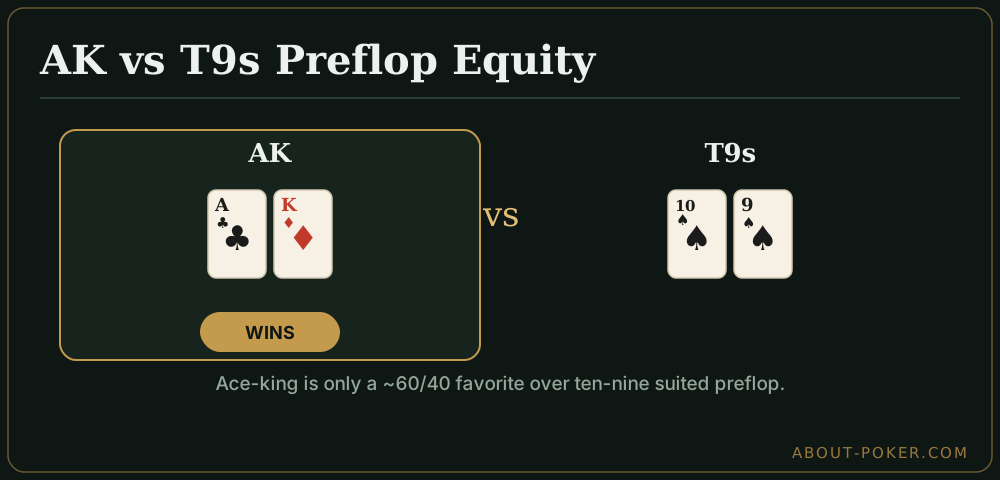
Every figure below comes from a full board enumeration cross-checked with a Monte Carlo run:
| Matchup | AK equity | T9s equity |
|---|---|---|
| AKo vs T9s | 59.8% | 40.2% |
| AKs vs T9s | ~61% | ~39% |
Ace-king wins about six times in ten. That is a real edge, but far from the 70/30-plus you get against a dominated hand. Drop the two holdings into the equity calculator and you will see it land right around 60/40.
Why the gap is small
Against a dominated hand like AK vs A9, the smaller ace has dead outs — the aces it wants to pair are mostly gone. Ten-nine suited has the opposite: every one of its cards is live. Neither the ten nor the nine touches ace-king, so it pairs cleanly, and its structure adds layers of upside.
What T9s is drawing to:
- Pair the ten or nine: six clean outs.
- Open-ended and gutshot straights: T9 connects to more straights than almost any two cards.
- Flush draws: the suit adds five- and four-card flush chances ace-king cannot match.
Stack those together and T9s realizes far more of its raw equity than a random unpaired hand would. That is why the suited connector keeps 40% against two overcards.
A worked example
Say 100 big blinds go in for a 200 big blind pot. Preflop, ace-king owns about 120 blinds of equity, T9s about 80. Now watch a flop swing it.
Flop 8♠ 7♦ 2♠: T9s picks up an open-ended straight draw and a flush draw — around fifteen outs — and rockets past ace-king to roughly 60% despite ace-king still holding two overcards. Change the flop to A♦ 6♣ 2♥, pairing the ace, and ace-king surges to about 85% while T9s is left drawing thin. That volatility is the point: AK’s 60% is an average across boards that swing hard in both directions.
How this compares to AK vs a pair
The instructive contrast is AK against a pocket pair. AK is a 44% underdog to a pair like JJ but a 60% favorite over T9s — a huge swing driven entirely by whether the opponent already has a made hand. T9s has no pair yet, so ace-king’s two overcards matter; against JJ they are chasing a hand that already exists. Tracking which outs are live and which are dead is the essence of combinatorics, and it explains why “overcards vs connector” and “overcards vs pair” sit on opposite sides of the coin flip.
How the race shifts with stack depth
The 60/40 number is a preflop all-in average, but almost no one gets all-in preflop with these two hands at every stack depth. Depth changes which hand you would rather hold.
Short — say 15 to 25 big blinds — the equity is close to all that matters, because most of the money goes in before or on the flop with little room to outplay anyone. At those depths ace-king is happy to get it in at 60% and ten-nine suited is happy to shove it as a low-variance semi-bluff with fold equity on top of 40% raw equity. The suited connector cannot realize much post-flop upside when the stacks are too shallow to see turns and rivers, so its extra straight and flush value gets compressed and the raw number is nearly the whole story.
Deep — 100 big blinds or more — the picture flips in a subtle way. Ace-king still holds the 60% raw edge, but ten-nine suited realizes more of its equity because it can see flops cheaply, make disguised straights and flushes, and stack a one-pair ace-king when it hits. A player with T9s deep has implied odds that a player with AK does not: when T9s makes its hand it can win a huge pot, whereas AK’s top pair is often the one paying off. So the raw 60/40 understates ten-nine suited’s practical value deep and overstates it short. This is the recurring lesson of overcards versus a live drawing hand — the equity number is fixed, but how much of it you keep depends on how deep you play.
A quick decision checklist
Before you commit chips in an AK-versus-T9s spot, run through four questions:
- Who is the aggressor? The player applying pressure adds fold equity to their raw share. AK shoving is a clean 60% plus folds; T9s shoving is 40% plus folds, which can make its all-in profitable even as the underdog.
- How deep are the stacks? Shallow favors the made-overcards hand and the raw number; deep favors the suited connector’s implied odds.
- What does the board do? On coordinated middling boards T9s often overtakes AK; on ace- or king-high boards AK pulls far ahead. You will not know until the flop, so weight both outcomes.
- Can you get away cheaply? With T9s out of position and no draw, folding when you miss preserves the edge that its big hands earn. Do not pay off ace-king with unimproved ten-high.
From equity to a decision
At 60/40 ace-king is a genuine but modest favorite, so position and playability matter as much as the raw number.
| Situation | Read | Line |
|---|---|---|
| You shove AK, called by T9s | ~60% | Favorite; fine to get it in |
| You call off T9s vs an AK shove | ~40% | Needs a price or fold equity |
| Deep-stacked, in position with T9s | — | Prefer flopping and applying pressure |
Lock in the anchor — AK is a ~60/40 favorite over T9s — and every “big cards vs suited connector” spot becomes a read on board texture and playability, not a guessed flip. Build the full line with preflop all-in odds, sharpen your counting with combinatorics, and explore the poker odds & math hub.
Frequently asked
What are the odds of AK vs T9s preflop?
Ace-king wins about 60% of the time against ten-nine suited, with T9s around 40%. If the ace-king is also suited, AK's edge grows to roughly 61/39. It is a modest favorite, not a runaway.
Why is AK vs T9s so close?
Ten-nine suited is one of the most connected drawing hands in the deck. It makes straights and flushes constantly, so its post-flop upside offsets ace-king's two-overcard head start and keeps the race near 60/40.
Does T9s have live cards against AK?
Yes, all of them. Neither the ten nor the nine is shared with ace-king, so T9s can pair either card cleanly, and its suit and connectedness give it straight and flush draws that ace-king rarely blocks.
Should you call an AK shove with T9s?
At 40% equity T9s needs a good price or fold equity to justify a call. It plays better as a hand that flops well and can apply pressure than as a pure all-in caller against a premium.