Odds of Making a Straight by the River
An open-ended straight draw hits by the river about 31.5% of the time; a gutshot about 16.5%. The exact outs, the math, and how to price your calls.
On this page · 8 sections
Straight draws are among the most common draws you’ll chase, and knowing your exact odds of making a straight by the river separates disciplined players from hopeful ones. The two draws you need cold are the open-ended straight draw and the gutshot. Get their numbers right and every call becomes a simple price comparison.
The two draws and their outs
- Open-ended straight draw (OESD): you have four cards in a row, like 7-8-9-T, and either end completes your straight. That’s eight outs (four cards on each end).
- Gutshot (inside straight draw): you’re missing one card in the middle, like 7-8-_-T-J needing a nine. That’s four outs.
Outs are everything here, so if counting them isn’t second nature yet, start with poker outs.
The exact odds by the river
From the flop (two cards to come):
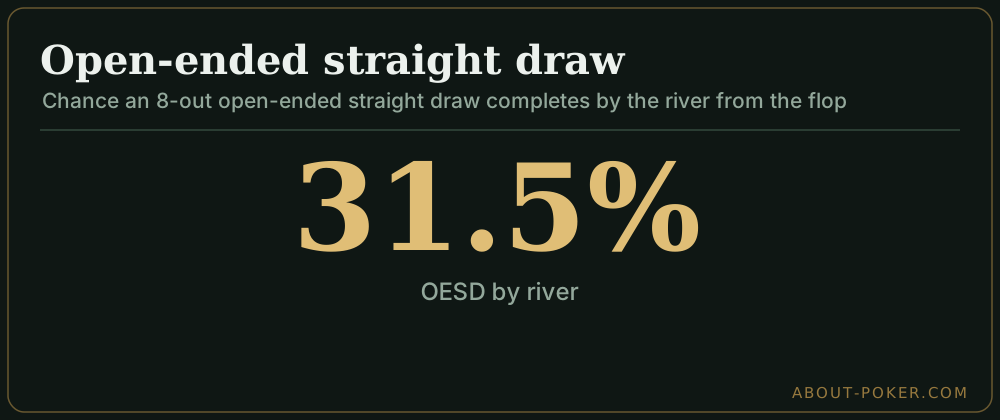
- Open-ended (8 outs): about 31.5% — roughly 1 in 3.
- Gutshot (4 outs): about 16.5% — roughly 1 in 6.
From the turn (one card to come):
- Open-ended (8 outs): about 17.4% — 8 outs out of 46 unseen cards.
- Gutshot (4 outs): about 8.7% — 4 outs out of 46.
Notice the drop from flop to turn: your open-ended draw goes from ~31.5% to ~17.4% once you’ve missed the turn. Each card you fail to hit makes the remaining chance smaller, which is why the price you’ll pay on the turn matters so much.
The quick math: rule of 4 and 2
At the table you don’t compute exact fractions. You use the rule of 4 and 2: on the flop, multiply outs by 4 for your percent to hit by the river; on the turn, multiply by 2 for the river card.
- 8 outs × 4 = 32% (exact: 31.5%) — spot on.
- 4 outs × 2 = 8% on the turn (exact: 8.7%) — close enough.
The rule is a hair optimistic for eight-plus outs but plenty accurate for decisions.
Worked example: pricing an OESD call
You hold 9h Th on a flop of 8c Jd 2s. You have an open-ended straight draw (any 7 or Q completes it) — eight outs, about 31.5% to hit by the river. Your opponent bets 6 into a pot of 10, so the pot is now 16 and you must call 6.
Your pot odds: you’re risking 6 to win 16, so you need to win 6 ÷ 22 = 27% of the time to break even. Your draw hits 31.5% of the time. Since 31.5% beats the 27% you need, this is a profitable call on pure pot odds alone — before even counting the extra money you might win when you hit. For the full framework on comparing your equity to the price, see how to use pot odds.
Gutshots need more than pot odds
A gutshot at ~16.5% from the flop rarely gets there on price alone against a normal bet. To call, you usually need implied odds — the expectation of winning a big pot on the streets after you hit. A gutshot to the nut straight with deep stacks and a hidden draw can be worth a call; a gutshot to a non-nut straight against a short stack usually is not.
Common mistakes
- Counting tainted outs. If a card that completes your straight also completes an obvious flush or pairs the board into a boat, it may not be a clean out. Discount accordingly.
- Treating turn odds like flop odds. After missing the turn your OESD is only ~17.4% to hit — recompute before calling a big river-inducing bet.
- Chasing gutshots on price alone. They need implied odds; the raw ~16.5% almost never covers a half-pot bet.
- Ignoring redraws. An open-ender that also picks up a flush draw is far stronger than eight outs — combo draws can exceed 50% equity.
Quick reference
| Draw | Outs | By river (from flop) | River card (from turn) |
|---|---|---|---|
| Open-ended | 8 | 31.5% | 17.4% |
| Gutshot | 4 | 16.5% | 8.7% |
| Double gutshot | 8 | 31.5% | 17.4% |
Checklist before you chase
- Count your true outs and subtract any that are tainted by flushes or board pairs.
- On the flop, an OESD is about 1 in 3 by the river; a gutshot about 1 in 6.
- Compare that to the pot odds — you need your equity to exceed the price.
- If pot odds fall short, only continue with real implied odds and position.
- Recompute on the turn; your odds nearly halve once one card has already missed.
Straights are satisfying to make, but the money is made by only chasing them when the price is right. Memorize 31.5% for the open-ender and 16.5% for the gutshot, and you’ll never overpay for a draw again.
Frequently asked
What are the odds of completing an open-ended straight draw by the river?
An open-ended straight draw has eight outs. From the flop with two cards to come you complete it about 31.5% of the time, roughly 1 in 3. From the turn with one card to come the chance drops to about 17.4%.
What are the odds of hitting a gutshot straight by the river?
A gutshot (inside straight draw) has four outs. From the flop it completes about 16.5% of the time, and from the turn about 8.7%. That is why gutshots need good pot odds or implied odds to chase profitably.
How do I calculate straight draw odds quickly at the table?
Use the rule of 4 and 2. On the flop multiply your outs by 4 for the approximate percent to hit by the river; on the turn multiply by 2 for the percent to hit on the river. Eight outs times four is 32%, very close to the exact 31.5%.