QQ vs AK: Preflop Odds & Equity
QQ is a slight favorite over AK — about 54% vs offsuit and 52% vs suited. Here's why queens vs ace-king is the classic coin flip, with exact preflop equities.
On this page · 7 sections
You shove Q♠ Q♥ and villain snap-calls with A♣ K♦. This is the classic race — the “pair versus two overcards” flip that decides so many tournaments. Queens are a slight favorite, winning about 54% against offsuit ace-king and roughly 52% against suited. It’s close enough to call a coin flip, but the pair has its nose in front. Two numbers to remember: ~54% vs AKo, ~52% vs AKs.
The headline equities
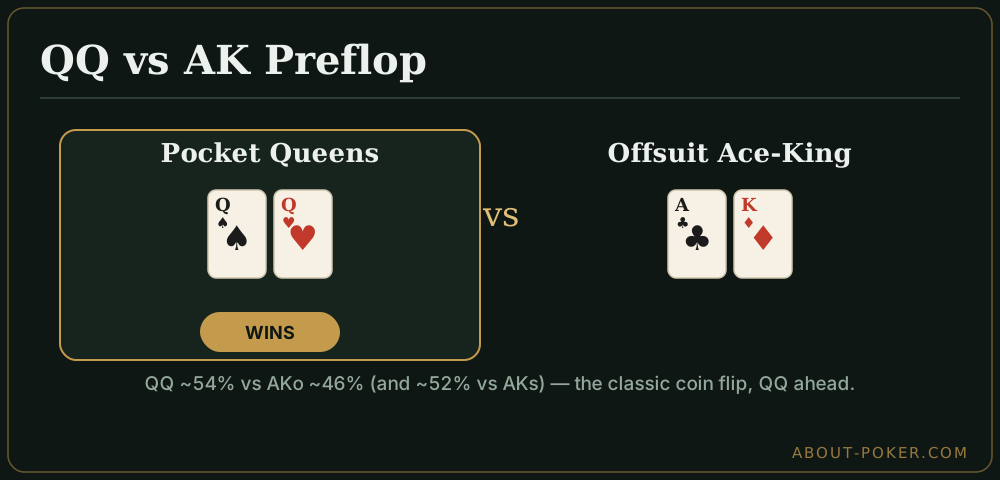
All-in preflop, pocket queens beat offsuit ace-king about 54% of the time and suited ace-king about 52%.
| Matchup | QQ equity | AK equity |
|---|---|---|
| QQ vs AKo (offsuit) | ~54% | ~46% |
| QQ vs AKs (suited) | ~52% | ~48% |
Queens are the favorite, but only just. Whoever wins this pot at the final table probably remembers it — it’s decided by a whisker.
Why it’s a coin flip, not a rout
The difference between this matchup and KK vs AK comes down to how many overcards AK has. Against queens, both the ace and the king are higher, so ace-king has six live cards to pair — three aces and three kings. That’s a real drawing hand.
- Pair an ace or king: six outs to make a pair that beats the queens. This is AK’s engine.
- Queens hold serve: most of the time no ace or king comes, and the pair simply wins.
- Both hands can back into straights and flushes, which is why suited AK is a couple points better.
Six live overcards is why AK gets to ~46-48% here instead of the ~30% it manages against kings. Understanding that outs, not hand names, drive the equity is the whole point.
The suited nudge
Suited ace-king does a little better than offsuit — about 48% versus 46% — for the same reason it does against every pair: extra flush outs. A♠ K♠ can run out a spade flush that the offsuit version can’t. It’s a small effect, worth roughly two points, and it never changes the headline: queens are a slight favorite either way.
A worked example
You’re in a tournament, 20 big blinds deep, and you open-shove Q♠ Q♥ from the button. The big blind wakes up with A♣ K♦ and calls. You’re a 54% favorite for a pot worth your tournament life.
Here’s the emotional trap: it feels like a flip, so a loss feels routine — but you were ahead, and getting queens in as a favorite is exactly what you want. Over a career these races are net winners for the pair. You’ll lose 46% of them, and that’s fine. The preflop all-in odds framework treats this as a clear call precisely because 54% beats the pot odds you’re getting in a shove-or-fold spot.
The range problem
The reason queens-versus-AK is usually a happy call isn’t just the flip — it’s the range around it. When you jam queens, villain’s calling range is rarely only AK. It contains hands you crush, like JJ, TT, and AQ, and hands that crush you, AA and KK. But AA and KK together are just 12 combinations, while AK is 16 combos and the dominated pairs and AQ add many more. Blend them with a little combinatorics and queens are comfortably profitable — the hands you’re flipping or crushing far outnumber the two you fear.
Carry the two anchors — QQ is ~54% over AKo and ~52% over AKs — and remember which coin flip you’re in. Against big slick, queens are a slight favorite and a get-it-in; the danger isn’t AK at all, it’s the rare aces or kings hiding in the range. Build the surrounding skills through equity, combinatorics, and the poker odds & math hub.
How QQ vs AK ranks among the pairs
It’s worth seeing where this flip sits relative to the other big pairs against ace-king, because the pattern explains the whole family of matchups.
| Pair vs AKo | Pair’s equity | Why |
|---|---|---|
| AA vs AKo | ~87% | AK shares the ace; only three kings and thin straight/flush help |
| KK vs AKo | ~66% | AK shares the king; only three aces are live overcards |
| QQ vs AKo | ~54% | No shared card; all six overcards (aces and kings) are live |
| JJ vs AKo | ~54% | Same as QQ — six live overcards, no shared rank |
The jump from KK’s ~66% to QQ’s ~54% is the key insight: it’s caused entirely by the king becoming a live overcard for AK. Against kings, AK pairs its ace to win; against queens, it pairs either an ace or a king. Doubling the live overcards from three to six is what drags the pair from a comfortable favorite down to a near-flip. Notice JJ and QQ are effectively the same equity against AKo — once no card is shared, the specific rank of the pair barely matters, only that both of AK’s cards are higher.
Applying it at the table
Knowing the number is only half the job; acting on it is the rest.
- Get it in, don’t agonize. At most tournament depths — and especially short, at 15–25bb — jamming or stacking off with QQ against a range that contains AK is a clear profit. You’re a favorite against the flip and crushing the JJ/TT/AQ combos that fill out most calling ranges.
- Respect the rare monsters. The only hands that beat you badly are AA and KK, just 12 combinations. If a very tight player 4-bet jams into you, that 12-combo cluster becomes a much larger share of their range, and folding queens can be correct — the read, not the raw flip, drives that decision.
- Don’t slow-play into overcard boards. Because AK has six live outs, roughly half the time an ace or king will appear by the river. Postflop, that means a queens overpair is more vulnerable than it feels; charge draws and overcards rather than trapping. The preflop all-in odds framework is what makes the shove itself automatic — the postflop caution applies only when the money isn’t already in.
The disciplined line is simple: get queens in against ace-king as a favorite, size your fear to the 12 combos that actually crush you, and don’t let a lost flip convince you the get-in was wrong.
Frequently asked
What are the odds of QQ vs AK preflop?
Pocket queens are a slight favorite: about 54% against offsuit ace-king and roughly 52% against suited ace-king. It's close enough that people call it a coin flip, with QQ nudging ahead.
Is QQ vs AK really a coin flip?
Nearly. Queens are a small favorite, winning about 52-54% of the time. It's the textbook 'pair vs two overcards' race — much closer than a big pair versus AK, where the pair dominates.
Why is QQ vs AK closer than KK vs AK?
Because both the ace and the king are overcards to the queens, so AK has six live cards to pair. Against kings, only the ace is a real overcard, so AK's outs are cut roughly in half.
Should you get QQ all-in against AK preflop?
Usually yes. Queens are a favorite and most all-in ranges also contain hands queens crush, like JJ and AQ. The main risk is running into AA or KK, which is only 12 combos out of a much wider range.